Whether an aftermarket exhaust passes inspection depends less on how it sounds and more on whether the emissions controls and OBD integrity are intact. A cat-back or muffler swap that leaves the catalytic converters and sensors untouched usually clears inspection as long as noise limits are met. Cut a catalyst, run a catless downpipe, or load a tune that alters emissions behavior, and you’re looking at a likely failure and possible Clean Air Act exposure. Rules also shift by state, so check your program’s requirements, especially if you’re in a state that follows CARB standards, before you install anything.
TL;DR:
- Installations that leave catalytic converters and sensors untouched generally pass inspections, provided noise limits are met, but using a catless downpipe or load-based tunes can cause failure.
- Visual and electronic checks, including OBD scans for monitor readiness, are crucial, especially in states requiring CARB EO labels, with noise levels varying by jurisdiction.
- The federal Clean Air Act prohibits modifications that bypass emissions controls nationwide, while CARB regulations apply in certain states, with catless parts and emissions-altering tunes posing the highest legal risks.
- Upstream exhaust modifications like catless downpipes are most likely to trigger OBD warnings and fail emissions tests, whereas downstream changes mainly affect noise levels.
- Before inspection, verify state requirements, document all parts, run readiness cycles, secure leaks, and test noise levels to improve chances of passing without violations.
Table of Contents
- What Inspectors Actually Check During an Exhaust Inspection
- Federal Rules vs. State Rules: Where the Clean Air Act and CARB Come In
- How Specific Mods Affect Your Emissions Test and OBD Readings
- Your Pre-Inspection Checklist for an Aftermarket Exhaust
- What Usually Passes and What Usually Fails: A Quick Risk Guide
- If You Fail Inspection: What to Do Next
- Choosing and Maintaining a Valved Exhaust That Clears Inspection
- How Exhaust Noise Is Actually Measured at Inspection
- Balancing Performance and Legal Compliance
- Build a Compliant Setup With Valve Control Exhaust
- Sources
- FAQ
What Inspectors Actually Check During an Exhaust Inspection
Every state inspection combines a few distinct checks, and each one can catch a different kind of aftermarket modification. Understanding what an inspector actually looks at helps you predict where your setup might get flagged before you ever pull into the test lane.
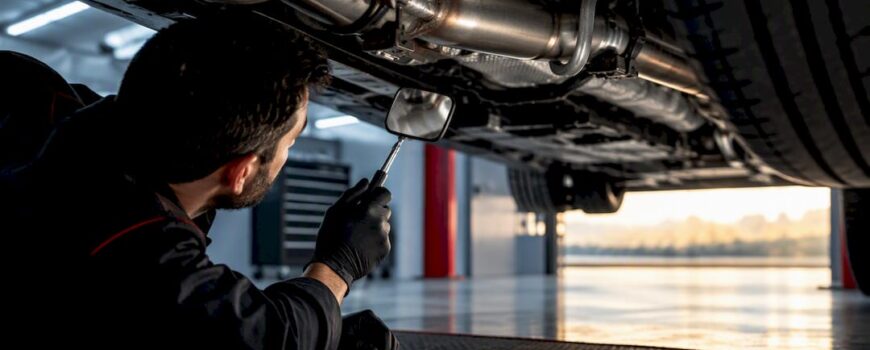
A visual inspection comes first in almost every program. The technician gets underneath the car or uses a mirror to look for missing or altered catalytic converters, exhaust leaks, loose or broken hangers, and any obvious cutout valves or bypass pipes that would let exhaust skip the emissions hardware entirely.
Next comes the OBD II scan, which reads the vehicle’s onboard computer for a Malfunction Indicator Light (MIL) status and the readiness monitors tied to the catalyst, oxygen sensors, and evaporative system. This is where a lot of otherwise-legal builds trip up: clearing trouble codes right before the test resets those readiness monitors, and an incomplete monitor often means an automatic rejection regardless of how clean your tailpipe actually is.
Noise enforcement is the least consistent piece of the puzzle. Some states run objective decibel-meter tests at a set RPM and distance, while others rely on subjective “excessively loud” judgment calls from the inspector or local police. Cities and counties frequently layer their own noise ordinances on top of state law, so a system that’s fine on the highway outside town might still draw a ticket downtown.
Finally, in states that follow California’s emissions standards, inspectors may check for a CARB Executive Order number stamped or labeled on the part itself. No EO number on a part that legally requires one is its own kind of flag, separate from whether the part physically works.
- Visual check: missing catalysts, leaks, loose hangers, cutouts or bypass valves
- OBD II scan: MIL status and monitor readiness, not just current fault codes
- Noise: decibel meters in some states, officer discretion in others, local ordinances on top
- Documentation: CARB EO numbers or labeling where state rules require them
Federal Rules vs. State Rules: Where the Clean Air Act and CARB Come In
The federal government and your state DMV are enforcing two different things, and mixing them up is where a lot of confusion starts. The Clean Air Act prohibits installing any part whose main effect is to bypass, defeat, or render inoperative a vehicle’s emissions controls. That’s a federal tampering rule, and it applies in all fifty states regardless of whether your state even has an emissions inspection program.
The EPA enforces this rule against manufacturers, sellers, and, in some cases, individual owners. Recent enforcement history backs this up directly: the Department of Justice’s settlement with COBB Tuning over aftermarket tuning products showed that even popular, well-known tuner hardware can draw federal penalties when it alters emissions-related engine behavior without proper certification. Civil penalties under the Clean Air Act scale by violation and by whether the party is a manufacturer or an individual, and EPA’s own guidance treats replacing a catalytic converter section with a straight pipe as tampering, full stop, requiring repair shops to restore proper catalytic configuration when they touch that part of the system.
CARB Executive Orders sit alongside this as a separate but related layer. An EO number certifies that a specific part, on a specific make, model, and model year, meets California’s emissions standards. That matters directly in California and in the roughly dozen states that have adopted CARB’s standards instead of the federal baseline. Even outside those states, an EO number is a useful piece of documentation, because it demonstrates a “reasonable basis” defense (an EPA fact sheet on aftermarket parts and defeat devices outlines this) that the part won’t increase emissions.
- Federal: Clean Air Act tampering rules apply nationwide, enforced by EPA
- State: CARB EO requirements apply in California and CARB-following states
- Practical line: a catless downpipe or cat delete creates federal exposure; a loud cat-back mostly creates a state inspection problem
How Specific Mods Affect Your Emissions Test and OBD Readings
Where a modification sits in the exhaust system determines almost everything about its risk level. Work upstream, near the engine and catalytic converters, and you’re touching the parts your state’s inspection and the EPA both care about most. Work downstream, past the last catalyst, and you’re mostly affecting sound.
Downpipes and catalytic converter work carry the highest risk in the entire category. A catless downpipe removes certified emissions hardware outright, and it commonly triggers the catalyst efficiency monitor on the OBD system, which throws a check engine light and fails the OBD portion of your test on its own. A catted downpipe, built with a high-flow catalyst rated for the application, keeps that monitor happy while still improving flow over a stock unit.
Cat-back systems, mufflers, and exhaust tips sit at the low end of emissions risk since they’re entirely downstream of the catalytic converters. Your risk here shifts almost entirely toward noise citations and mechanical issues, like a poorly fitted section that disturbs an oxygen sensor’s readings or introduces a leak upstream of where it should matter.
ECU tunes and standalone tuners deserve their own warning. Any tune that changes emissions control strategy, alters sensor interpretation, or disables a monitor is treated by EPA as a defeat device, which is the same legal category as a straight-piped downpipe, according to the COBB settlement itself. This is high legal risk even if the car “sounds and drives fine.”
Valved exhaust systems with downstream valves and tips are generally a sound modification, not an emissions one, since the valve sits well past the catalysts. Sloppy installation is the real threat there, since a leaking flange or a valve actuator pinching a wiring harness can introduce the same sensor and leak problems as any other downstream work.

Your Pre-Inspection Checklist for an Aftermarket Exhaust
Running through a short checklist before you drive to the inspection station catches most of the preventable failures. Work through these in order.
- Confirm your state’s inspection type and CARB status. Some states run full OBD and visual checks, some add tailpipe sniffer tests, and CARB states expect EO documentation on modified parts.
- Gather your paperwork. Pull together purchase receipts, part labels, any CARB EO documentation that came with the product, and the invoice from whoever installed it.
- Run your own OBD scan a week out. Check for a MIL and confirm your readiness monitors are set. Do not clear codes right before the test. Clearing codes resets those monitors, and an incomplete monitor status is one of the most common avoidable rejections.
- Drive a full readiness cycle. If a monitor shows incomplete, a mix of highway and stop-and-go driving over a few days typically resets it. Rushing straight from an ECU flash to the inspection line is a classic mistake.
- Fix what’s visible. Secure any loose hangers, patch leaks at flanges and joints, and make sure there’s no cutout valve or open bypass anywhere in the system.
- Do your own sound check. Test against your state’s decibel limit and RPM method if one exists, and avoid revving hard anywhere near the inspection station.
Pro Tip: Keep every receipt and part label in a single folder, physical or digital, from the day you install anything. If an inspector questions a part, producing documentation on the spot turns a possible failure into a five-minute conversation.
A complete sound testing guide walks through the actual measurement setups if your state uses a formal decibel test, and it’s worth a read before you assume your setup is quiet enough.
What Usually Passes and What Usually Fails: A Quick Risk Guide
Not every modification carries the same odds, and mapping your specific setup to a rough risk category before you install anything (or before you drive to inspection) saves a lot of guesswork.
Low risk: Cat-back systems paired with a muffler and fully intact OEM catalytic converters typically pass the emissions and OBD portions without issue. Your main variable at this level is noise, since an aggressive muffler can still draw a citation even with perfect emissions numbers.
Medium risk: Resonator deletes and louder aftermarket mufflers usually still pass the emissions test, since the catalysts are untouched, but they raise your odds of a noise-based fail or a subjective rejection from an inspector who just doesn’t like how the car sounds at idle.
High risk: Catless downpipes, any removal of a catalytic converter, and emissions-altering tunes are likely fails and carry real exposure to the civil penalties described under EPA’s enforcement framework. Treat these as a last resort for track-only builds, never for a car you plan to register and drive on public roads.
- Dual exhaust conversions on cars sold with a single system can complicate visual inspection if the setup doesn’t match registration records
- Engine or chassis swaps often carry their own emissions certification requirements tied to the donor engine’s model year, not the chassis year
- Older vehicles, generally pre-OBD II models from before 1996, follow different and often looser state rules, so check your program’s age cutoffs directly
If You Fail Inspection: What to Do Next
A failed inspection isn’t the end of the road, but the clock usually starts ticking the moment you get the paperwork. Most states set a fixed re-inspection window, often 15 to 30 days, and some waive the re-test fee if you return within that period, so check your state’s specific rules right away.
Start with the fastest fix available. If a catless downpipe or missing catalyst caused the fail, reinstalling the OEM converter or swapping in a catted downpipe is usually your quickest path back to compliance. Leaks and loose hangers are cheap, same-day repairs at most exhaust shops.
Keep every receipt, part label, and installer invoice from this process. That paperwork demonstrates good-faith compliance and becomes essential if a CARB EO applies to your state or if you ever need to contest a citation.
- Confirm your state’s re-inspection deadline and fee before you leave the station
- Prioritize reinstalling OEM emissions hardware over chasing a cheaper aftermarket fix under time pressure
- Save all documentation from repairs and reinstalls
- If the same issue keeps failing or enforcement escalates, a licensed emissions repair shop or an attorney familiar with vehicle code is worth the consultation
Choosing and Maintaining a Valved Exhaust That Clears Inspection
For street-driven performance cars, the safest configuration keeps the OEM catalytic converters in place or upgrades to a catted downpipe built for the application rather than removing catalytic hardware entirely. That single choice does more for your inspection odds than anything downstream of it.
Installation quality matters just as much as part selection. A shop that routes wiring harnesses correctly and leaves oxygen sensors in their factory locations avoids the false codes and readiness monitor issues that a rushed install can create. Valve Control Exhaust’s compatibility guidance on valved systems covers which configurations keep sound customization without disturbing emissions sensors, and keeping the product labels and compatibility documentation from your purchase on hand speeds up any conversation with an inspector.
Routine maintenance matters too. Valve actuators, clamp seals, and flange joints are the parts most likely to develop a leak over time, and a leak near a sensor can trigger the same OBD flags as a missing catalyst.
How Exhaust Noise Is Actually Measured at Inspection
Noise enforcement splits into two very different methods depending on where you live, and knowing which one your state uses changes how you should prepare. The first is an objective decibel-meter test, where the inspector places a calibrated meter at a fixed distance, typically around 20 inches from the tailpipe at a specified angle, and revs the engine to a set RPM, often around three-quarters of the manufacturer’s redline. The reading against a posted limit, commonly somewhere in the 95 to 100 decibel range depending on the state and vehicle class, determines pass or fail.

The second method is subjective: an officer or inspector judges whether the exhaust sounds “excessively loud” or “modified from stock” without any meter involved. This is far more common at the roadside than at formal inspection stations, and it’s also far less predictable, since it depends entirely on individual judgment.
Local ordinances complicate both methods. A city or county noise limit can be stricter than the state standard, which means a system that passes your state’s formal inspection might still draw a citation from local police on a residential street. Testing your exhaust yourself before inspection day, using the same distance and RPM method your state specifies, is the only reliable way to know where you stand. A detailed guide to noise regulation breaks down the state-by-state variation in far more depth than any single inspection visit will show you.
Balancing Performance and Legal Compliance
Keeping catalytic hardware intact on a street car isn’t a compromise, it’s the smart baseline. A catted downpipe or a valved cat-back gives you real sound and power gains without gambling on OBD monitors or federal tampering exposure. Document every install, use a shop that knows emissions wiring, and run your own diagnostics before test day. That combination beats hoping the inspector has a good day.
— Info
Build a Compliant Setup With Valve Control Exhaust
An advantage over piecing together parts from random online listings is straightforward compatibility details to help keep a build inspection-friendly instead of guessing after the fact.

If you’re planning an upgrade with inspections in mind, start with the Down Pipe category for catted options built to preserve OBD monitor function, or browse Exhaust Parts for cat-back and muffler configurations that keep your emissions hardware untouched. The Accessories section covers the clamps, gaskets, and sensor hardware that prevent the small leaks responsible for a surprising number of inspection failures. Before you buy, the Sports Car Exhaust Legal Checklist walks through state-specific documentation requirements so you know exactly what to keep on file. Check compatibility for your specific make and model, and consider a professional installation to keep sensor wiring and valve actuators exactly where the factory put them.
Sources
- U.S. EPA — Clean Air Act vehicle and engine enforcement case resolutions
- U.S. Department of Justice — Agreement with Cobb Tuning products (Clean Air Act violations)
- New York DMV — Vehicle safety and emissions inspection program
FAQ
Are Aftermarket Exhausts Legal in the US?
Yes, as long as they don’t bypass or remove federally required emissions controls like catalytic converters. The Clean Air Act governs this nationally, and legality has nothing to do with how loud the exhaust sounds.
Can You Pass Emissions With an Aftermarket Exhaust?
Most cat-back systems, mufflers, and valved exhausts pass emissions testing without issue because they leave the catalytic converters and OBD sensors untouched. A catless downpipe or an emissions-altering tune is far more likely to trigger a failed OBD monitor or a visual fail.
In What States Are Modified Exhausts Illegal?
No state bans aftermarket exhaust modifications outright, but California and the states that follow CARB standards require CARB Executive Order documentation for parts that alter emissions configuration. Every state also enforces some form of noise limit, whether through a decibel test or officer discretion, separate from its emissions rules.
Do You Need a Certification for an Aftermarket Exhaust?
You need a CARB Executive Order number specifically if you’re in California or a CARB-following state and the part changes your vehicle’s emissions configuration, like a catted downpipe. Cat-back systems and mufflers installed downstream of the catalytic converters typically don’t require this certification since they don’t affect emissions hardware.
Does Valve Control Exhaust Offer Inspection-Friendly Options?
Inspection-friendly catted downpipe options and cat-back configurations designed to keep OEM emissions hardware and OBD monitors intact are available. Current pricing and compatibility details are available directly on the product pages.