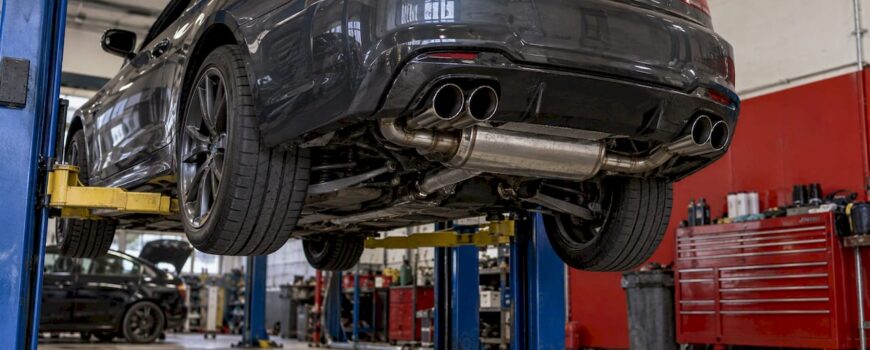
The exhaust mods that stay emissions-friendly are the ones behind the catalytic converter (cat-back and axle-back systems, mufflers, tips) and, up front, converters or catted downpipes that keep the emissions hardware working and are approved for your exact car. Anything that removes, bypasses or guts the converter, the oxygen sensors or the software that monitors them is where federal law, state inspections and your warranty all push back. A valved system lets you keep the sound civil when it matters and open it up when it does not. That is why we build our range around it: exhaust parts that change sound and flow without touching what the emissions system does.
TL;DR
- Cat-back and axle-back changes leave the converter in place, so they are the lowest-risk route to more sound and flow. Noise limits still apply.
- Federal law bars removing or disabling emissions devices, and selling or installing parts whose main effect is to defeat them. Straight pipes and catless downpipes sit squarely in that zone.
- If you replace a converter or downpipe section, the part must be certified for your vehicle, and in California and New York that means a CARB Executive Order (EO) number.
- A valved exhaust has to be legal in its loudest mode. Closing the valves for the inspector does not fix an open mode that is too loud.
- Keep part numbers, EO documentation and original parts, and confirm warning lights and readiness monitors after the install.
Table of Contents
- What “emissions-friendly” means for an exhaust mod
- Which mods keep your emissions system intact
- State rules: California, New York and the rest
- Why the catless route is the wrong trade
- Valved exhausts: sound control that respects the rules
- Before you install: an owner’s and mechanic’s checklist
- Where our parts fit
- Our perspective
- FAQ
- Sources
What “emissions-friendly” means for an exhaust mod
Two separate rulebooks govern your exhaust, and they test different things.
Emissions rules are about what comes out of the tailpipe and whether the equipment that cleans it is still there and working. The federal Clean Air Act makes it illegal to knowingly remove or render inoperative any emissions device installed on a motor vehicle. It also prohibits manufacturing, selling or installing a part whose principal effect is to bypass or defeat such a device, as EPA’s tampering page explains. This applies in all 50 states.
Noise rules are set by states and sometimes cities. They cover muffler requirements and either a decibel cap or a vague “excessive or unusual noise” standard. Some states use objective limits, typically in the 80 to 95 dBA range, tested with a standard such as SAE J1169, a parked-vehicle test at a set engine speed. Others leave it to an officer’s judgment.
An emissions-friendly mod passes both. It leaves the emissions hardware intact and certified, and it keeps the car at a sound level your state tolerates. A replacement muffler or cat-back system can be lawful when it preserves required emissions equipment and meets state and local noise rules. A straight-pipe conversion that removes a converter can violate federal law even if the car runs perfectly.
Which mods keep your emissions system intact
The cleanest way to sort exhaust parts is by where they sit relative to the catalytic converter.
| Modification | Where it sits | Emissions risk | Noise risk |
|---|---|---|---|
| Axle-back (muffler and tips) | After the axle | None, converter untouched | Low to moderate |
| Cat-back | Everything behind the converter | None, converter untouched | Moderate |
| Muffler delete | Rear section | None | High |
| Catted downpipe or replacement converter | Ahead of or at the converter | Depends on certification for your car | Low to moderate |
| Catless downpipe, straight pipe, test pipe | Converter removed | Federal violation | High |
The first three rows follow DriveSafeGuide’s risk breakdown. The catted and catless rows follow the federal and state rules covered below.
Axle-backs and cat-backs
These are the standard starting point. You get a different tone, less restriction behind the converter and a visible change at the tips, and the emissions equipment is not part of the job. One practical note: dropping resonators or fitting very free-flowing mufflers can add highway cabin drone, so choose a design built to manage it. Our exhaust system anatomy guide shows what each section does, which helps you decide where to change things.
Catted and sport-cat downpipes
Turbocharged European cars often get the biggest flow gain at the downpipe, the pipe that carries exhaust out of the turbo. The emissions-friendly version keeps a catalytic converter in that pipe. A high-flow sport cat is less restrictive than the factory unit but still does the cleaning. See our write-up on passing U.S. inspections with a catted downpipe, and browse the down pipe category by chassis.
Two cautions apply to any converter work. First, the converter must be a legitimate replacement. EPA guidance on exhaust repair says converters may not be removed and replaced with converter replacement pipes by anyone, private owners included. Second, certification matters. In Texas, an aftermarket converter must be EPA-certified and carry a visible EPA number. The same Texas page says a single exhaust cannot be swapped for a dual exhaust unless the manufacturer certified an identical engine and chassis configuration, because backpressure affects emissions.
Particulate filters and newer cars
Many recent European cars carry an OPF or GPF (a gasoline particulate filter, which traps soot from direct-injection engines). It is part of the emissions system and has to stay. If you drive a newer BMW or Mercedes, match the downpipe to your car’s filter configuration. Our OPF-compatible exhaust upgrades guide covers that choice.
State rules: California, New York and the rest
Federal law sets the floor. States decide how hard they check.
California. The Bureau of Automotive Repair’s Smog Check Manual says emission controls must be complete and installed in the original California or federal configuration, or in a CARB aftermarket configuration. Parts that change that configuration and are not CARB-approved or exempted cause a fail. Inspectors check the EO number on the part’s label against CARB’s listings. The manual also says modified and add-on parts need an EO exemption under Vehicle Code §27156, while straight replacement parts generally do not, and a change in the number of converters is acceptable only with an EO exemption.
New York. After January 1, 2023, every aftermarket catalytic converter sold or installed on an on-road gasoline light or medium-duty vehicle must carry a CARB Executive Order. The installer rules add that the converter must be verified for your vehicle’s test group, sit in the same location and flow direction as the original, leave the converter count and oxygen sensor positions unchanged, and show its CARB label from underneath.
Colorado and other inspection-light states. Colorado’s health department lists installing an aftermarket pre-catalyst exhaust or headers and reprogramming the engine computer as tampering, and says the prohibition applies even in areas without periodic emissions inspections. Technicians there check converters, oxygen sensor placement, completed OBD readiness monitors and whether any emissions-relevant part or software was changed without an EO exemption.
Ohio. Ohio EPA’s repair guidelines require shops to install a converter when replacing a whole exhaust system if the certified configuration had one, including when the pipe section that held it is replaced or moved.
The practical rule: check your own state’s vehicle code and inspection program before you buy. Our CARB legal exhaust guide walks through the EO and EPA checks, and the sports car exhaust legal checklist gives a quick pre-purchase run-through.

Why the catless route is the wrong trade
People ask whether straight pipes add power. They can free up flow, but the price is a federal violation, a failed inspection in states that test, a check-engine light and a car that is hard to resell. The legal exposure is real for sellers and installers too. In a 2025 consent decree, the Justice Department and EPA set stipulated penalties of $2,500 per unit for the first 100 defeat products, $4,500 per unit after that and $10,000 per vehicle for removing an emissions element in the case against a parts distributor. A 2024 decree against a performance shop imposed a $10,000 civil penalty for selling and installing products that defeat emission controls, including software tunes.
The OBD system is protected too. EPA notes that the Clean Air Act also makes it a crime to knowingly tamper with a required monitoring device, and OBD qualifies. Clearing codes or tuning around a missing converter is not a workaround.
A softer enforcement day-to-day does not mean a loophole. DriveSafeGuide notes that most routine exhaust issues are handled as state noise violations, yet inspection states actively fail cars with missing or bypassed converters.
If you want the full picture on how enforcement reaches owners and shops, read our EPA tampering enforcement explainer and the five-step EPA exhaust tampering checklist.

Valved exhausts: sound control that respects the rules
A valved exhaust uses a flap in the system that opens and closes. Closed, gas goes through the muffler path and the car stays quiet at cruise and in neighborhoods. Open, it takes a freer path for more volume and response. Ours add remote electronic valve control, so you change modes from a controller instead of a toolkit. Our guide to three ways to adjust exhaust sound compares valves with other approaches.
For legality, treat the loudest setting as the one that counts. If the open mode is above your state’s limit, a closed mode does not make the system compliant when an officer or inspector hears it open. Pick a system that stays within your state’s standard in open mode, and use the closed setting for daily driving, early mornings and the road home.
This matters most on high-end platforms. For a concrete example, see how the Mercedes-AMG C63 valved exhaust guide approaches street-legal ownership.
Before you install: an owner’s and mechanic’s checklist
- Identify what changes. List every component you will replace and where it sits relative to the converter and oxygen sensors. If a part touches the converter section, it needs certification.
- Verify coverage. Where your state requires it, confirm the exact part number and your exact vehicle appear under a CARB EO. A converter that physically fits is not automatically legal or compliant.
- Get documentation. Ask for part numbers and written paperwork, and keep it with the car.
- Keep the original parts and the installation records. They are your proof of what was fitted and let you restore stock if needed.
- Mind sensor placement. Do not move oxygen sensors or add spacers. Colorado’s inspection guidance treats a spacer on a sensor as an illegal tamper indicating a missing or failed converter.
- Check afterward. Confirm no warning lights and that diagnostic readiness monitors complete over a normal drive cycle, since inspections look at them.
- Measure the noise. If your state has a decibel limit, test the loudest mode, not the quiet one.
If a car arrives at your shop with earlier tampering, the work usually involves restoring the right parts first. Ohio’s rule for previously tampered vehicles requires restoring proper parts before other work, and a shop that handles engine repairs and diagnostics can confirm the converter, sensors and codes are all sorted.
What counts as a qualifying converter is not casual either. Industry research summarizes EPA’s replacement converter program as requiring at least 70% HC and CO reduction and 30% NOx reduction after 25,000 miles or five years, which is why certified units are different from generic pipes.
Where our parts fit
We sell valved exhaust systems, downpipes, mufflers, tips, controllers and performance parts for Audi, BMW, Porsche, Ferrari, Lamborghini, Mercedes-AMG and other European and luxury performance cars, sourced as genuine products from authorized manufacturers.
For an emissions-friendly build, start with the exhaust parts for cat-back and valve upgrades, then look at the down pipe range and the accessories for controllers and finishing parts. Match each part to your chassis, model year and OPF or non-OPF configuration before you order. For model-specific pairs, see our buyer’s guide to performance exhaust brands.

Our perspective
We think the best exhaust is the one you can drive every day without thinking about it. That means the converter stays in the system, the sensors stay where the engineers put them, and the sound follows your mood instead of the other way around.
That is why we focus on valved systems with remote electronic control. A car that is quiet through the neighborhood and loud on a road you choose is easier to live with, and easier to keep within the rules, than one that is fixed at one volume.
We also see the exhaust as a way to improve response, not just volume. Our write-up on why an aftermarket exhaust improves engine response explains the thinking. Whether you drive a Ferrari, a Lamborghini or a daily BMW, the approach is the same: choose parts for your exact car, keep the emissions hardware working and keep your paperwork.
Info
FAQ
Are aftermarket exhausts legal in the US?
Many are. There is no federal rule banning every aftermarket exhaust. A cat-back that leaves the factory converter in place can be lawful if it meets your state’s noise and equipment rules. Removing or disabling the converter or other emissions equipment violates the federal Clean Air Act.
Do cat-back exhausts affect emissions?
A cat-back replaces only the parts behind the catalytic converter, so the emissions hardware stays untouched. Your remaining risk is noise, since states set their own limits, and in some places a vague standard that depends on an officer’s judgment.
Do I lose horsepower if I straight pipe?
Not necessarily, but the trade is poor. Straight piping removes the converter, which is a federal violation, and it can fail inspection, trigger warning lights and raise your noise exposure. A catted downpipe with a free-flowing cat-back gives you much of the flow benefit while keeping the emissions system working.
Do I need a CARB EO number for my exhaust?
It depends on the part and your state. California requires CARB approval or an exemption for parts that modify the emissions configuration, and New York requires a CARB EO for aftermarket catalytic converters. Check the exact part number and your vehicle against the EO listing before you buy.
Sources
- Tampering and Aftermarket Defeat Devices, EPA Clean Air Northeast
- Is It Illegal to Modify Your Exhaust? Laws in All 50 States
- What Makes a Modified Exhaust Illegal? Federal and State Rules
- Modified Exhaust Legality: What You Need to Know
- EPA exhaust system repair guidance
- Texas TCEQ: Tampering of Vehicle Emission Controls
- California BAR Smog Check Manual
- New York DEC: Guidelines for Selling and Installing Aftermarket Catalytic Converters
- Colorado: Tampering with vehicle emissions control systems
- Ohio EPA: Repairs of exhaust systems FAQ
- MECA: Aftermarket Converter Requirements in the U.S.
- U.S. v. Turn 14 Distribution consent decree
- Consent decree, White’s Diesel Performance