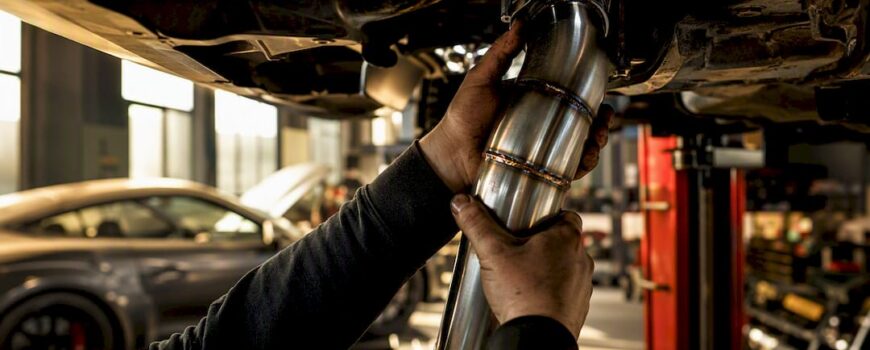
Most aftermarket downpipe installs commonly cost several hundred to over a thousand dollars total, once you add parts and labor together. Bare-bones catless setups on common platforms can cost a few hundred dollars if you turn your own wrenches, while premium catted units on luxury or high-horsepower turbo cars often cost more once a tune enters the picture. Two things swing that range more than anything else: whether the part still carries a catalytic converter, and whether your car needs an ECU remap to run clean afterward.
- DIY on a common platform: $200–$450 (part only, weekend install)
- Specialty shop install: $600–$1,200 (part + labor + basic setup)
- Full tuned build with premium downpipe: $1,500–$2,500+
Forum-reported totals back this up. Owners on Audizine describe jobs ranging from low hundreds for straightforward bolt-in installs to more than one thousand dollars once labor, gaskets, and sensor work get added in.
TL;DR:
- Installing a downpipe can cost from $350 for DIY bolt-ins to over $2,500 for full tuned builds, depending on parts, labor, and tuning needs.
- Material quality, especially 304 stainless steel with TIG welds, significantly impacts long-term durability and potential rework costs.
- Labor time varies from 1-2 hours for simple swaps to 5-6 hours for rusted or complex setups, with shop rates ranging from $80 to over $200 an hour.
- Choosing a catted or high-flow catted downpipe ensures emissions compliance, while catless options require an ECU tune and may be illegal in some regions.
- Always verify if your vehicle needs a tune, gasket replacements, sensors, or adapters, and confirm emissions legality before purchasing to avoid costly rework or fines.
Table of Contents
- How Much Does a Downpipe Cost by Part Tier?
- How Much Is Downpipe Installation Labor?
- Catted vs. High-Flow Catted vs. Catless: What’s the Price Difference?
- Which Vehicle-Specific Factors Change the Total Cost?
- Is a Catless Downpipe Legal to Drive on the Street?
- How Much Horsepower Does a Downpipe Add?
- Why Fitment and Brand Choice Affect What You Pay
- How Do You Get an Accurate Downpipe Quote?
- Key Takeaways
- What Enthusiasts Get Wrong About Downpipe Budgeting
- Get a Specialist Fit Instead of Guessing on Compatibility
- Sources
How Much Does a Downpipe Cost by Part Tier?
Downpipe pricing breaks into three rough tiers, and the difference isn’t just marketing. It’s material thickness, welding quality, and whether the part includes a catalyst at all.
- Budget tier: Usually mild steel or thinner stainless, often catless or with a low-cell-count cat. Fine for track builds, riskier for daily drivers.
- Mid-range tier: The sweet spot for most enthusiasts. Expect 304 stainless construction, a high-flow catalyst, and better fitment tolerances.
- Premium tier: Cast stainless or fully TIG-welded units, sometimes with OEM-matched flanges and integrated sensor bungs for factory-style diagnostics.
OnlyMechanic’s pricing breakdown confirms these bands and specifically flags material quality as the reason premium parts cost more. Do the math on a total: a $500 mid-range downpipe plus 3 hours of labor at $125 an hour puts you at $875 before tax, roughly the midpoint of what most owners actually report paying. Retail catalogs like Demon Tweeks show this spread holds across platforms, with some specialty parts running into the low thousands.
How Much Is Downpipe Installation Labor?
Installation time typically runs several hours, and where you land in that range depends on three things: how corroded your factory bolts are, how much room the engine bay gives a technician, and whether the new part is a true bolt-in or needs modification.
- Simple bolt-in swaps (many BMW and Audi four-cylinder platforms): 1–2 hours
- Tight-access V6 or V8 layouts, especially AWD cars with more hardware in the way: 3–4 hours
- Rusted fasteners, oxygen sensor swaps, or custom fitment issues: 5–6 hours
Shop hourly rates vary by type. Independent general shops often charge $80–$120 an hour, specialty tuner shops run $120–$180, and dealership service departments can exceed $200. That gap alone can shift your total by several hundred dollars for the same part.
Watch for add-ons that aren’t optional once the old part is off: new gaskets, fresh oxygen sensor connectors if the originals are brittle, and exhaust hanger realignment if the geometry shifts even slightly.
Pro Tip: Ask the shop for a labor estimate in a written range, not a flat number. A quote that says “2 to 4 hours” is more honest than one that promises a fixed 2 hours, because corroded bolts are the single most common reason installs run long.
Catted vs. High-Flow Catted vs. Catless: What’s the Price Difference?
The catalyst inside a downpipe is the single biggest driver of both price and legality. A full catalytic converter with high cell density filters more emissions but restricts flow, and it costs more to manufacture, which is why catted downpipes usually sit at the top of the price bands.
- Catted downpipes: Highest part cost, but street legal in every state and usually pass emissions testing without issue.
- High-flow catted downpipes: A middle ground, lower cell count (typically 100 to 200 cell) for better flow, still emissions-compliant in most jurisdictions.
- Catless downpipes: Cheapest to produce and often the least expensive to buy, but they almost always require an ECU tune to avoid a check-engine light, and they’re frequently sold for off-road or racing use only.
When comparing parts at similar price points, prioritize 304 stainless steel construction and TIG welds over cheaper materials. OnlyMechanic notes that this combination meaningfully cuts the odds of leaks or premature corrosion, which matters because a failed cheap downpipe often costs more in rework labor than the premium part would have cost upfront.
Which Vehicle-Specific Factors Change the Total Cost?
Turbocharged platforms almost always cost more to convert than naturally aspirated ones, simply because there’s more hardware between the turbo and the midpipe. A Porsche Panamera or an AMG G-Wagon involves more disassembly than a straightforward four-cylinder Audi, which is reflected in platform-specific parts like the FI Exhaust downpipe for the Panamera 3.0T or the Mercedes-AMG G500/G550 downpipe.
- New gaskets and studs: $10–$40, replace every time you break the flange seal.
- Oxygen sensor replacement: $50–$150 per sensor, needed if old sensors are damaged during removal.
- Midpipe adapters for non-matching flanges: $30–$100.
- ECU reflash or dyno tune: $150–$600, and it’s often close to mandatory once a catless or high-flow part goes in, since some racing-spec downpipes explicitly require a Stage 2 remap to avoid a check-engine light.
Is a Catless Downpipe Legal to Drive on the Street?
Legality depends entirely on where you live, and it hinges on whether your state or region requires emissions testing. Removing a catalytic converter often makes a car noncompliant for road use in states with strict programs, even if the car passes a visual inspection.
Before you buy, run through this short checklist:
- Ask the seller if the part carries a CARB EO number (California Air Resources Board Executive Order), which signals it’s been tested for emissions compliance.
- Check whether your state requires periodic emissions testing at all. Many states don’t, which changes the calculus.
- Ask your shop directly whether the specific part you’re buying will pass an emissions test in your area.
- When in doubt, choose a high-flow catted option instead of going fully catless. It’s the more reliable path to staying road legal.
How Much Horsepower Does a Downpipe Add?
On most turbocharged platforms, swapping to a high-flow or catless downpipe alone typically yields modest horsepower gains in the single-digit to low double-digit range. That’s a modest bump on its own, roughly what you’d feel as slightly quicker turbo spool rather than a dramatic power jump.
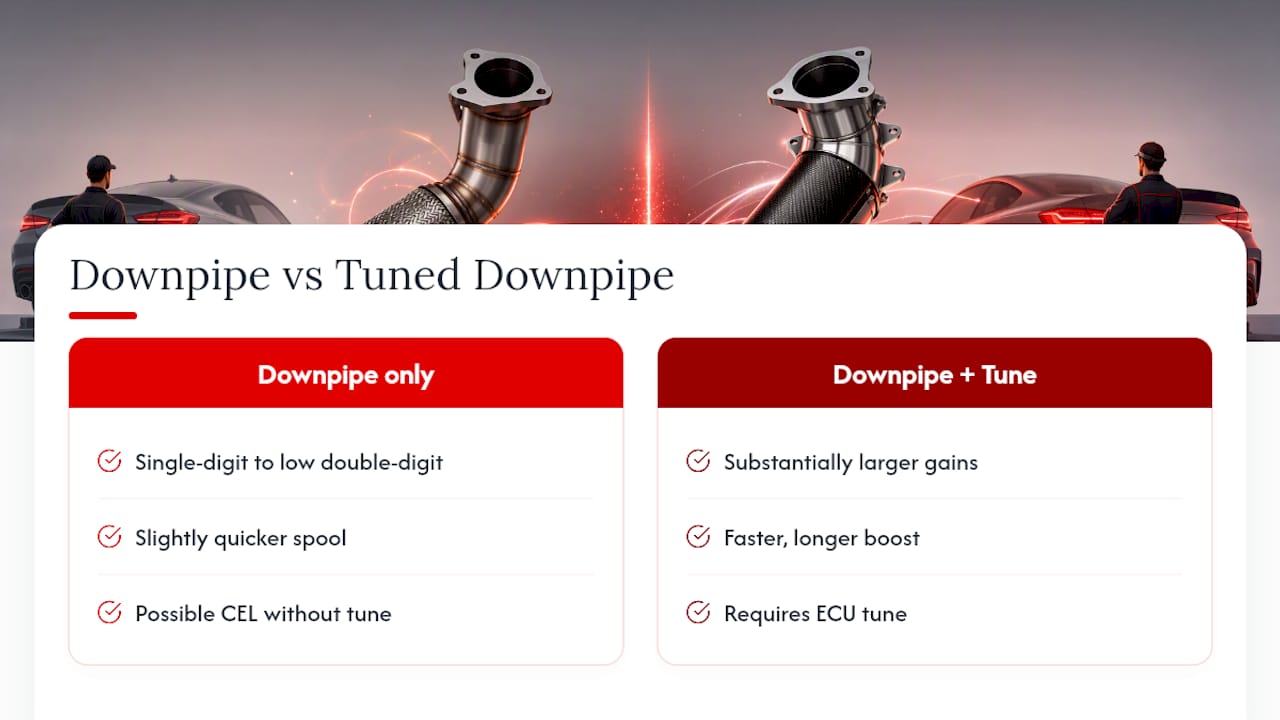
The real gains show up when the downpipe is paired with a proper ECU tune. Freeing up exhaust flow lets the turbo build boost faster and hold it longer, and a tune calibrated for that airflow change is what actually converts the hardware into meaningful power, often stacking on top of the downpipe’s gains rather than replacing them. Skip the tune and you risk a check-engine light with little to show for it besides a louder exhaust note. If sound is your main goal, a catted downpipe with a valved system delivers that without touching emissions compliance or triggering fault codes.
Why Fitment and Brand Choice Affect What You Pay
Not all downpipes at the same price point deliver the same result, and fitment accuracy is where the gap shows up fastest. Valvecontrolexhaust builds and sources downpipes engineered for specific chassis, including platforms like the BMW 535i F10/F11 and the Audi A4/A5, rather than one-size-fits-most designs.
- Compatibility across Audi, BMW, Porsche, Mercedes-AMG, Ferrari, and Lamborghini platforms means less guesswork on flange fit.
- Integration with remote-controlled valved exhaust systems lets you dial in sound and flow rather than committing to one static setup.
- Owners report noticeably improved engine response alongside the sound customization once the downpipe and valve controller work together.
Pro Tip: If you already run, or plan to run, a valved exhaust system, buy the downpipe and controller as a matched set. Mixing a generic downpipe with a valved system often means fighting sensor compatibility issues later. For background on how these parts fit together, see how exhaust system anatomy works.
How Do You Get an Accurate Downpipe Quote?
Before calling shops, total up five line items: part price, labor (hours multiplied by the shop’s hourly rate), tune cost if needed, extra parts like gaskets and sensors, and a 10 to 20 percent contingency for surprises like corroded bolts.
Then ask every shop the same six questions so you’re comparing apples to apples:
- How many labor hours do you estimate for my specific vehicle?
- Does the quote include gaskets, studs, and sensor hardware, or are those extra?
- What warranty comes with the part and the installation labor?
- Will this setup pass emissions testing in my state?
- Is a tune required, and is that priced separately?
- Do you road test the car after install to confirm no fault codes?
Pro Tip: If a shop can’t answer the emissions question directly, that’s a signal to call around. A shop that installs downpipes regularly should know your state’s rules cold. DIY makes sense for simple bolt-in swaps on common platforms; a specialist earns their labor rate on tight-access engine bays or valved systems that need calibration.
Key Takeaways
Most downpipe projects cost $350 to $1,500 total, with catalyst type and tuning needs driving the biggest swings in that range.
| Point | Details |
|---|---|
| Total cost range | Budget $350 to $1,500 for parts and labor combined; complex or tuned builds can cost more. |
| Material matters most | 304 stainless with TIG welds costs more upfront but avoids rework labor from leaks or corrosion. |
| Labor swings by shop type | Independent shops run $80–$120 an hour versus $120–$180 at specialty tuners and $200+ at dealers. |
| Catless parts need a tune | Removing the catalyst almost always requires an ECU reflash to prevent check-engine lights. |
| Check legality before buying | Ask for a CARB EO number and confirm your state’s emissions testing rules before going catless. |
| Specialist fit reduces risk | Valvecontrolexhaust builds platform-specific downpipes for Audi, BMW, Porsche, and Mercedes-AMG that integrate with valved exhaust controllers. |
What Enthusiasts Get Wrong About Downpipe Budgeting
Most cost guides treat the downpipe as an isolated purchase, and that’s the mistake. The part price is almost never the number that determines whether you’re happy with the project. It’s the tune, the sensor compatibility, and whether the shop actually understands your specific chassis.
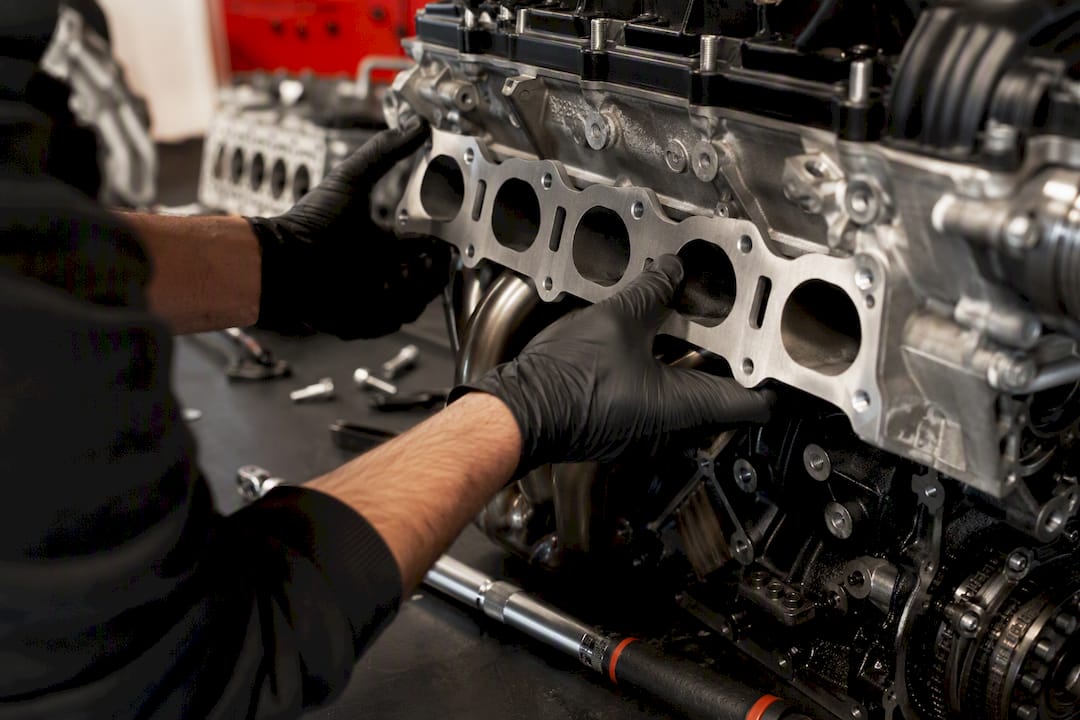
Conventional advice tells you to chase the cheapest catless part because the horsepower math looks similar to a premium unit. What that advice skips is what happens six months later: a check-engine light, a failed inspection, or a rattle from a gasket that never sealed right. The cheap route often costs more in round two.
If you’re driving something with a factory valved exhaust or planning to add one, prioritize fitment and sensor integration over shaving fifty dollars off the part price. A downpipe that fights your car’s diagnostics or your valve controller isn’t a bargain, it’s a second repair bill waiting to happen. Budget for the tune from day one instead of treating it as optional, because on most turbo platforms it’s the difference between a downpipe that does something and one that just sounds different.
— Info
Get a Specialist Fit Instead of Guessing on Compatibility
Generic downpipe listings force you to cross-reference flange diagrams and hope the sensor bungs line up. Valvecontrolexhaust skips that gamble by selling downpipes engineered per chassis, so an Audi A4/A5 owner or a Porsche Panamera Turbo owner gets a part built for that exact platform, not a universal fit that needs adapters.
That specificity matters most when you’re pairing a downpipe with a remote-controlled valved exhaust system, since sound and flow tuning depends on every component talking to the others correctly. Valve Control Exhaust builds compatibility across Audi, BMW, Porsche, Mercedes-AMG, Ferrari, and Lamborghini platforms specifically so enthusiasts don’t have to reverse-engineer fitment themselves. If you’re comparing premium options before you buy, the performance exhaust buyer’s guide breaks down when a specialist system justifies the higher price. Browse your platform’s downpipe listing and check exact fitment before you call a shop for a labor quote.
Sources
- What Is a Downpipe ? Benefits, Performance Gains & Installation Guide 2026 – Onlymechanic
- Typical downpipe installation cost | Audizine Audi Enthusiast Forums
- Exhaust Downpipes – Demon Tweeks
- Cast Stainless Steel Racing Downpipe, 8V Audi A3/S3 & MKVII Volkswagen Golf R