
Most UK and international circuits set static noise limits generally within a typical range around 98 to 105 dB(A) and drive-by limits usually within a range around 92 to 98 dB(A). A stock road car almost always clears both. An aftermarket exhaust, a decat pipe, or a tired muffler often do not.
If you’re unsure where your car lands, do this before you drive to the circuit:
- Check the event listing for the exact dB number and whether it’s static, drive-by, or both.
- Pack a removable baffle or db-killer if your exhaust has one.
- If your car is genuinely loud, book an unrestricted or “loud” day instead of gambling on a restricted one.
Noise testing at track days isn’t a formality. Fail it, and you can be turned away before you turn a wheel.
Key Takeaways
Track day noise compliance depends on knowing your circuit’s exact static and drive-by numbers and verifying your exhaust against both before you arrive.
| Point | Details |
|---|---|
| Two different tests | Static uses a meter 0.5m from the exhaust at rpm; drive-by monitors you at speed trackside. |
| Limits vary by venue | Static typically runs 98–105 dB(A); drive-by runs 92–98 dB(A), set by council planning conditions. |
| Packing degrades over time | A previously compliant car can fail later if muffler packing has blown out or worn down. |
| Baffles are the quickest fix | A removable db-killer is the most common on-the-day save for a borderline car. |
| Failing carries real cost | Most circuits don’t refund noise failures and may exclude repeat offenders. |
Table of Contents
- How Track Day Noise Limits Are Measured: Static vs Drive-By
- Why Circuit Noise Limits Vary So Much From Track to Track
- What to Expect at Sign-On and While You’re on Track
- Why Cars Fail Noise Tests, and What Fixes Actually Work On the Day
- Prepping Your Car and Booking Before You Even Leave Home
- How Valved Exhaust Systems Help You Manage Track Noise
- What Happens If You Fail: Consequences and Next Steps
- What the Noise Rules Actually Reward
- Sources
How Track Day Noise Limits Are Measured: Static vs Drive-By
The two tests measure different things, and passing one doesn’t guarantee you’ll pass the other. A static test uses a handheld meter positioned about 0.5 meters from your exhaust outlet at a 45 degree angle, with the engine held at a prescribed rpm (often three quarters of peak power rpm, though some circuits use a fixed range like 4,500 to 5,500 rpm). A drive-by test works differently: fixed meters positioned trackside, usually near the fastest or loudest section of circuit, log every car as it passes at speed.
Both readings use dB(A) weighting, which filters sound the way a human ear perceives it, cutting very low and very high frequencies more than the midrange where exhaust drone lives.
Three variables that shift readings on the day:
- Ambient temperature — cold exhausts and cold air can read differently than a fully warmed system.
- Humidity — denser, damper air affects sound propagation and can nudge readings up.
- Background noise — a paddock full of running engines during a static test can throw off a marshal’s meter if it isn’t shielded properly.
A car that scrapes past a static test at 104 dB(A) can still trip a drive-by meter later if you’re accelerating hard through the monitored zone.
Why Circuit Noise Limits Vary So Much From Track to Track
There’s no single national number, and that catches a lot of first timers out. As a rough guide, static limits typically sit between 98 and 105 dB(A), while drive-by limits run lower, usually 92 to 98 dB(A). The gap exists because drive-by testing catches a car at speed and load, which is louder in real driving than a stationary rev.
The bigger reason limits differ between venues comes down to planning permission, not preference:
- Circuits operate under agreements negotiated with local councils, and those agreements often specify a maximum number of “loud” or unrestricted days per year.
- Tracks near residential areas typically run tighter limits than those in more isolated locations.
- A circuit might post 105 dB(A) static on one date and 98 dB(A) static on another, purely because of which planning condition applies that day.
Treat the number on your specific booking as final. Don’t assume last year’s limit, or a figure a friend quoted from a different date, still applies.
What to Expect at Sign-On and While You’re on Track
Sign-on testing follows a fairly consistent script at most circuits, even though the exact numbers shift.
- A marshal or noise official will ask you to bring the car to a designated bay, usually away from other idling engines.
- You’ll warm the engine to normal operating temperature first, since a cold exhaust can give a falsely low or inconsistent reading.
- Staff hold the meter at the prescribed distance and angle, ask you to hold a set rpm for a few seconds, and read the peak.
- Cars with multiple exhaust outlets typically get tested at whichever outlet reads loudest, not an average.
Once you’re on circuit, drive-by monitoring runs continuously from fixed positions, and some circuits log or forward readings that feed back to council reporting requirements. A single trip over the limit usually earns a warning relayed through marshals or a pit board. Repeated trips typically mean a call into the pits, where a noise official may ask you to fit a baffle, back off through that section, or stop for the day.
Pro Tip: If a marshal flags you as borderline at sign-on, ask what specifically pushed the reading up. Sometimes it’s a loose heat shield resonating, not the exhaust itself, and that’s a five-minute fix instead of a session lost.
Why Cars Fail Noise Tests, and What Fixes Actually Work On the Day
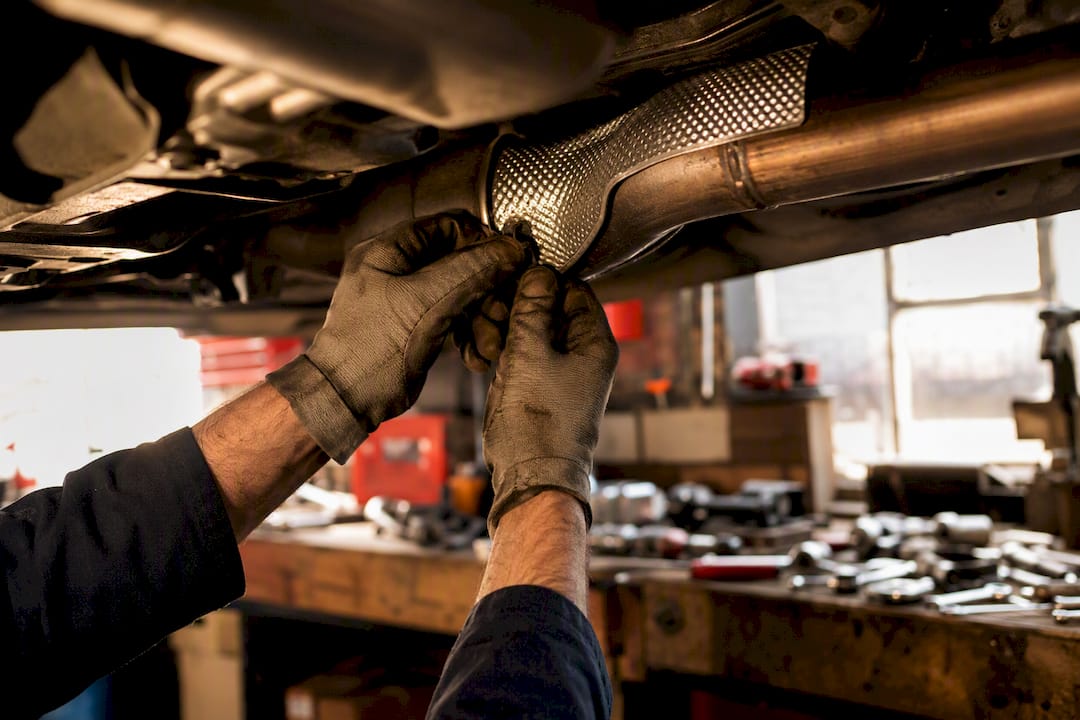
The failures are predictable once you’ve seen a few. Aftermarket systems, decat or sports cat downpipes, race cans without proper packing, and mufflers with degraded internal wadding account for most of them, as explained in detail in this DPF delete tuning article. Blown-out packing material is a sneaky one, because it turns a car that passed comfortably six months ago into a borderline fail with no other changes made.
Fixes that circuits generally accept without a full exhaust swap:
- Fit a removable baffle or db-killer if your system supports one. This is the single most common save on a paddock full of failed cars.
- If your muffler packing has degraded, repacking it restores attenuation and often drops readings by several dB(A).
- Warm the car properly before testing. A cold engine at high rpm can read louder and less consistently than a fully warmed one.
- If your exhaust has a quiet driving mode, use it. Systems with switchable valve states are built exactly for this.
Beyond the quick fixes, a few checks are worth doing before you even leave the driveway: confirm heat shields and resonators are bolted down tight (loose metal buzzes and adds apparent volume), and think about your throttle inputs through any section you know is monitored. Flooring it past a drive-by meter is a self-inflicted problem.
Pro Tip: A cheap phone dB app can give you a rough sanity check at home, but it isn’t accurate enough for real certification. Use it to catch an obvious problem, not to declare yourself compliant.
Prepping Your Car and Booking Before You Even Leave Home
Most noise failures are avoidable with a bit of homework before you arrive.
- Read the event listing carefully and note whether it states a static limit, a drive-by limit, or both, and the exact dB figure attached.
- Email or call the organizer if you’re unsure. Many circuits, including Three Sisters, offer pre-event or walk-in noise testing so you’re not finding out for the first time on the day.
- If your car runs a louder aftermarket setup, filter event calendars specifically for “loud” or unrestricted days rather than booking the first available slot.
- Get a rough check at a local garage or performance shop beforehand if your exhaust has been modified since your last event.
How Valved Exhaust Systems Help You Manage Track Noise
Adjustable valve technology lets you change exhaust flow and perceived volume electronically, without swapping hardware or removing a baffle by hand. A quiet mode routes gases through a more restrictive path for sign-on and street driving; a track or sport mode opens the valves for the session itself, or vice versa depending on what a specific circuit’s rules ask for.
This only works as a compliance strategy if the system is configured correctly ahead of time. Static and drive-by tests measure different scenarios, so a valve mapped for one might still trip the other if you haven’t checked both.
A valved system is preparation, not a loophole. It gives you a legal, repeatable way to dial in the right sound for sign-on and the right performance for the session, but only if you’ve verified both settings work before you’re standing in front of a marshal’s meter.
Before any event:
- Confirm your valve controller’s quiet setting actually reads below the posted static limit, not just “quieter than default.”
- Check the mapping hasn’t reverted after a software update or battery disconnect.
- Run a test pass, static and moving, if the circuit offers pre-testing.
Valvecontrolexhaust’s guides on configuring race mode settings and managing decibel output walk through exactly how to verify both states before you leave the driveway.
What Happens If You Fail: Consequences and Next Steps
Failing on the day rarely ends with a polite warning alone.
- Common outcomes range from refused entry at sign-on to a pit-lane call-in mid-session, formal warnings, or exclusion from the event after repeated breaches.
- Most circuits won’t refund a failed noise test, and some charge extra if they fit a baffle for you on-site. Read the terms before you book.
- If you’re turned away, your realistic options are fitting a temporary baffle on the spot, rebooking for a designated loud day, or getting a proper pre-test done before your next attempt.
What the Noise Rules Actually Reward
The conventional advice around track day noise limits treats it as a last-minute problem: show up, hope for the best, fit a baffle if a marshal frowns at you. That approach wastes money and, more often, wastes a full track day when a car gets turned away at sign-on.
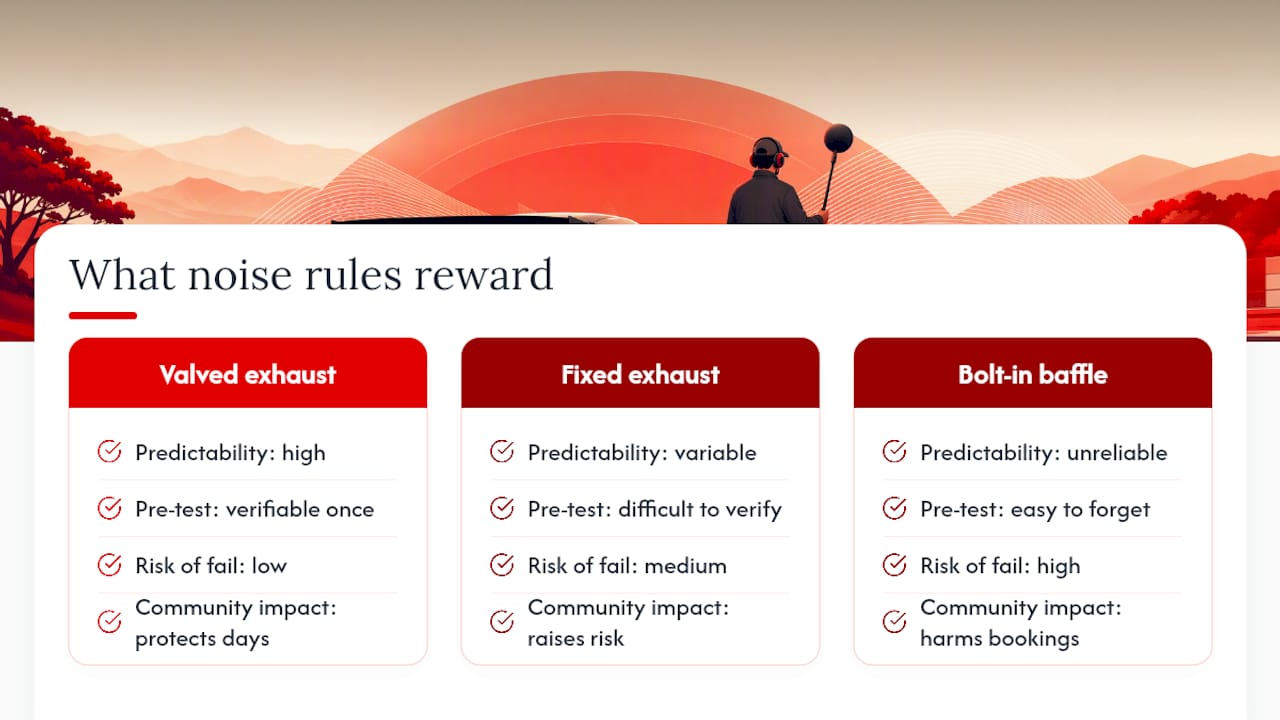
The research here points somewhere more useful. Noise compliance isn’t really about volume at all, it’s about predictability. Circuits aren’t chasing quiet cars; they’re protecting a finite number of loud operating days negotiated with local councils, and every failed test on record makes that negotiation harder for everyone who books after you. That’s why the smartest move isn’t a louder or quieter exhaust. It’s a system, or a habit, that gives you the same reading every time you test it.
That’s where a valved exhaust earns its keep over a fixed system or a bolted-in baffle you might forget to reinstall. It’s not a workaround. It’s the only setup that lets you verify compliance once and trust it on race day. If your current exhaust has you guessing each time, that uncertainty is the actual problem, not your decibel number.
— Info
Sources
- Track Day Noise Limits UK: Static and Drive-By Limits Explained – TrackdayFinder Blog
- Car Track Days FAQs :: Three Sisters Circuit
- Trackday noise limits testing – News
- How does drive-by noise limit monitoring work at car track days? – Trackdays Help Centre
- CFR reference on muffler packing degradation (technical support)