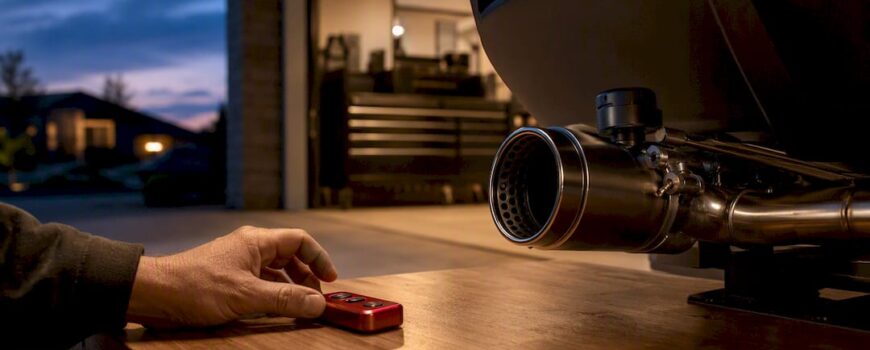
For most Ferrari 488 owners, a valved cat-back paired with a high-flow mid-pipe or sport catalyst option delivers the best balance of sound and everyday usability. Expect a noticeable jump in exhaust note and a modest, honest horsepower gain rather than a dramatic one. A valve controller lets you stay quiet leaving the house and open the system up on demand. Some companies build this exact configuration, often paired with a sport catalyst and an OBD module to keep the ECU happy.
TL;DR:
- Upgrading to a valved cat-back system with a high-flow mid-pipe offers a significant sound improvement and modest horsepower gains, especially if the valves are controlled electronically.
- Removing catalytic converters or replacing mid-pipes results in larger power increases but requires an OBD module to manage check-engine lights and potential diagnostic risks.
- Fitment varies across Ferrari 488 models, particularly for the Pista, so owners must confirm VIN, connector compatibility, factory part numbers, and ECU software before purchasing.
- Labor costs for exhaust installation can be substantial, often exceeding parts prices, especially when removing catalysts or adding tuning features, requiring specialized tools and longer shop time.
- The most satisfying upgrades balance sound preferences with daily driving comfort, emphasizing valve control quality and fitment confirmation over maximum horsepower claims.
Table of Contents
- Types of Ferrari 488 Exhaust Upgrades Explained
- How Much Sound and Power Do You Actually Gain?
- Does Your Exhaust Fit a GTB, Spider, or Pista the Same Way?
- What a Ferrari 488 Exhaust Upgrade Actually Costs
- How to Choose the Right Upgrade and Installer
- Where Valve Control Exhaust Fits Into a 488 Upgrade
- What Most Guides Get Wrong About Exhaust Upgrades
- Get a VIN-Matched Exhaust Quote From Valve Control Exhaust
- Sources
Types of Ferrari 488 Exhaust Upgrades Explained
Every Ferrari 488 exhaust system upgrade falls into one of a few categories, and knowing the difference keeps you from buying the wrong part twice.
- Valved (valvetronic) systems replace the factory back box with one containing electronically controlled valves. Closed, the car stays civil at low RPM; open it, and the exhaust drops restriction and raises volume, often with a remote or app-based controller.
- Cat-back systems swap everything from the catalytic converters rearward, including mufflers and sometimes the mid-pipe, leaving the factory cats and turbos untouched.
- Mid-pipes, downpipes, and decat options sit closer to the turbos and cats. Removing or replacing the catalytic sections increases flow the most but also carries the biggest diagnostic risk.
- X-pipes versus H-pipes shape tone differently. X-pipes tend to produce a sharper, more blended growl, while H-pipes keep more separation between cylinder banks. Titanium construction shaves weight and often deepens the tone slightly compared to stainless, which is heavier but cheaper and just as durable.
Most 488 owners start with a valved cat-back, then decide later whether a decat pipe or sport catalyst is worth the added complexity.
How Much Sound and Power Do You Actually Gain?
Set your expectations here before you set your budget. A vendor writeup from Scuderia Car Parts describes conservative gains in a modest horsepower range when a valved back box is combined with decat pipes, and that figure assumes the catalytic sections are removed entirely, not just swapped for a sport version. A cat-back alone with the factory cats in place will land well below that.
Sound and Power at a Glance: Valved cat-back alone: biggest sound swing between closed and open, smallest power gain. Cat-back plus sport catalysts: moderate sound and power gain, no CEL risk. Cat-back plus full decat: largest power gain, requires an OBD module to manage check-engine lights.
Acoustic character shifts differently depending on the path. Valved setups change dramatically between idle (near stock, if you want it) and full throttle, where the valve opens and the note sharpens. Decat pipes raise the baseline volume everywhere, even at idle, which some owners love and others find fatiguing on a daily commute.
Throttle response improves slightly with reduced backpressure, but the 488’s twin-turbo V8 responds far more to tuning than to exhaust alone. If you’re chasing throttle feel specifically, pair the exhaust with an ECU tune rather than expecting the pipes to do that job solo.
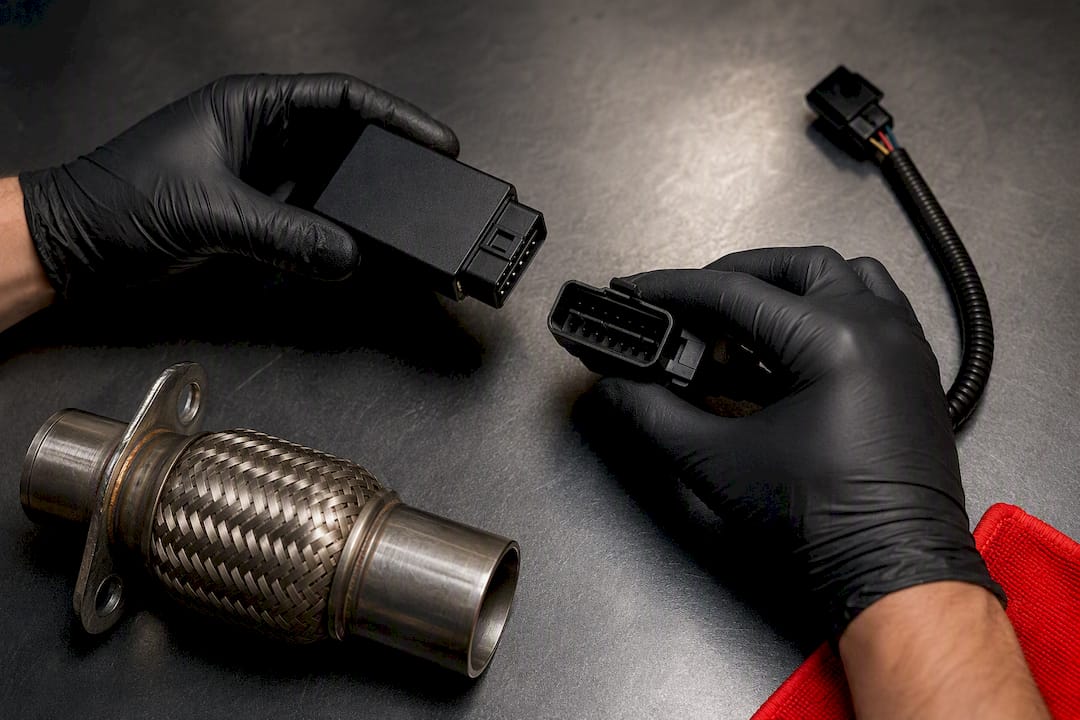
Pro Tip: If you remove the catalytic converters, budget for an OBD module from day one. Scuderia’s writeup notes these modules are the standard fix for cat-related check-engine lights, and retrofitting one after the fact means a second trip to the shop.
Does Your Exhaust Fit a GTB, Spider, or Pista the Same Way?
Not always, and this is where owners get burned buying online without checking fitment first. Most cat-back and valved back box hardware is shared across the GTB and Spider, since both use the same 3.9-liter twin-turbo platform and similar mounting geometry. The Pista, though, runs a different factory exhaust tune and, in some cases, different flange spacing, so parts marketed as universal 488 fitment don’t always bolt straight on.
Before you order anything, confirm these four things:
- VIN and model year. Give the seller your VIN, not just “488 GTB,” since running changes across model years can shift bracket or sensor positions.
- Valve actuator connectors. Confirm the replacement part uses a factory-style connector or includes an adapter harness for the valve motor.
- ECU and OBD module compatibility. Ask specifically whether the module supports your model year’s ECU software, since Ferrari has revised calibration across the 488’s production run.
- Factory part numbers. Bring photos of your current exhaust and any part numbers stamped on brackets, which lets the shop cross-reference fitment instead of guessing from your VIN alone.
What a Ferrari 488 Exhaust Upgrade Actually Costs
Budgeting for a Ferrari 488 aftermarket exhaust means pricing parts and labor separately, because the labor swings more than most owners expect.
- A cat-back system alone, parts only, tends to run into the low thousands, with SOUL Performance’s product listings giving a useful reference point for current market pricing.
- A valved cat-back adds cost for the controller and actuators on top of the base system price.
- Downpipes or decat sections cost more in labor than parts, since removing catalytic hardware on a mid-engine car often means dropping the rear subframe or working through tight clearances.
Installation typically takes a full day for a straightforward cat-back swap and can take longer if downpipes, an OBD module, and a tune are included. A shop handling this work needs welding capability, ECU or OBD diagnostic tools, and time for a proper test drive before handoff.
Pro Tip: Ask for a recorded sound sample before and after the install, plus fitment photos with your VIN visible. It costs the shop nothing and gives you proof if something needs to go back for adjustment.
Extra costs to plan for including a tune if you’re chasing throttle response, an alignment if subframe components were disturbed, and the OBD module itself if it wasn’t bundled with the exhaust kit.
How to Choose the Right Upgrade and Installer
Work through this in order rather than shopping by price first.
- Define your sound goal. Decide whether you want a quiet-at-idle, loud-on-demand valved setup, or a consistently louder decat build for track days.
- Match the exhaust to how you actually drive. A daily-driven GTB benefits far more from valve control than a Pista that only sees a track a few weekends a year.
- Ask for VIN-matched fitment photos, not stock product shots, before you pay anything.
- Ask the installer to demonstrate valve operation on a similar car if possible, since a stuck or noisy actuator is a common complaint on cheaper controllers.
- Confirm the warranty terms in writing, including whether it covers the actuator motor and controller electronics separately from the piping.
- Walk away from sweeping horsepower claims with no supporting data. Real gains from exhaust work alone are modest, and any seller promising huge numbers without a dyno chart is guessing.
Owner threads consistently point back to one habit that avoids most bad outcomes: insisting on before-and-after sound recordings and VIN-confirmed fitment before final payment.
Where Valve Control Exhaust Fits Into a 488 Upgrade
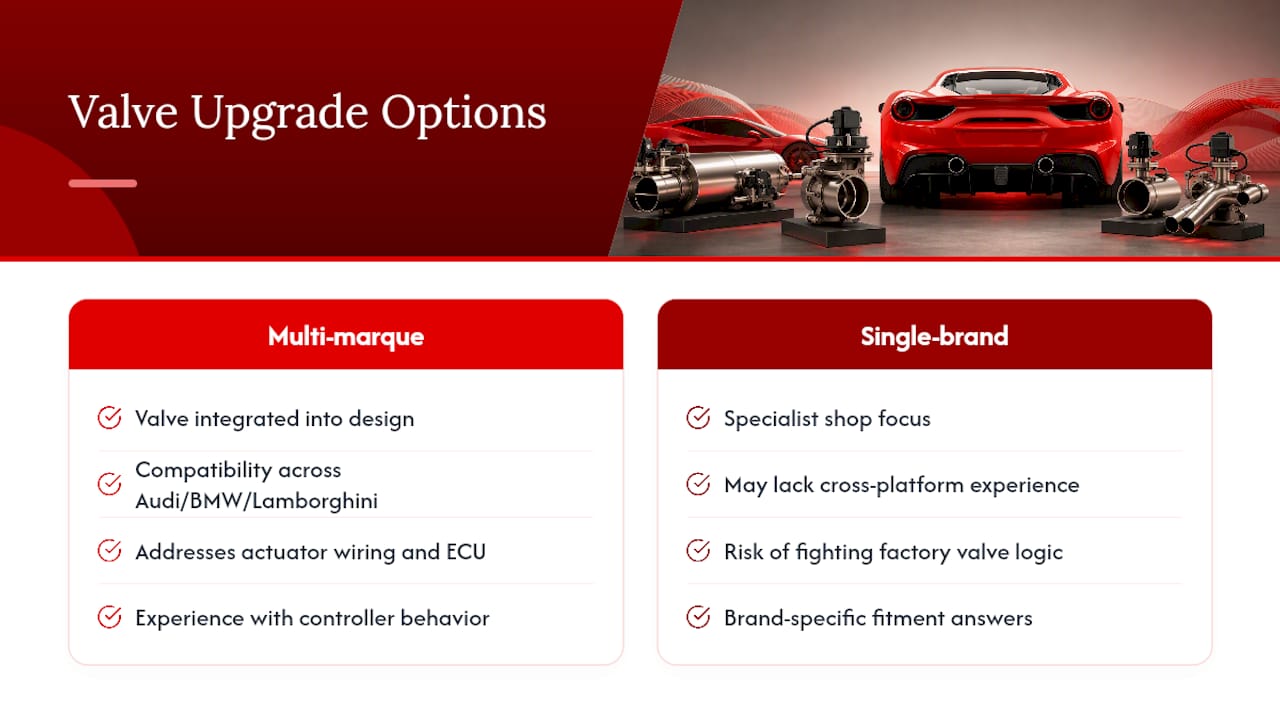
Certain manufacturers build customizable valved exhaust systems for European and luxury performance platforms, including Ferrari, with remote electronic valve control integrated into the design rather than added later. That distinction matters for a 488 specifically, since the factory setup already uses valve technology, and a replacement system needs to integrate with that logic rather than fight it.
Some companies have compatibility work spanning multiple luxury marques, helping address fitment questions about actuator wiring, ECU connectors, and controller behavior across platforms such as Audi, BMW, and Lamborghini. For owners comparing Ferrari exhaust system options, that cross-platform experience with valve integration is worth weighing against a single-brand specialist shop.
What Most Guides Get Wrong About Exhaust Upgrades
The conventional advice treats sound and horsepower as the two variables that matter, and ranks every option by how loud it gets or how many horsepower it claims. That framing misses what actually determines whether an owner is happy six months later: whether the car is still pleasant to drive to dinner.
A decat system with the biggest claimed power number is the wrong answer for someone who drives their 488 three times a week and hates explaining exhaust drone to passengers. The valve controller is the feature that resolves that tension, not the pipe diameter or the catalytic converter’s absence. Owners who skip valve control to save money almost always end up retrofitting it later, which costs more than buying it once.
The other place guides fall short is fitment. Plenty of listings claim direct-fit compatibility, and some genuinely are, but “fits 2015 to 2020 488 models” on a product page is not the same as fitment confirmed against your specific VIN. Spend the extra week getting fitment photos before you spend the money. It’s the cheapest insurance in the entire process.
— Info
Get a VIN-Matched Exhaust Quote From Valve Control Exhaust
Some manufacturers build their systems with an advantage: real electronic valve control engineered into the exhaust from the start, not added as a separate controller kit bolted onto a generic pipe. For a 488 owner who wants dramatic sound on demand and a quiet garage exit, that built-in integration is the difference between a system that feels factory and one that feels aftermarket in the wrong way.
Start by understanding how the components fit together on the exhaust system anatomy page, then request a VIN check against your specific 488 model year before ordering. If you’re still comparing valved systems against other performance exhaust brands, the performance exhaust buyer’s guide breaks down the feature categories worth caring about. Either way, get your VIN and factory part numbers ready and reach out for a fitment-confirmed quote before you commit to a system.
Sources
- Ferrari 488 – The exhaust that should have been – Scuderia Car Parts
- Ferrari 488 Exhaust Systems – SOUL Performance