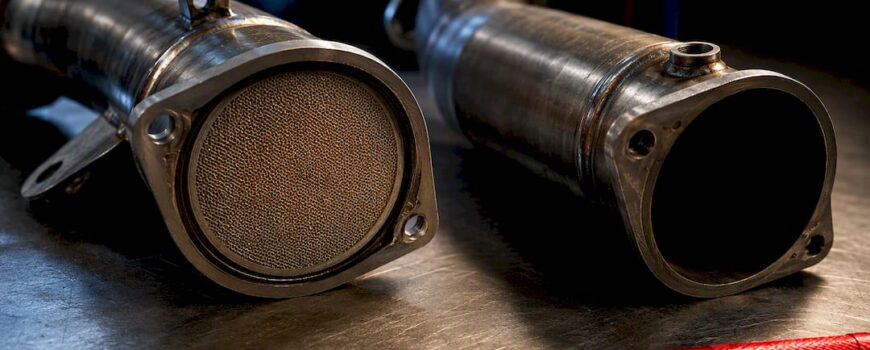
For most street-driven cars, a high-flow catted downpipe is the right call. Catless belongs on dedicated track builds where emissions equipment and inspections don’t matter. The deciding factors are simple: whether you can run a proper tune afterward and whether your car still needs to pass emissions. Some shops build around this exact split, pairing high-flow catted setups with valve control so daily drivers don’t have to choose between quiet commutes and an angry exhaust note on demand.
TL;DR:
- Most street-driven cars will benefit more from a high-flow catted downpipe due to better balance of performance gains and legal compliance.
- Removing the catalytic converter can cause check engine lights and false emissions fault codes because the downstream O2 sensors detect the absence of catalytic activity.
- Upgrading from stock to high-flow catted pipes delivers most horsepower gains, while catless pipes provide marginal improvements mainly on high-boost or race builds.
- Catless pipes produce a raspier sound and more drone, especially at low RPMs, which can be managed with resonators, vibration dampers, or valved exhaust systems.
- Legal issues are significant; catless downpipes almost always fail inspections in regulated states, while certified high-flow catted pipes offer a safer compliance path for street use.
Table of Contents
- Catted Vs Catless Downpipe: How the Turbo and Sensors Actually See It
- How Much Power Does a Catless Downpipe Really Add?
- Sound and Drone: What You’re Actually Signing Up For
- Emissions, Legality, and Your Chances of Passing Inspection
- Installing a Downpipe the Right Way: A Checklist
- Which One Fits Your Car: A Quick Decision Guide
- Why a Shop Perspective Changes the Calculus
- Where Valvecontrolexhaust Fits Into This Decision
- Sources
- FAQ
Catted Vs Catless Downpipe: How the Turbo and Sensors Actually See It
A downpipe is the pipe that carries exhaust gas from the turbo’s turbine housing into the rest of the exhaust system. Its diameter, bend radius, and whatever sits inside it (or doesn’t) determine how much backpressure the turbo has to fight on its way out. Less restriction means the turbine spins freer, which lowers exhaust gas temperatures and can quicken spool at certain RPM ranges.
A catalytic converter sits in that path specifically to convert pollutants, and it does so at the cost of flow. Pull it out entirely (catless) and you get the least restriction possible. Swap it for a high-flow unit, commonly built around a 200-cell metallic core, and you recover most of that flow while keeping some emissions control in place.
Here’s where it gets tricky for anyone who just bolts a downpipe on and drives off:
- The downstream O2 sensor sits close to where the cat used to do its work, and it’s calibrated to expect certain readings coming out of a catalyst.
- Removing the cat changes those readings enough that the OBD-II system can flag a catalyst efficiency fault.
- That fault often lights the check engine light even when the car runs fine, because the computer is reading the absence of catalytic activity, not an actual problem.
- A high-flow catted pipe usually keeps enough catalytic function that the sensor stays inside its expected range.
That’s the mechanical reality behind almost every complaint you’ll read about catless pipes throwing codes.
How Much Power Does a Catless Downpipe Really Add?
Not as much as forum bragging suggests, most of the time. A high-flow catted downpipe captures the majority of the available gains on most street setups, while a catless pipe adds a comparatively small amount on top of that for daily-driven cars.
The real gap: on a typical street car, the jump from stock to high-flow catted is where most of the horsepower shows up. Going catless from there is usually a marginal gain, not a second leap.
That’s not a knock on catless pipes. It’s just where the flow curve flattens out for cars that aren’t pushing serious boost. The story changes on high-boost or race-prepped builds, where every bit of backpressure reduction matters and the turbo is already working near its limits. There, catless can unlock a real, repeatable gap, especially in spool response under sustained load.
What changes with either upgrade is how the turbo behaves under throttle:
- Spool tends to arrive slightly sooner because the turbine isn’t pushing against as much resistance.
- Wastegate duty cycle often drops a bit, since the turbo doesn’t need to work as hard to hit target boost.
- Drivability on a well-tuned catted setup usually stays smooth; catless setups without a matching tune can feel abrupt or inconsistent in the midrange.
If you actually want to know your number instead of guessing from someone else’s build thread, a logged before-and-after or a proper dyno session beats every “I felt it” claim on the internet. Platform, tune, and boost level all move the needle more than the downpipe choice alone.
Sound and Drone: What You’re Actually Signing Up For
Catless pipes sound raw. There’s more rasp, more mechanical edge, and depending on the platform, a distinct fuel smell that some owners love and others can’t stand after the novelty wears off. A high-flow catted downpipe tends toward a deeper, more finished tone, since the catalyst substrate absorbs some of the higher frequencies that create rasp in the first place.
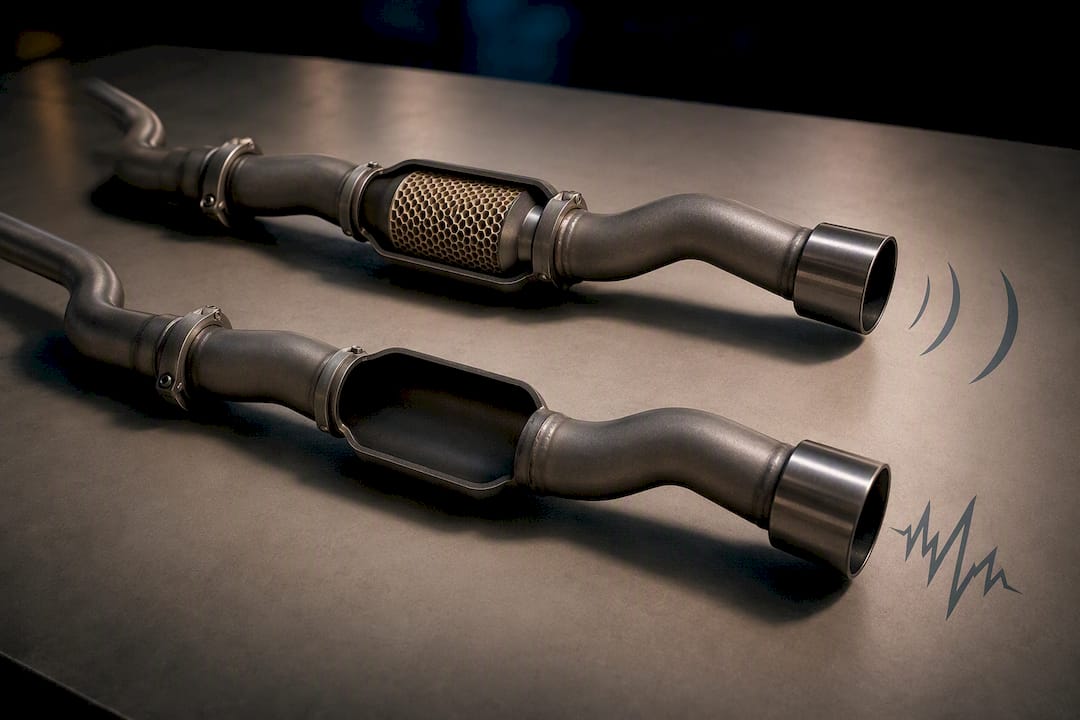
Drone is the part people underestimate before they buy. Low RPM cruising, the exact speed you spend most of your commute at, is where resonant frequencies inside the cabin build up and turn a great-sounding exhaust into a headache on the highway. Community reports on platforms like the WRX subreddit consistently flag this as the biggest regret point, more than outright loudness.
A few ways to manage it without giving up the sound entirely:
- Add a resonator in the midpipe to knock down specific drone frequencies without gutting overall volume.
- Choose mounting hardware and hangers rated for vibration damping instead of stock rubber that’s already fatigued.
- Consider a valved exhaust system that lets you close off resonance at cruise and open up under load.
Pro Tip: Drive the exact commute you do every day before committing to a catless setup, ideally in someone else’s car with the same combination. Rasp that sounds great for five minutes at a meet is a different animal at mile forty of a highway drone session.
Emissions, Legality, and Your Chances of Passing Inspection
Running a catless downpipe on a public road in the United States isn’t a gray area. Federal law under the Clean Air Act prohibits tampering with emissions control equipment, which is exactly why most catless pipes ship labeled “for off-road or competition use only.” That label isn’t decoration. It’s the manufacturer’s way of drawing a legal line between what they sell and how you’re allowed to use it.
Inspectors don’t need a lab to catch this. A visual check under the car during a standard emissions test finds a missing cat immediately, and OBD-II readiness monitors will flag catalyst efficiency codes long before the car ever reaches the inspection line. Between the two, catless setups fail at a noticeably higher rate than catted equivalents on cars that see regular street use.
States with CARB-style emissions programs go further, requiring specific Executive Order numbers on aftermarket parts before they’re legal for street use at all. A high-flow catted downpipe with proper certification is generally the compliant path in these states; a catless pipe almost never is.
If you’re weighing the risk, work through this before you order anything:
- Verify the part actually carries emissions certification for your state, not just a generic “legal in some states” disclaimer.
- Plan for how the O2 sensor will behave once the cat’s gone, since that’s what trips most inspection failures.
- If you want catless for track days only, budget for a reversible install so you can bolt the OEM or catted pipe back on before inspection season.
Installing a Downpipe the Right Way: A Checklist
Getting a downpipe swap wrong doesn’t just cost you power. It can leave you with a check engine light, a rattling heat shield, or a burned wiring harness six months later. Work through it in order:
- Confirm fitment first. Match the downpipe to your exact chassis and turbo generation. A cast performance downpipe designed for one platform won’t bolt cleanly onto a different one, even within the same brand family.
- Reinstall heat shields correctly. They’re not cosmetic. They keep exhaust heat off wiring, fuel lines, and plastic components sitting nearby.
- Seat the O2 sensor properly. A sensor that’s loose or angled wrong reads inconsistently and can trigger false codes even on a correctly flowing system.
- Torque V-band or flange clamps to spec. An underclamped joint leaks exhaust gas and throws off downstream sensor readings before you even finish the drive home.
- Get the car tuned. A Stage 2 or custom map recalibrates fueling and timing for the new flow characteristics, which manufacturers frequently recommend specifically to avoid check engine lights after the swap.
Catless setups need extra attention here. Without the cat’s thermal buffering, nearby components run hotter, so ceramic coating or heat wrap on the pipe itself is worth the extra cost.
Pro Tip: If you’re comfortable under the car and have a torque wrench, a downpipe swap is a reasonable DIY job. The tune afterward isn’t. Leave that to a shop with logging tools and platform-specific experience, because a bad map on a new downpipe can do real damage under load.
Which One Fits Your Car: A Quick Decision Guide
Here’s the tradeoff in plain terms:
- Catted (high-flow): captures most of the performance gain, keeps inspection risk low, sounds deep rather than raw, and pairs cleanly with a standard tune.
- Catless: maximum flow and peak potential, highest inspection and legal risk, more rasp and cabin drone, and it demands more careful tuning and heat management.
Ask yourself three questions before buying: Do you drive this car daily or take it through inspection? Is your build already at a boost level where the last few percent of flow actually matters? And do you want to fight drone every time you’re on the highway? If two of three answers point toward comfort and compliance, catted wins. If you’re building a dedicated track car that never sees a public inspection line, catless makes sense.
A valve-controlled exhaust paired with a catted downpipe splits the difference for a lot of owners: quiet and compliant on the way to work, loud and unfiltered with the valves open at the track.
Why a Shop Perspective Changes the Calculus
Most owners overestimate how much catless adds and underestimate how much a bad tune costs them. We’d rather sell a catted setup that a customer keeps for years than a catless pipe that gets pulled off after one failed inspection. Check your OBD-II readiness monitors before and after any downpipe change, log the difference, and if you’re going catless for track use, keep your stock parts so you can put the car back to legal spec in an afternoon.
— Info
Where Valvecontrolexhaust Fits Into This Decision
Some companies build around the tradeoff this article just walked through: performance without giving up control over how the car sounds and behaves on public roads. Pairing a high-flow catted downpipe with a valve-controlled exhaust can keep the emissions path largely intact while offering a louder, more aggressive mode on demand, rather than committing to one fixed sound around the clock.

That’s the practical advantage over going catless outright: you’re not locked into rasp and drone every time you start the car, and you’re not gambling on an inspection. Valvecontrolexhaust’s exhaust system anatomy guide breaks down how these components work together across compatible platforms, including Audi, BMW, Porsche, and other performance and luxury vehicles. For readers upgrading other parts of the drivetrain at the same time, a properly matched brake kit upgrade is worth pricing alongside the exhaust work, since more power usually means more stopping demand too. If you’re ready to see what fits your car, browse the current downpipe and valve control lineup and get a fitment check before you order.
Sources
- Downpipes and exhaust: power, heat, sound, and legality (a practical guide) | Drivurs Academy
- What Is a Downpipe ? Benefits, Performance Gains & Installation Guide 2026 – Onlymechanic
- Install Guide — 034Motorsport (cast performance downpipe DIY install)
FAQ
Do catted downpipes add horsepower?
Yes. A high-flow catted downpipe, typically built around a 200-cell catalyst, captures most of the available gain over a stock downpipe by reducing exhaust backpressure at the turbo outlet.
How much louder is catless vs catted?
Catless pipes run noticeably rasper and louder, especially under load, while high-flow catted setups produce a deeper, more controlled tone with less high-frequency edge.
What are the downsides of having a catless downpipe?
Catless pipes carry higher risk of failed emissions inspections, more frequent check engine lights from catalyst efficiency codes, added cabin drone, and extra heat exposure to nearby components since there’s no catalyst acting as a thermal buffer.
Is a catted downpipe illegal?
A properly certified high-flow catted downpipe is generally compliant on public roads in states with emissions programs, while a catless downpipe used on the street violates the Clean Air Act’s prohibition on tampering with emissions equipment.