
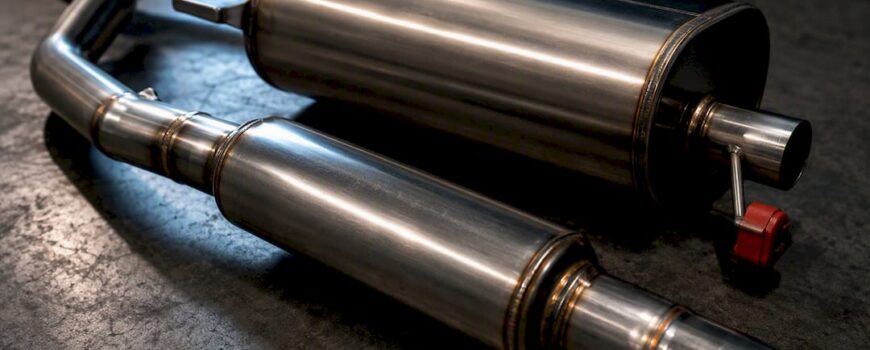
For raw, loud volume and a deeper growl, a muffler delete wins. For a moderate rasp with less risk of overwhelming the cabin, a resonator delete is the safer bet, though it’s also the more likely of the two to cause drone. Neither adds meaningful horsepower on its own, and both carry legal and comfort trade-offs that a valve-controlled exhaust is built to avoid entirely.
TL;DR:
- Removing a muffler produces the loudest, deepest growl with more pops, cracks, and moderate drone risks, but offers little to no horsepower gains.
- Deleting a resonator results in lower peak volume, more drone at highway cruising RPM, and generally exposes the car to higher legal and comfort risks.
- A valve-controlled exhaust provides adjustable sound and drone management, making it a better option for daily drivers seeking flexibility and noise control.
- Most deletes are unlikely to increase horsepower significantly; performance gains depend on headers, tuning, and flow-optimized systems.
- Always test drive with temporary replacements and check local noise laws before permanently modifying exhaust components.
Table of Contents
- Resonator Delete vs Muffler Delete: Sound and Drone Compared
- Does a Resonator or Muffler Delete Add Horsepower?
- Installation, Cost, and Build Choices
- Is a Resonator or Muffler Delete Illegal?
- How to Choose: A Decision Checklist
- Why Valve-Controlled Exhausts Often Beat a Simple Delete
- An Installer’s Honest Take on Deletes vs Deciding to Wait
- Get Sound You Control, Not Sound You’re Stuck With
- Sources
- FAQ
Resonator Delete vs Muffler Delete: Sound and Drone Compared
Every exhaust chamber exists to cancel specific sound waves. Mufflers and resonators use internal baffling to interrupt sound frequencies before they reach your cabin, so cutting either one out changes which frequencies survive the trip down the pipe. Pull the muffler, and you lose most of the system’s sound cancellation. Pull the resonator, and you lose the piece designed specifically to tame the drone-prone frequencies that resonate at highway cruising RPM.
That difference shows up immediately in how each mod actually sounds on the road.
A muffler delete produces the loudest, rawest result of the two. Expect a deeper, more aggressive tone at idle, sharper rasp under load, and a real chance of pops and crackles on deceleration, especially on cars whose factory tune already favors overrun enrichment. It’s the classic “loud show car” setup, and it sounds like one.
A resonator delete is more measured. You keep the muffler’s sound dampening, so peak volume stays lower, but you lose the resonator’s job of smoothing out midrange frequencies. The result is often a persistent drone at 1,800 to 2,500 RPM, exactly the range most people cruise in on the highway. Community reports across multiple platforms consistently flag resonator deletes as more drone prone than muffler deletes on the same vehicle, even though the muffler delete is louder overall.
Quick side-by-side of what owners actually report:
- Muffler delete: highest peak volume, deeper rasp, more pops and crackles, moderate drone risk.
- Resonator delete: lower peak volume, midrange buzz, higher drone risk at cruising speed.
- Both together: maximum volume, maximum drone risk, minimum refinement.
- Valved system: adjustable volume with drone tuned out at the factory level.
Pro Tip: Before you commit to cutting anything, clamp on a temporary replacement resonator or muffler and drive it for a week. It’s a cheap way to hear your actual drone frequency before you weld anything permanent, a step sound comparison resources recommend for exactly this reason.
Does a Resonator or Muffler Delete Add Horsepower?
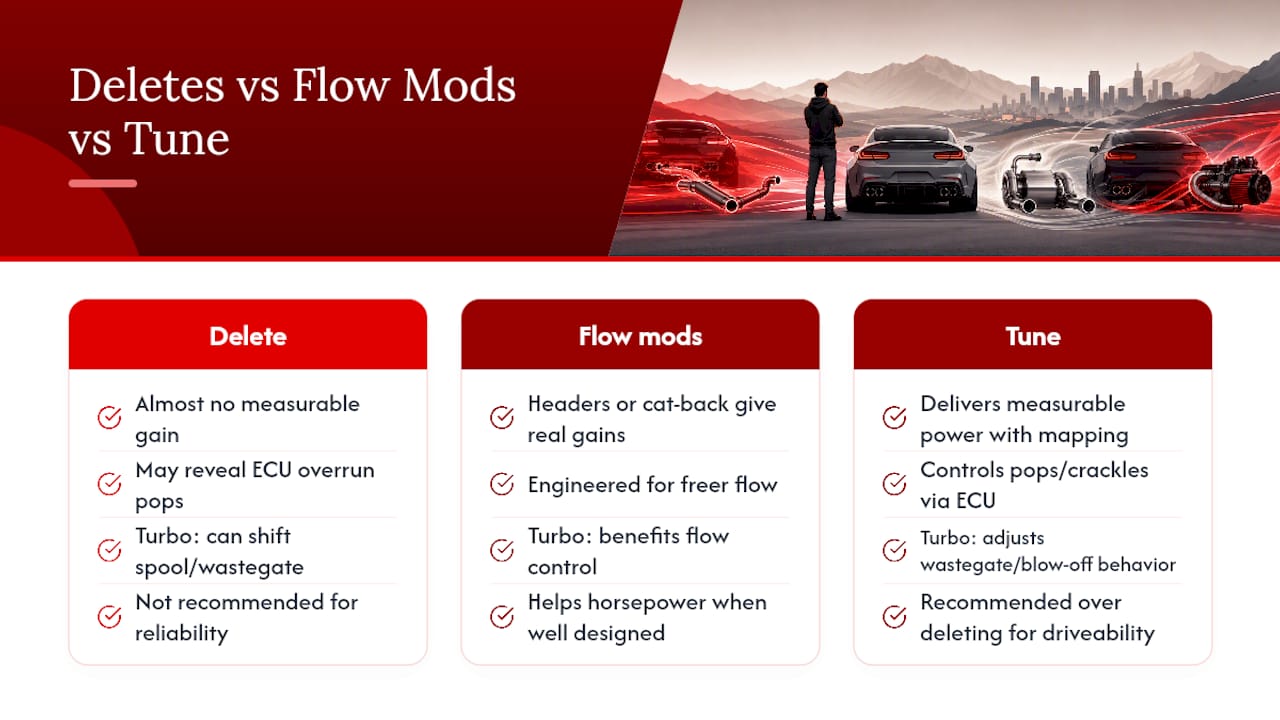
Barely, if at all. Deletes change backpressure, but on a modern fuel-injected engine, that change rarely translates into a measurable dyno number. Real gains come from freer-flowing headers, a cat-back system engineered for flow, or an actual tune, not from simply removing a chamber. Technical consensus on exhaust modifications backs this up: deletes alone almost never move the needle on horsepower or torque in any way you’d notice from the driver’s seat.
Turbocharged cars deserve extra caution here. Reducing backpressure downstream of the turbo can shift spool characteristics slightly, and on some setups it changes how the wastegate and blow-off valve behave under load. It’s rarely dramatic, but it’s not nothing either.
The pops and crackles people chase after a delete come from the ECU’s overrun programming, not the missing chamber itself. If your factory map already enriches fuel on deceleration, a delete lets you hear that behavior more clearly. If it doesn’t, you won’t get dramatic crackle no matter what you cut. Chasing that sound usually means a tune or a valve-controlled system that actually manages the behavior, not a chamber removal.
If reliability matters more than sound to you, leaving the exhaust stock and spending that budget on a proper tune will do more for how the car drives.
Installation, Cost, and Build Choices
Clamped deletes are reversible and cheaper, but they’re more prone to leaks and rattle over time. Welded deletes are quieter and more permanent, but you’re stuck with the result if you don’t like it. Stainless steel resists corrosion far better than mild steel and tends to hold its tone longer, though it costs more upfront.
- Resonator delete: typically the cheapest of the three, often a straightforward pipe swap.
- Muffler delete: moderate cost, more labor if the muffler is welded into a single-piece system.
- Valve-controlled system: the highest upfront cost, but it replaces both decisions with one adjustable unit.
The most common fitment mistake is cutting too close to a sensor or catalytic converter and damaging wiring or the cat itself, which turns a simple sound mod into an emissions problem. A rushed weld job with thin-gauge pipe is the second most common regret, since it corrodes and rattles loose within a couple of years.
Is a Resonator or Muffler Delete Illegal?
It depends entirely on where you live and drive. Noise ordinances vary by city and state, and enforcement has been tightening in a number of US municipalities, with fines and fix-it tickets tied directly to decibel limits rather than the mod itself. A delete that passes fine in one county can get you cited two towns over.
Emissions testing is a separate risk. Deleting a resonator or muffler doesn’t touch your catalytic converters or oxygen sensors, so it typically doesn’t affect an emissions test by itself. Sloppy installation that damages a sensor or cat is a different story, and it’s the more common way a “simple” delete turns into a failed inspection.
- Measure your actual output with a decibel meter before assuming you’re compliant.
- Check local noise regulations before cutting anything permanent.
- Keep catalytic converters and sensors physically untouched during any delete work.
- Consider a valved system or a drone-tuned resonator replacement instead of a full removal.
How to Choose: A Decision Checklist
Start with your actual goal, not what sounds cool in a video. A loud show car, a refined daily driver, and a track-only build each point toward a different answer.
- Define your primary use. Daily commuting, weekend cruising, or track days each tolerate very different drone levels.
- Rate your drone tolerance. If you spend an hour a day at highway RPM, drone will wear on you fast.
- Set a real budget. Include labor, not just parts, and factor in whether you’ll want a tune later.
- Decide if you’re willing to tune. Chasing crackle and pop without supporting tuning usually disappoints.
- Check your legal environment. A quiet suburb with strict enforcement is a different calculation than a rural county.
When you talk to a shop, ask specific questions: what decibel range they’re targeting, whether valve options exist for your platform, what the warranty covers, and whether catalytic converters or sensors stay untouched. Walk away from any shop promising major horsepower gains from a delete alone, or one casually suggesting you cut into the catalytic converter to “open things up.”
Pro Tip: Ask to hear a recording of the exact setup on your model before committing. Vehicle-specific acoustics vary enough that a delete sounding great on a forum video can drone badly on your car’s particular exhaust geometry.
Why Valve-Controlled Exhausts Often Beat a Simple Delete
A permanent delete is a one-way bet. You get one tone, one volume, and one legal risk profile, every time you start the car. A valve-controlled system gives you a quiet cold start, a refined cruise, and an aggressive note on demand, all from the same hardware. Well-designed valved systems produce louder tones and pops when open while staying refined when closed, which solves the drone problem a resonator delete tends to create.
This matters most on luxury and performance daily drivers, where the factory tune and pipe geometry are already dialed in and cutting into them throws that balance off. Owners who want one setting for the school run and another for a weekend canyon run are exactly who valve control was built for. Understanding how resonators actually manage frequency and drone makes it clear why removing one is a blunt tool compared to controlling it electronically.
- Adjustable loudness without a permanent legal or comfort trade-off.
- No fixed drone frequency baked into the pipe.
- Preserves resale value better than an irreversible cut-and-weld job.
- Works across driving modes instead of locking you into one sound.
An Installer’s Honest Take on Deletes vs Deciding to Wait
Most regret comes from skipping the test step. Clamp on a temporary setup, drive it at your actual cruising RPM for a week, and listen for drone before you weld anything. If you’re a cautious daily driver, err toward keeping more of the system intact or going valved. If you’re building strictly for the track, a straight delete is a defensible, honest choice, and you already know what you’re trading away.
— Info
Get Sound You Control, Not Sound You’re Stuck With
Everything a delete promises, more volume, more attitude, a sound that matches your mood, is available without the drone, the fix-it ticket risk, or the one-way commitment. Valve-controlled exhaust systems are built to provide a quiet morning start and an aggressive evening drive from the same exhaust.

Instead of choosing between a muffler delete’s raw volume and a resonator delete’s drone risk, a valved system lets you dial in both ends of that spectrum on demand, closed valves for the neighborhood, open valves for the on-ramp. It’s why customizable exhaust appeals to serious car enthusiasts who’ve already been burned by a permanent mod they couldn’t undo. Browse the current lineup and get matched with the right setup for your specific model, then talk to a specialist about professional fitment before you cut anything you can’t put back.
Sources
- Exhaust noise laws and enforcement reporting
- Exhaust sound comparison: valved aftermarket versus stock
- Exhaust-sound
FAQ
Will a Resonator Delete Hurt My Engine?
No. A resonator delete doesn’t touch the engine itself; it only changes exhaust flow and sound. The main risks are drone and legal exposure, not mechanical damage.
Is a Resonator Delete or Muffler Delete Louder?
A muffler delete is louder overall, with deeper rasp and more pops on deceleration. A resonator delete is quieter in peak volume but more prone to sustained drone at cruising speed.
How Much Horsepower Do a Muffler Delete and Resonator Delete Add?
Typically very little to none on modern fuel-injected engines. Measurable gains usually require freer-flowing headers, a flow-optimized cat-back system, or an actual tune.
Is a Resonator Delete Illegal?
It depends on your local noise ordinance and decibel limits, which vary by city and state. A resonator delete that’s legal in one area can draw a fine or fix-it ticket elsewhere, so checking local noise regulations before modifying is worth the five minutes it takes.