
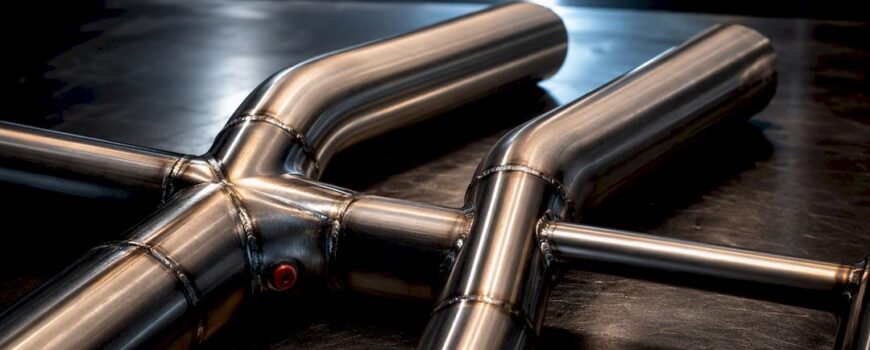
An X-pipe gives you a smoother, higher-pitched note with a raspy edge, and it usually favors top-end power. An H-pipe keeps a deeper, chunkier tone that sounds closer to classic muscle car rumble. The performance gap between them is small on most street builds, so the sound difference should drive your decision more than any dyno sheet.
TL;DR:
- An X-pipe favors high-end power and produces a higher-pitched, raspier tone by canceling bass frequencies, while an H-pipe offers a deeper, rumbling sound with better low-end torque.
- An X-pipe enhances scavenging at high rpm, leading to slight horsepower gains of 7 to 12 hp on a typical 400-hp street car, with a 2 to 4 hp edge over an H-pipe at peak output.
- Installing an X-pipe is more difficult than an H-pipe due to specific clearance, angle, and weld quality requirements, making retrofit projects more challenging.
- Final exhaust sound and volume are heavily influenced by muffler and resonator choices, with valve-controlled systems providing switching between different tonal personalities.
- Political and legal constraints depend more on noise and emission compliance in your area, not the crossover design itself.
Table of Contents
- What an X-Pipe Sound Actually Sounds Like Next to an H-Pipe
- The Mechanics Behind the Tone: Scavenging, Pulses, and Flow
- How Much Horsepower Do You Actually Gain?
- Fitment Realities: What Makes X-Pipe Installs Harder
- How Mufflers, Resonators, and Valves Finish the Job
- Choosing the Right Crossover for Your Build
- Why Valve Control Exhaust Recommends Valved Solutions for Undecided Owners
- Ready to Stop Choosing One Exhaust Personality?
- Sources
- FAQ
What an X-Pipe Sound Actually Sounds Like Next to an H-Pipe
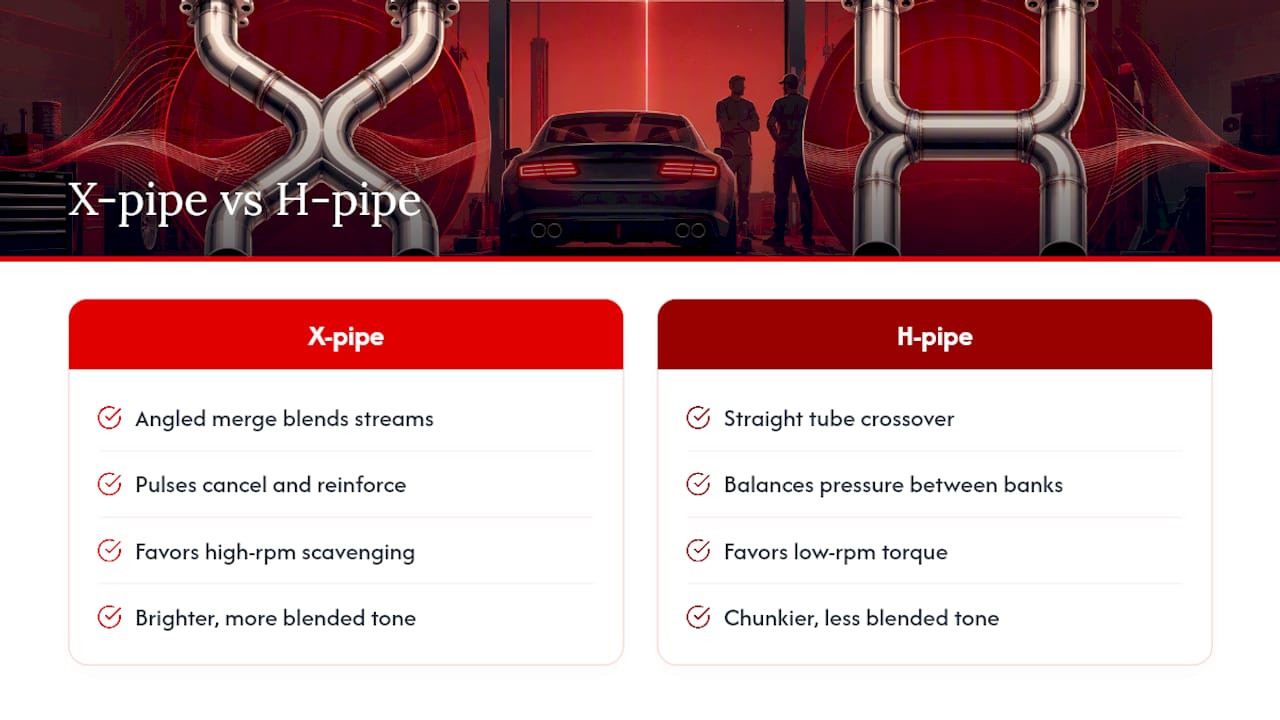
The tonal split comes down to which frequencies each design cancels. X-pipes cancel out more bassy frequencies and tend to yield a higher-pitched tone, while H-pipes cancel higher frequencies and give a deeper, more traditional tone. That difference shows up differently depending on where you’re standing and what gear you’re in.
- At idle, an X-pipe car often sounds smoother and less choppy, while an H-pipe idles with more of a lopey, chunky pulse.
- Under cruise, the X-pipe’s higher pitch reads as raspier, almost European in some applications, since it smooths cylinder-to-cylinder separation in the note.
- Under hard acceleration, the X-pipe opens up cleaner at high rpm, while the H-pipe holds onto its deeper growl through the midrange.
- Inside the cabin, mufflers and resonators shape the final volume and drone more than the crossover shape does. Swap a straight-through muffler for a chambered one and the same X-pipe can go from raspy to mellow.
Tip pipe diameter and shape matter too. Larger tips tend to deepen and soften whatever tone the crossover already produces.
The Mechanics Behind the Tone: Scavenging, Pulses, and Flow
The sound difference isn’t cosmetic. It’s a byproduct of how each crossover manages exhaust pulses. An X-pipe merges the two exhaust streams at an angle, blending pulses from each bank so they partially cancel and reinforce each other in ways that favor higher frequencies. This blending creates more scavenging at higher rpm, improving top-end breathing, which is the venturi effect enthusiasts talk about: faster-moving exhaust gas from one bank helps pull spent gas out of the other bank’s cylinders during valve overlap.
An H-pipe, by contrast, just connects the two pipes with a straight crossover tube. It balances pressure between banks without the same merge geometry, which favors low-rpm torque and preserves a chunkier, less blended sound. Design variables change how strong these effects are: crossover diameter, the length of the merge section, and whether the pipe uses a true X-shape or a D-port style junction all shift where on the powerband you feel the benefit. A too-small X-pipe loses most of its scavenging advantage regardless of how well it’s shaped.
How Much Horsepower Do You Actually Gain?
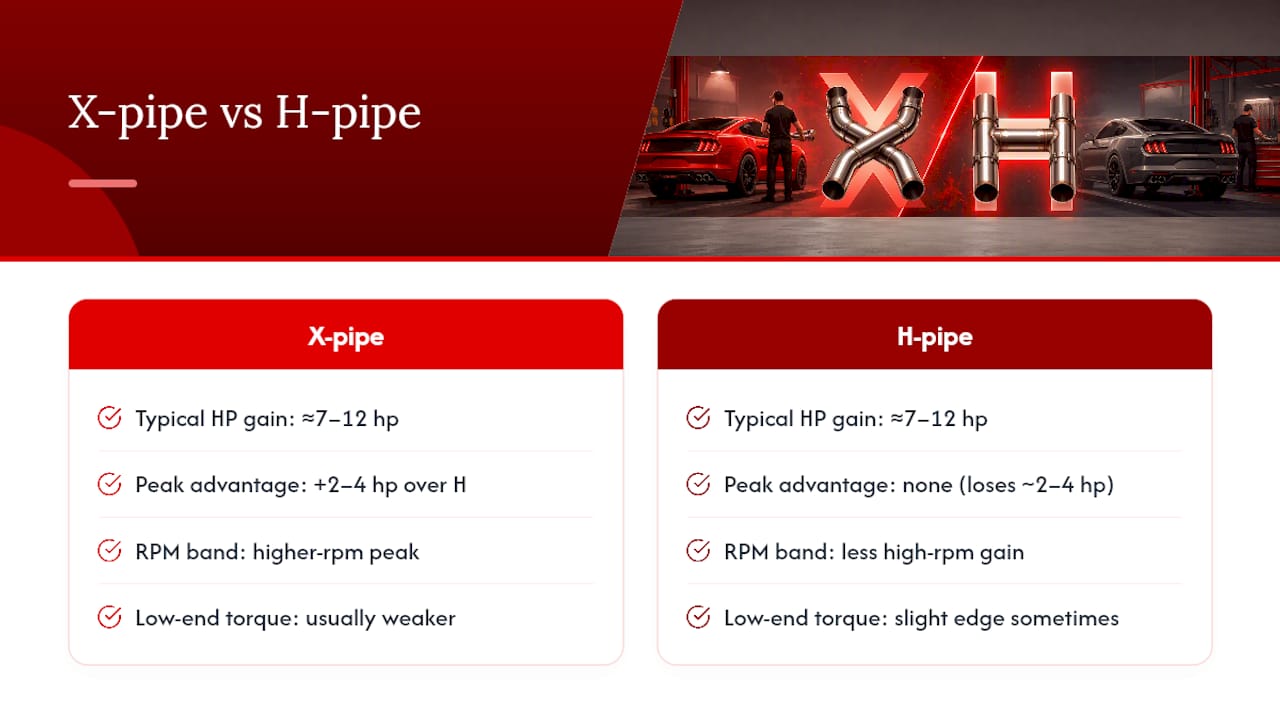
Don’t expect night-and-day dyno numbers from a crossover swap alone. On a typical 400-horsepower street car, adding an X-pipe or H-pipe can add roughly 7 to 12 horsepower, depending heavily on the rest of the exhaust, the cats, and how the engine is tuned.
Between the two designs, the X-pipe usually edges out the H-pipe by about 2 to 4 peak horsepower in similar setups, and that gain concentrates at higher rpm where scavenging matters most. The H-pipe can hold a slight edge in low-end torque on some combinations. On a mostly stock engine, either swap is often more about sound than power. On a built engine with headers, high-flow cats, and a tune, the gap widens and becomes worth chasing on the dyno.
Fitment Realities: What Makes X-Pipe Installs Harder
X-pipes are frequently harder to retrofit than H-pipes because the merge geometry needs specific clearance and angle to work correctly, not just a straight tube connection.
- Check for necking. A crossover that’s undersized for your pipe diameter kills scavenging and can choke flow. Tuners consistently warn against necking an X-pipe down just to make it fit.
- Confirm placement relative to the collectors. Crossovers positioned too close to the headers or too far back change the balance point between the banks, and wheelbase length limits where it can physically sit.
- Verify weld quality and material. A crossover built from thin-wall tubing or with rushed welds will crack under heat cycling faster than a properly gusseted stainless piece.
- Leave heat clearance. X-pipes run hotter at the merge point, so clearance from fuel lines, wiring, and the floor pan matters more than on a simple H-pipe.
How Mufflers, Resonators, and Valves Finish the Job
The crossover sets the base character, but system-level choices like muffler type, resonators, and valve control frequently change the audible outcome more than the crossover alone. A raspy X-pipe paired with a deep chambered muffler can mellow out considerably. The same X-pipe run with a straight-through muffler stays aggressive and loud.
- Resonators soften harsh frequencies without killing volume, useful if an X-pipe’s rasp is sharper than you want at cruise.
- Chambered mufflers tend to deepen and round off an X-pipe’s higher pitch.
- Valve-controlled mid-pipes let you switch between a quiet commute mode and an aggressive track mode without swapping hardware, and they cut cabin drone at highway rpm when closed.
- Compatible platforms for valved setups span most European and luxury performance cars, from Audi and BMW to Porsche and Mercedes-AMG.
Pro Tip: Before committing to a crossover, test drone with and without a resonator in the loop. Drone at 1,800 to 2,200 rpm is almost always a muffler and resonator issue, not something the X-pipe or H-pipe itself caused.
Choosing the Right Crossover for Your Build
Match the crossover to how you actually drive the car, not to what sounds best in a video.
- Daily driver or cruiser: an H-pipe’s deeper, steadier tone usually causes less cabin fatigue over long highway stretches.
- High-rpm performance or track car: an X-pipe’s scavenging advantage and cleaner top-end note fit the use case better.
- Undecided or split use: a valved or hybrid D-port crossover gives you both characters without picking one permanently.
Before you buy, ask your installer three things: what drone to expect at highway rpm, whether they have dyno proof on a similar combination, and what diameter options fit your headers. Walk away from any shop offering an undersized merge section, sloppy welds, or no heat clearance plan. If you’re still torn, listen to real clips on a similar chassis before spending money, since exhaust tone reads very differently through a phone speaker than in person.
Why Valve Control Exhaust Recommends Valved Solutions for Undecided Owners
Choosing between an X-pipe’s rasp and an H-pipe’s rumble used to mean committing to one character for good. Valved exhaust systems remove that trade-off. Owners can switch between a quiet, drone-free commute and an aggressive, scavenging-optimized top-end note without touching a wrench, using an electronic valve control system built into the mid-pipe or cat-back section. For readers pairing a crossover with the right mufflers and resonators, that flexibility solves the exact dilemma this article walks through.
Ready to Stop Choosing One Exhaust Personality?
If you’ve read this far, you already know the real problem isn’t X-pipe versus H-pipe. It’s that a fixed exhaust locks you into one tone whether you’re idling in a parking garage or flying past 6,000 rpm on a back road. Valved mid-pipes, resonated centerpipes, and valved cat-back systems are available to allow switching between different exhaust tones without choosing a permanent personality for your car.

Compatible platforms span a range of European and luxury performance cars, with remote valve control that lets you dial in quiet mode for the morning commute and open it up on a canyon run. Start by reading through the exhaust system anatomy breakdown to see how a valved crossover fits into your specific setup, then check the benefits of a valve control exhaust system for the sound and performance trade-offs on your model. When you’re ready for a vehicle-specific fitment check, reach out to get a quote before your next install date fills up.
— Info
Sources
- X-Pipe vs H-Pipe Exhaust: Which is Better? (Holley)
- X-pipes and H-pipes Add Easy Horsepower (Hot Rod)
- What’s the difference between an X-pipe and an H-pipe? (LSX Mag)
FAQ
What does an X-pipe do for sound?
An X-pipe merges exhaust pulses from both banks at an angle, which cancels bassy frequencies and produces a smoother, higher-pitched, raspier tone than a straight crossover.
Is an X-pipe illegal?
Legality depends on overall exhaust noise and emissions compliance in your state, not the crossover shape itself. An X-pipe is not inherently illegal, but pairing it with high-flow cats or no cats can violate local emissions or noise rules.
What sounds better, an X-pipe or H-pipe?
Neither is objectively better. An X-pipe gives a raspier, higher-pitched note that favors top-end power, while an H-pipe gives a deeper, chunkier tone with a slight low-end torque advantage in some setups.
Does an X-pipe make it louder?
Not by default. An X-pipe changes pitch and character more than raw volume. Final loudness depends far more on the muffler, resonator, and whether the system includes valve control.