
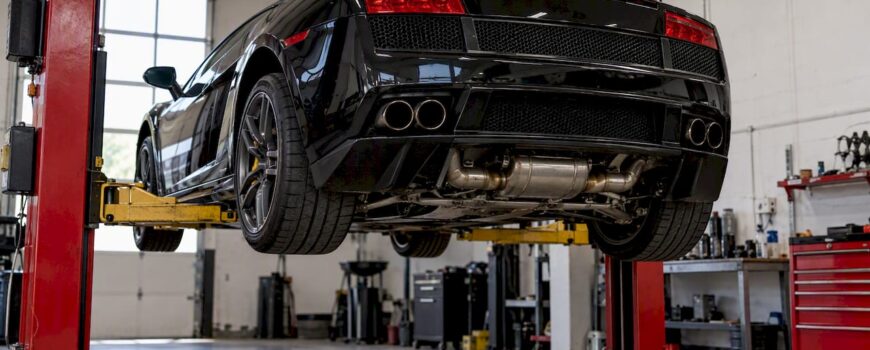
The best Gallardo exhaust for most owners is a valved system. It keeps the car civil in traffic and opens up the V10 when you want it. Which one fits depends on your generation (the early 5.0L cars versus the later 5.2L cars), your body style, and whether you want to keep the factory tips. This guide covers the parts that matter, how they differ, what shapes the final price, and the US rules to know before anything gets bolted on.
TL;DR
- A valved exhaust gives you two cars in one: a quieter mode for commuting and neighborhoods, and a fully open mode for the V10’s full voice.
- Fitment is set by generation and model year, so confirm the year range on the product page before you order.
- Tips, headers, bypass pipes and full systems each change something different. Pick by the result you want, not by the part name.
- Federal law bars removing or defeating required emissions equipment on road vehicles, and states set their own noise limits. Plan the build around both.
- Total cost is more than the part: installation labor, any tuning, and whether you want matching tips all count.
Table of Contents
- Know your Gallardo before you shop
- The main types of Gallardo exhaust upgrades
- Valved vs. non-valved: what you actually hear
- Materials and components to compare
- What to expect: sound, response and reliability
- What a Gallardo exhaust costs
- Installation, emissions and noise rules in the US
- Our perspective: why we recommend valved systems for the Gallardo
- Ready to choose your system
- FAQ
- Sources
Know your Gallardo before you shop
The Gallardo ran for roughly a decade and the exhaust story changes along the way. Two broad groups matter for buying.
Early cars (2004-2008, 5.0L V10). These include the base car, the SE and the Superleggera. Several aftermarket parts are listed specifically for this range, such as cat bypass pipes for the 2004-2008 Gallardo and muffler bypass pipes for the same years.
Later cars (LP 5xx series, 5.2L V10). Later cars use different exhaust routing, so parts for the early cars will not simply carry over. For example, our long tube catless header listing for the LP570-4 Ultimate is a titanium part with its own year range.
Body style matters too. Coupe and Spyder cars can differ in how the system is packaged, and the Superleggera has its own listings. Before ordering, check three things: model year, engine size, and whether the listing names your variant. If a listing says Gallardo/Superleggera, it is written for both.

The main types of Gallardo exhaust upgrades
The aftermarket splits into a handful of part types. Each changes the car differently.
Valved rear sections
A valved rear section replaces the factory mufflers with units that have electronically controlled flaps. Closed, the exhaust is routed through the quieter path. Open, gas flows freely and the V10 gets louder and sharper. You switch between modes with a remote or controller.
This is the option most owners end up wanting, because it removes the usual trade-off of a loud exhaust: the drone on the highway and the stares at 6 a.m. For the full picture of how the flaps work, see our guide on how exhaust valves toggle automatically.
We carry several valved Gallardo options, depending on the tips you want:
- A valved exhaust for the Gallardo
- A Gallardo/Superleggera valved exhaust that keeps your OEM tips
- A Gallardo/Superleggera valved exhaust with carbon fiber tips
Tips
Tips are the cosmetic and acoustic finishing touch. They change the look of the rear of the car, and tip design can add a little character to the sound. They are also the easiest, least invasive upgrade. If you only want the rear to look more aggressive, quad-style tips for the 2004-2008 Gallardo are a straightforward choice.
If you plan to fit a valved rear section later, choose between keeping the OEM tips or going with a set that comes with the system. That is why the listings above are split by tip type.
Headers
Headers sit at the front of the exhaust, right at the engine. A long tube header changes how exhaust pulses leave each cylinder bank, which is where much of the character and response of a V10 comes from. Titanium reduces weight compared with heavier materials. Headers are a larger project than a rear section, so they suit owners building a complete setup.
Bypass pipes
Cat and muffler bypass pipes replace restrictive components with straight sections. They are the loudest and most dramatic route. They are also the part type with the most legal strings attached, which is covered in the rules section below. On a car driven on public roads, the required emissions equipment must stay in place and working. Bypass pipes are best thought of as a competition or off-road component, and any build that touches catalytic converters needs a careful read of the law first.
Valved vs. non-valved: what you actually hear
A fixed (non-valved) exhaust has one sound. A good one is wonderful on a back road and tiring in daily use. A valved exhaust solves that with a second voice.
| Feature | Fixed exhaust | Valved exhaust |
|---|---|---|
| Sound modes | One | Two or more (quiet and open) |
| Control | None | Remote or controller |
| Cold start and neighborhood use | Same volume as always | Quiet mode available |
| Highway cruising | Constant tone | Quiet mode reduces drone |
| Full-throttle sound | Fixed character | Open mode for maximum sound |
The real advantage is flexibility. Many enthusiasts use quiet mode around home and on long drives, then open the valves on a clear road. We explain the reasoning in more depth in why variable valve exhausts outperform fixed systems, and in our overview of ways to adjust exhaust sound.
Materials and components to compare
When you read a listing, a few details tell you what you are getting.

Stainless steel vs. titanium. Stainless steel is durable and the common choice. Titanium is lighter and often gives a higher-pitched, more exotic tone. Pick titanium if weight and sound character matter to you, and stainless if you want a proven, straightforward setup.
Valve design. Look for how the valves are controlled (remote, app or controller) and whether the system is built for your exact car rather than adapted from another.
Tip style. Quad, round, carbon fiber, or OEM. Check that the tips fit your rear bumper opening and diffuser.
What is replaced. Does the system replace only the mufflers, or also the mid-pipes and catalytic converter sections? That decides how much the sound changes and how much work installation takes.
Fitment range. Always confirm the year range. A listing for 2004-2008 is not automatically right for a later car.
For a refresher on how the pieces connect, our exhaust system anatomy guide walks through each section from header to tip.
What to expect: sound, response and reliability
Sound is the biggest change. A V10 with an open valved exhaust sounds more urgent and more layered, particularly above mid-range revs. Owners of luxury sports cars who use our valved systems report better engine response and a sound they can tune to their mood. Those are owner reports, and results vary by car, setup and tune.
Performance gains depend on what you change. A rear section alone is mostly about sound. Headers and mid-pipe work are where flow changes become more meaningful, and a proper tune helps a car make the most of them. Don’t buy purely for a horsepower number. Buy for the way the car sounds and feels.
On reliability, good fitment is what counts. A system designed for your exact year and body style, installed with the correct hangers and mounts, should sit cleanly without rattles. Support brackets and mounts are worth checking whenever the exhaust is off the car, since they carry the weight of the system and it is easy to replace worn ones while you are under there.
What a Gallardo exhaust costs
We do not publish a single price for a Gallardo system here, because the right answer depends on what you choose. The listings above show current pricing on each product page. What moves the total:
- Part type. Tips cost far less than a valved rear section, and headers sit on the higher end of the scale.
- Material. Titanium generally costs more than stainless steel.
- Tips. Systems with carbon fiber tips differ in price from versions that retain your OEM tips.
- Installation. A specialist shop will charge labor, and the Gallardo’s tight engine bay and body panels mean access takes time. Ask your shop for a quote before you order.
- Tuning. If you change anything upstream of the mufflers, ask your tuner whether the car needs software work to run cleanly.
To compare options side by side, browse our exhaust parts category and our full range of Lamborghini exhaust systems and tips.
Installation, emissions and noise rules in the US
This is the part many guides skip, and it can cost owners a lot if they get it wrong.
Federal emissions rules
The EPA’s tampering policy prohibits manufacturing, selling or installing aftermarket parts that bypass, defeat or render inoperative required emissions controls on motor vehicles under the Clean Air Act. The same policy treats aftermarket parts that change ECU programming in a way that defeats emissions controls as potential illegal defeat devices.
For a road-driven Gallardo, the practical rule is simple: keep the required catalytic converters and emissions equipment in place and functioning. Choose valved rear sections and tips for street use. Treat bypass pipes and catless headers as parts for vehicles that are not used on public roads, and talk to your installer about what is appropriate for your car’s use.
State noise limits
Noise is regulated at the state level. California is the clearest example. California Vehicle Code 27151 prohibits modifying or operating a vehicle with an exhaust system that makes it noncompliant with the state’s noise limits. For vehicles under 6,000 pounds GVWR, 95 dBA or less meets the limit in that section. Other states have their own rules, and some use different measurement methods.
This is where a valved exhaust earns its keep. Quiet mode lets you drive through town at a sensible volume, and you choose when to open the valves. Check your own state’s vehicle code, and if you live in California, ask your installer how the current rules apply to your setup.
Installation tips
- Have a shop experienced with Lamborghini work install the system. The Gallardo’s rear end is tightly packaged.
- Replace worn rubber hangers and check support mounts during the job.
- Check clearances around the bumper, diffuser and tips before final tightening.
- After installation, confirm that the valve controller or remote pairs and cycles the valves properly.
Our perspective: why we recommend valved systems for the Gallardo
We built our catalog around one belief: an exotic car should not force you to choose between sounding great and living with it. The Gallardo V10 is one of the best-sounding engines of its era, and a valved exhaust lets you hear all of it on your terms.
That is why we focus on customizable systems with remote electronic valve control. You get a quiet mode for everyday driving and an open mode for the moments that matter, from one system.
We sell only genuine products from authorized manufacturers, and we list each part against specific years and models so you can match it to your car with confidence. For the Gallardo, that means separate listings for early and later cars, for OEM tips and upgraded tips, and for stainless and titanium builds.
Our advice: start with a valved rear section, add tips if you want the look, and plan any larger work with your installer so the whole system works together.
Info
Ready to choose your system
If you know your year and want a setup that works every day, start with a valved system. Our Gallardo listings cover OEM-tip and upgraded-tip versions, and the rest of our catalog covers headers, downpipes and accessories for European and luxury performance cars.

Browse the Gallardo valved exhaust, or see everything in our exhaust parts category. If you are still deciding between brands and styles, our performance exhaust buyer’s guide lays out how to compare them. Our Lamborghini exhaust valve upgrade guide covers what to expect from the upgrade itself.
FAQ
What is the best Gallardo exhaust?
For most owners, a valved system built for your exact year. It gives you a quiet mode and a full-volume mode, so you are not stuck with one sound. If you want to keep the factory look, choose the version that retains OEM tips. If you want a different rear appearance, choose the carbon fiber tip version.
Will an aftermarket exhaust fit every Gallardo?
No. Fitment depends on model year, engine and body style. The early 5.0L cars and the later 5.2L cars use different parts, so read the year range on each listing before ordering. If your variant is not named, contact us before you buy.
Is a Gallardo exhaust legal on the street?
It depends on the parts and your state. Federal law prohibits defeating required emissions controls on road vehicles, so keep catalytic converters in place. States also set noise limits, and California’s is 95 dBA for vehicles under 6,000 pounds GVWR under Vehicle Code 27151. A valved system with a quiet mode makes it easier to stay within local rules.
Do I need a tune after installing a new exhaust?
A valved rear section normally does not require one, but changes further upstream, such as headers or mid-pipes, may. Ask your installer or tuner about your specific setup. Any tune must keep emissions controls working as required.
Sources
- EPA Tampering Policy: Enforcement Policy on Vehicle and Engine Tampering
- California Vehicle Code 27151