
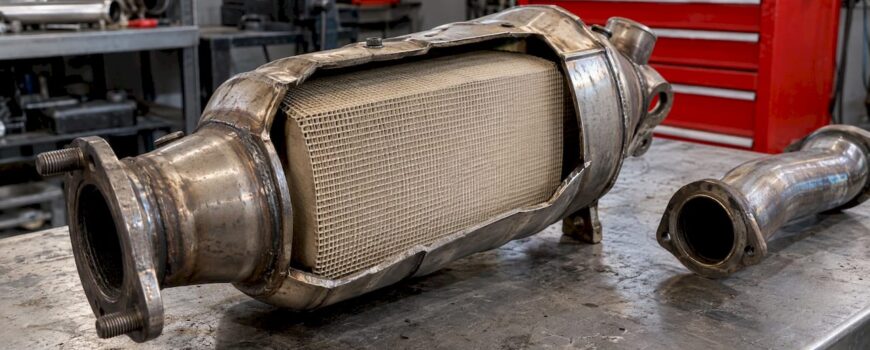
A gasoline particulate filter (GPF) usually makes a car’s exhaust sound somewhat quieter and more muffled, because it adds a restriction and changes how sound waves travel through the pipe. How much you notice depends on the engine, the filter’s position, and the rest of the exhaust. The filter is an emissions-control part, so in the US it should stay on the car. The legal way to get your voice back is to work on the sound downstream of it.
This guide explains the mechanism, what to expect from model to model, what regeneration sounds like, and how to shape your tone without crossing federal lines.
TL;DR
- A GPF is a ceramic wall-flow filter that traps soot. It adds flow resistance and reflects sound waves, so the tailpipe note is often softer and flatter.
- The change varies by car. Filter placement, engine, and muffler design all shift the result, and a loaded filter can change the acoustics further.
- Regeneration (the soot burn-off) can add subtle sounds or change engine behavior for a short time. That is normal operation.
- Under the EPA’s tampering policy, replacing a filter with a hollow pipe or fitting delete kits can be illegal. Don’t remove it.
- Valved exhaust components downstream of the filter let you set volume and tone for different driving situations.
Table of Contents
- What a GPF is and why it exists
- How a GPF changes exhaust volume and tone
- Why the change differs from car to car
- Does regeneration change the sound?
- GPF versus catalytic converter: what each does to sound
- What the EPA says about removing a GPF
- Getting the sound you want with the filter in place
- Our perspective
- Find parts for your car
- FAQ
- Sources
What a GPF is and why it exists
A GPF is the gasoline counterpart of the diesel particulate filter. Corning describes it as a wall-flow filter with a honeycomb structure and porous cordierite walls, built to capture fine gasoline particulates, including PM2.5 and smaller. The same source says these ceramic substrates can withstand temperatures above 1,100°C (2,000°F) and are designed for rapid heat-up and thermal shock resistance.
Porsche’s engineers explain the flow path this way: exhaust gas moves through narrow, alternating channels. The gas passes through the porous walls, while larger soot particles stay trapped.
That design is the key to the sound. Exhaust gas is forced through a dense ceramic wall instead of flowing straight through an open tube. Anything that does this to gas also does it to the pressure pulses that become sound.
Carmakers added these filters to direct-injection gasoline engines to cut soot. Volkswagen Group announced its rollout in 2016, claiming reductions of up to 90 percent in soot particle emissions from direct-injection petrol engines. Since then, filters have spread across European performance brands, which is why so many enthusiasts now ask what they did to their favorite engine’s voice.
How a GPF changes exhaust volume and tone
Two separate things happen inside the filter. A study from the Universitat Politècnica de València on particulate filter acoustics separates them into reactive effects and dissipative effects.
Reactive effects: reflected sound waves
The filter body is a sudden change in the pipe’s cross-section and internal structure. Part of each pressure wave bounces back toward the engine instead of continuing to the tailpipe. Reflection changes which frequencies make it out, much like the chambers in a muffler do.
Dissipative effects: flow losses
As gas squeezes through the porous walls, it loses energy to friction. Some of that energy would otherwise have been sound. The result is a lower overall level, especially in the sharper, higher-pitched edges of the note.
The UPV study notes that these effects set the wave pattern downstream of the after-treatment device. That matters, because it determines how much attenuation the muffler still has to provide. In other words, the filter is already doing part of the muffler’s job before the sound reaches the rear of the car.
The enthusiast’s description
Media explanations are less technical but match the engineering. CarThrottle puts it as the GPF being an extra restriction, with restrictions tending to produce a more muffled tailpipe sound. Treat that as an owner-level description, not a measurement. It does line up with what many drivers report: less crackle on overrun, less rasp at the top of the rev range, and a rounder idle.
Why the change differs from car to car
Two cars with a GPF can sound very different. Several factors explain it.
| Factor | How it shapes the sound |
|---|---|
| Filter position | Close to the engine, the filter sees hot, strong pulses and removes more energy before the rest of the system can shape it. Farther back, the muffler and resonators already shape the sound. |
| Muffler and resonator design | Because the filter handles some attenuation, a car may be tuned with less muffling downstream. The final note is the sum of both. |
| Engine layout | A turbo V8, a flat-six, and an inline-four produce different pressure pulses, so the same filter treats them differently. |
| Filter loading | The UPV study states that soot and ash accumulation raise backpressure and can modify acoustics, efficiency, and gaseous emissions. A clean filter and a loaded one do not sound identical. |
| Cabin tuning | Many manufacturers also shape the interior sound with intake and cabin acoustics, so what you hear inside may differ from the street-side sound. |
This is why comparisons between a pre-filter model and a post-filter model of the same car are only a guide. The filter is one element in a chain, and each manufacturer tunes the chain in its own way.
Does regeneration change the sound?
A GPF fills with soot and must periodically clean itself. This is regeneration. Porsche states that trapped soot burns off when exhaust temperature exceeds 600°C, particularly during overrun, when you lift off the accelerator and oxygen is available. For cold weather or short trips, Porsche adds that the engine controller can raise exhaust temperature through another combustion event or higher engine speed to support regeneration.
What can you hear? Ford’s guidance on its diesel particulate filter, a related technology, says regeneration can change engine or exhaust sound and may produce a clicking, metallic sound as parts heat and cool. Gasoline systems differ in detail, so check your owner’s manual for what your car’s manufacturer says.
In practice:
- A slightly different idle or a faint ticking from underneath after a drive is consistent with heat cycling.
- Short, repeated cold-start trips give the system fewer chances to reach burn-off temperatures. Periodic longer drives at steady speed help the car do its own cleaning.
- A new warning light, a loud rattle, or a noticeable loss of power is not a tone question. Have a qualified technician look at it.
GPF versus catalytic converter: what each does to sound
Both parts sit in the exhaust path and both add resistance, so both take some edge off the sound. The difference is in the construction and purpose. A catalytic converter is coated to chemically convert gases, while a GPF is built to physically trap soot with a wall-flow design. The wall-flow structure described above is what sets the filter apart acoustically, since gas has to pass through the ceramic wall rather than along open channels.
We haven’t found a published, like-for-like measurement comparing the two on the same car, so we won’t quote a number. What owners generally find is that a car with both parts is quieter and smoother than one with neither, which is exactly why the muffler stage and any valved section downstream are where tone work is done.

What the EPA says about removing a GPF
Because the filter reduces sound, some owners think about taking it out. In the US, that is a legal problem. The EPA’s Tampering Policy says aftermarket parts whose principal effect is bypassing, defeating, or rendering inoperative an emissions-control element may be illegal defeat devices. The policy lists filters, catalysts, ECU controls, and onboard diagnostics among those elements.
It also names examples of potentially prohibited hardware: hollow straight pipes that replace filters or catalysts, and delete kits that remove after-treatment systems. A “GPF delete” falls right into that description.
That has practical consequences beyond federal rules. Emissions-related tampering can affect inspections and warranty conversations, and our own guides cover these in more depth:
- Five steps to avoid exhaust tampering problems for US luxury owners
- How tampering enforcement works
- How to pass an aftermarket exhaust inspection
- Whether an exhaust affects your warranty
State and local noise and emissions rules vary, so check the rules where you register and drive the car.
Getting the sound you want with the filter in place
If the filter stays, the sound is shaped from the filter rearward. That is where an exhaust has the most freedom: pipe diameter, muffler construction, tips, and valves.
Open the rear section, not the emissions hardware
The muffler stage is the main tone-control point after the filter. A well-engineered rear section can restore depth and presence without touching any emissions-control element. A full-system approach tends to give better results than a single swap, and we explain why in why a full exhaust system outperforms a partial upgrade.
Use valves to choose your volume
A fixed exhaust forces one compromise: loud enough to enjoy and quiet enough for the neighborhood at 7 a.m. A valved exhaust avoids this. With a remote electronic controller, you open the valves for a fuller voice on a back road and close them for cruising, early departures, or a drive past a noise-sensitive area. Our guides on how electronically controlled exhaust works and decibel management for supercars go into the details. If you are weighing valved against fixed designs, see why variable valve exhaust outperforms fixed systems.
The point is the same one the legal picture makes: a muffler delete is not street legal in the US, but a valve gives you control without removing the part. We cover that in our muffler delete explainer.
Understand the system before you buy
If you are not sure where the filter, catalytic stage, and muffler sit on your car, start with our exhaust anatomy guide. Knowing the layout makes it easier to tell which part shapes which part of the sound.
Match the part to your car’s filter configuration
Fitment matters. Some of our downpipe listings are specific to filter configuration: for example, there is a listing for a BMW downpipe in an OPF version and one for a Mercedes-Benz GLC downpipe in a non-OPF version. OPF is the term some manufacturers use for a gasoline particulate filter. Pick the listing that matches your model, year, and filter equipment, and confirm fitment for your exact car before you order.
Our perspective
We hear the same question from owners of newer European performance cars: where did the sound go? The filter is part of the answer, but it is rarely the whole story. The note you hear is built from the engine, the filter, the catalytic stage, the muffler, and the tips working together.
Our view is that the right response is to treat the system as a whole and put the control where it belongs. A valved exhaust with a remote electronic controller lets you decide how much sound you want at any moment, instead of locking in one setting for every drive. Our offering is built around that idea, with compatibility across brands such as Audi, BMW, Porsche, Ferrari, Lamborghini, and Mercedes-AMG.
We sell genuine products direct from authorized manufacturers, and we encourage every owner to keep emissions-control hardware in place. You get your drive’s character and you stay on the right side of the rules. That is a better result than a loud, fixed system you end up regretting on a Monday morning.
Info
Find parts for your car
When you are ready to shape your sound, start with the category that matches your goal. Our exhaust parts range covers valved systems, mufflers, and tips for European and luxury performance cars, with remote electronic valve control for adjustable sound. Our downpipe category lists fitment by model, including OPF and non-OPF versions where they apply.

Controllers and other add-ons are in accessories. If you want help comparing system types first, our performance exhaust buyer’s guide is a good next stop.
FAQ
Does a GPF make a car quieter?
Usually, yes, to some degree. The filter reflects sound waves and causes flow losses, both of which reduce and reshape the sound reaching the tailpipe, according to the UPV acoustics study. The size of the change depends on the car.
Does a blocked or loaded filter change the sound?
It can. The same study states that soot and ash accumulation increase backpressure and can modify acoustics, efficiency, and emissions. If you notice a change along with a warning light or a loss of power, have a qualified technician check it.
Is it legal to remove a GPF in the US?
Generally no. The EPA Tampering Policy treats filters as emissions-control elements and flags delete kits and hollow pipes that replace them as potentially prohibited. Keep the filter and adjust the sound downstream.
How can I get a louder tone without touching the filter?
Focus on the sections behind it. A well-designed rear exhaust with electronically controlled valves lets you open up the sound when you want it and quiet it down when you don’t, with the emissions hardware untouched.
Sources
- What is a Gasoline Particulate Filter (GPF)? | Corning
- Cleaning Up | Porsche Newsroom
- Particulate filter acoustics study, Universitat Politècnica de València
- What Are Petrol Particulate Filters, And Why Do They Make Cars Sound Worse | CarThrottle
- Engine Emission Control – Diesel Particulate Filter | Ford
- EPA Tampering Policy
- Volkswagen Group newsroom