
An exhaust resonator is a precisely engineered acoustic component that shapes vehicle sound by canceling specific unwanted frequencies rather than reducing overall volume. The role of resonators in exhaust systems is fundamentally different from what most drivers assume. Resonators act as acoustic filters, targeting low-frequency drone in the 30–60 Hz range that causes cabin vibration at highway speeds. Mufflers reduce broad sound volume; resonators sculpt the tone. Valvecontrolexhaust builds this acoustic precision directly into its valve-controlled exhaust designs for vehicles like BMW, Ferrari, and Lamborghini, treating sound tuning as an engineering discipline rather than an afterthought.
How do resonators work to modulate exhaust sound?
Resonators cancel specific sound frequencies through a principle called destructive interference. When exhaust gases pass through the resonator chamber, the component generates a reflected sound wave that is 180 degrees out of phase with the original wave. The two waves cancel each other at that precise frequency, eliminating the targeted tone while all other frequencies pass through unchanged. This is not noise reduction in the traditional sense. It is frequency-specific sound sculpting.

The geometry of the resonator determines which frequency it targets. Chamber volume, inlet/outlet diameter, and neck length all interact to set the cancellation point. Change any one of those dimensions and you shift the target frequency. This is why resonators tuned for drone at 2,000 RPM offer no benefit at 3,500 RPM. Some performance systems use multiple resonators to address drone across a wider RPM band.
Resonator types differ in how precisely they operate:
- Bottle-style Helmholtz resonators target a narrow, specific frequency with high precision. They are the most common type in factory exhaust systems.
- Glasspack resonators smooth sound character across a broader range but lack the precision frequency cancellation of Helmholtz designs. They trade accuracy for a wider effect.
- Chambered resonators use internal baffles to redirect sound waves, creating a more aggressive tone while still reducing some frequencies.
- Louvered resonators use perforated inner tubes to scatter sound energy, offering a middle ground between tone refinement and volume control.
Each type reflects a different philosophy. Helmholtz designs prioritize accuracy. Glasspacks prioritize breadth. The right choice depends on the vehicle, the engine note, and the driver’s tolerance for drone at cruising speed.
Why do vehicles include or remove resonators?
Resonators exist primarily to eliminate highway drone, the persistent low-frequency hum that builds in the cabin at steady cruising speeds. That drone sits in a frequency range the muffler does not address. A resonator alone does not make the car quieter overall but removes the specific tone that fatigues drivers on long trips. For daily drivers, this is the most practical benefit resonators deliver.
Resonator removal is a common modification among enthusiasts chasing a louder, rawer exhaust note. The results are not always what drivers expect. Removing the resonator often reintroduces drone and raspiness that the muffler cannot control. The exhaust note becomes louder but also harsher, with metallic high-frequency tones that grow irritating over time. Many enthusiasts who delete their resonator end up re-adding an aftermarket unit to fix the rasp they created.
The practical decision process for resonator use or removal follows a clear logic:
- Assess your driving profile. Daily highway commuters benefit most from resonators. Track-only vehicles can tolerate more drone.
- Listen before you cut. Record your exhaust note at 60–70 mph before any modification. Drone is easier to identify on a recording than in the moment.
- Identify the problem frequency. Drone at idle differs from drone at cruise. Knowing which RPM triggers the issue helps you choose the right resonator type.
- Consider the full system. Changing the mid-pipe geometry can introduce secondary acoustic harmonics that mufflers cannot fix, making resonator placement critical.
- Test before committing. Some shops offer temporary resonator bypass testing so you can hear the result before permanent removal.
Pro Tip: If your exhaust sounds great at idle but becomes harsh at highway speeds, the resonator is doing its job. Removing it to chase a better idle note will almost always make the highway experience worse.
What impact do resonators have on exhaust system performance?
The most persistent myth about resonators is that they restrict exhaust flow and cost horsepower. Properly designed resonators add minimal backpressure and have negligible impact on engine power. A well-engineered resonator chamber allows exhaust gases to pass through with almost no restriction. The acoustic effect happens through reflected waves inside the chamber, not through physical obstruction of flow.
Exhaust scavenging, the process by which outgoing exhaust gases help pull fresh intake charge into the cylinder, is influenced more by pipe diameter, header design, and collector geometry than by resonator placement. Resonator position in the mid-pipe does affect the timing of pressure pulses, but the effect on scavenging efficiency is minor compared to primary header tuning. Enthusiasts who expect significant power gains from resonator changes are chasing the wrong variable.
Thermal management and ECU calibration affect performance far more than any resonator modification. Heat soak, coolant temperature consistency, and fuel map accuracy all have larger measurable effects on engine output than whether a resonator is present or absent. Chasing exhaust flow gains by removing a resonator before addressing heat management is a common mistake in performance tuning.
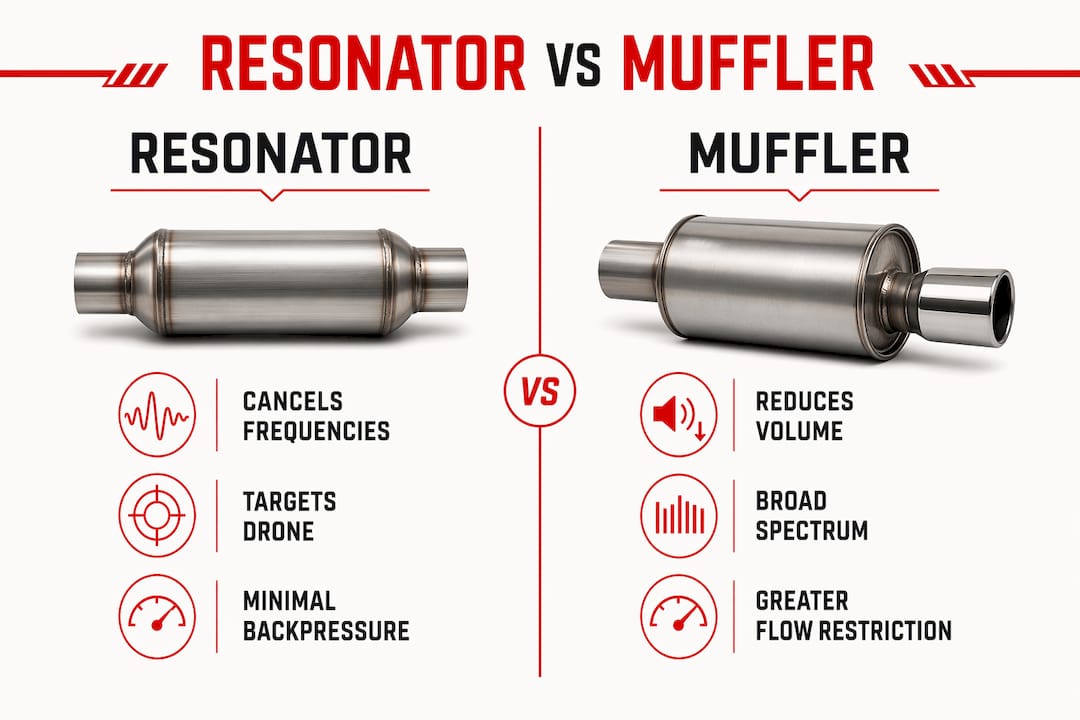
The table below clarifies what resonators and mufflers each actually do to sound and performance:
| Feature | Resonator | Muffler |
|---|---|---|
| Primary function | Cancels specific frequency tones | Reduces overall sound volume |
| Effect on drone | Eliminates targeted low-frequency drone | Minimal effect on drone specifically |
| Flow restriction | Minimal when properly designed | Moderate, varies by design |
| Engine power impact | Negligible | Small, varies by restriction level |
| Sound character | Refines and sculpts tone | Reduces loudness broadly |
Pro Tip: Before modifying your resonator for performance reasons, check your ECU logs for heat-related timing pulls. Fixing heat management will deliver more measurable power than any resonator change.
For enthusiasts interested in how exhaust flow and backpressure interact in turbocharged applications, the relationship between resonator placement and turbo spool behavior adds another layer worth understanding.
How do you diagnose and maintain resonators?
Resonator problems follow predictable patterns. Catching them early prevents the kind of sound degradation that makes a well-tuned exhaust note turn harsh and inconsistent.
Common signs of resonator damage or wear include:
- Increased drone at cruise speed. If highway drone appears or worsens, the resonator chamber may have cracked or corroded internally, breaking its acoustic tuning.
- Rattling under the vehicle. Internal baffles or packing material can loosen over time, creating a metallic rattle at specific RPM ranges.
- Visible rust or corrosion. Surface rust on the resonator body often signals deeper internal corrosion that compromises the chamber geometry.
- New high-frequency rasp. A previously smooth exhaust note that develops metallic harshness often points to resonator failure rather than muffler issues.
- Physical damage from road debris. Resonators sit low in the exhaust path and are vulnerable to impact damage on rough roads.
Stainless steel construction resists corrosion and heat degradation far better than mild steel or aluminized steel. A stainless resonator maintains its chamber geometry over years of thermal cycling, keeping its acoustic tuning consistent. Lower-quality materials corrode internally, altering the chamber volume and shifting or eliminating the target frequency cancellation.
Inspection is straightforward. Lift the vehicle on a proper jack stand, not just a floor jack, and visually inspect the resonator body for rust, cracks, and physical deformation. Shake the unit gently to check for loose internal components. A hollow, consistent sound when tapping the body indicates intact internal structure. A dull or inconsistent sound suggests internal damage.
Pro Tip: When replacing a resonator, match the internal volume and neck diameter to the original spec if you want to preserve the factory sound tuning. Upgrading to a larger-volume unit shifts the target frequency and may introduce new drone at a different RPM.
Drivers who use their vehicles on both track days and public roads benefit from cabin sound management approaches that account for the full RPM range rather than optimizing for a single driving condition.
Key Takeaways
Resonators are precision acoustic tools that cancel specific frequencies rather than simply reducing volume, making them indispensable for exhaust tone quality and long-distance driving comfort.
| Point | Details |
|---|---|
| Resonators cancel, not muffle | They use destructive interference to eliminate targeted drone frequencies, not reduce overall volume. |
| Removal creates new problems | Deleting a resonator often introduces harsh rasp and drone that the muffler cannot address. |
| Performance impact is minimal | Properly designed resonators add negligible backpressure and have no meaningful effect on engine power. |
| Material quality matters | Stainless steel maintains chamber geometry over time; cheaper metals corrode and lose acoustic accuracy. |
| Tuning is frequency-specific | A resonator tuned for one RPM range offers no benefit at other engine speeds, so system design matters. |
Why resonators deserve more respect than they get
Most enthusiasts treat resonators as optional noise suppressors they can remove without consequence. That view misses what resonators actually do. A resonator is a sound sculpting tool, not a silencer. The difference matters enormously when you spend two hours on a highway and your exhaust note shifts from satisfying to fatiguing.
The part that surprises people is how much of a vehicle’s exhaust character comes from what is removed rather than what is amplified. The aggressive, purposeful note you hear from a well-tuned performance exhaust is partly the result of specific frequencies being canceled. Without that cancellation, you get noise rather than character.
Resonator tuning is as much art as engineering. The same chamber volume that eliminates drone on a 3.0-liter inline-six creates a completely different effect on a V8. Vehicle-specific tuning matters, and off-the-shelf resonators rarely deliver the same result as purpose-built units matched to a specific engine and exhaust path. Enthusiasts who understand this stop treating resonators as expendable and start treating them as one of the most consequential components in the system.
My honest advice: before you delete your resonator, spend a week recording your exhaust note at different speeds and RPM ranges. You will almost certainly hear the drone that the resonator was suppressing. That data changes the decision.
— Info
Valvecontrolexhaust and precision exhaust sound tuning
Valvecontrolexhaust approaches resonator design as part of a complete acoustic system rather than an isolated component choice. Their valve-controlled exhaust systems for Audi, BMW, Ferrari, and Lamborghini allow real-time adjustment of exhaust character, giving drivers the ability to shift between a refined daily-driving tone and a more aggressive open sound without sacrificing either.

The result is a system where resonator function and valve control work together. Drone is managed at cruise, and full exhaust character is available on demand. For enthusiasts ready to move beyond factory sound limitations, the performance exhaust buyer’s guide at Valvecontrolexhaust covers the full range of options with detailed technical analysis. A critical analysis of leading valved systems is also available for drivers comparing premium exhaust solutions.
FAQ
What is the main role of a resonator in an exhaust system?
An exhaust resonator cancels specific low-frequency drone frequencies using destructive interference, refining exhaust tone without reducing overall sound volume the way a muffler does.
Does removing a resonator improve performance?
Resonator removal delivers no meaningful performance gain. Properly designed resonators add minimal backpressure, so removing them does not free up measurable power.
What happens when a resonator fails?
A failing resonator typically causes increased highway drone, a new metallic rasp in the exhaust note, or an audible rattle from loose internal components at specific RPM ranges.
What is the difference between a resonator and a muffler?
A muffler reduces overall exhaust volume across the sound spectrum. A resonator targets and cancels a narrow band of specific frequencies, particularly low-frequency drone, without broadly reducing loudness.
How long do exhaust resonators last?
Stainless steel resonators last the life of the vehicle under normal conditions. Mild steel units typically show corrosion-related degradation within five to ten years depending on climate and road salt exposure.