
BMW M exhaust sound control is the ability to manage your car’s exhaust valve positions to tailor tone and volume to your exact preference, independent of standard drive modes. On models like the M2, M3, M4, and M5, this means the difference between a subdued morning commute and a full-throated track session, all from the same car. The factory M Setup menu gives you a starting point, but aftermarket valve controllers from brands like MAD, ASR, and EPC unlock a level of personalization that BMW’s engineers deliberately left off the table. This guide covers both paths, from factory controls to plug-and-play aftermarket modules, so you can make an informed decision.
How does BMW M exhaust sound control work from the factory?
BMW integrates exhaust valve control directly into the M Setup menu on current M series models. The system uses electrically actuated flaps inside the rear silencers to open or close the exhaust path, changing both volume and tone in real time. On the M2, for example, BMW’s M Performance exhaust features electrically controlled valves tuned through Advanced Acoustic Control, with distinct acoustic profiles for Sport and Sport+ driving modes.
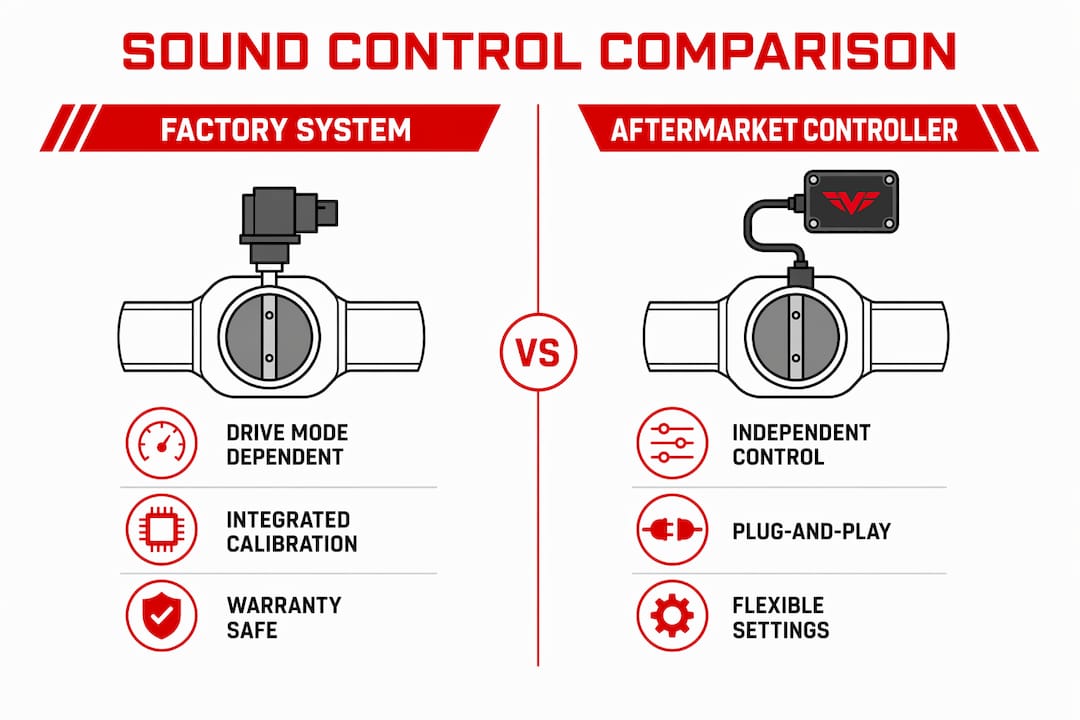
The factory system is deeply integrated with the vehicle’s drive mode logic. When you select Comfort, the valves stay mostly closed for a quieter note. Switch to Sport or Sport+, and the valves open progressively to deliver a more aggressive exhaust character. BMW’s Advanced Acoustic Control preserves the engineered driving experience by tying sound directly to vehicle behavior, which is exactly what makes it satisfying on a back road.

The limitation is just as clear. You cannot lock the valves at a specific position independent of the drive mode. If you want a half-open tone in Comfort mode for a Sunday cruise, the factory system will not allow it. The valves follow the mode, not your mood. For many M owners, this is where the factory system stops being enough.
BMW’s latest factory option for the M2 is the M Performance Track Kit, available from July 2026 at a starting price of 8,343.50 euros excluding installation. It adds multiple exhaust sound modes and reduces weight compared to the standard system. This is the most capable OEM sound control option BMW currently offers, but it still operates within the factory mode framework.
Pro Tip: If you own an M2, M3, or M4 and primarily use Sport+ mode, the factory system may already satisfy your sound goals. Test it thoroughly across all drive modes before spending money on aftermarket hardware.
Key factory system characteristics:
- Valves controlled by the M Setup menu in Sport and Sport+ modes
- No independent manual valve position locking
- Sound tuning engineered to match BMW’s acoustic targets
- Zero warranty impact when using factory or M Performance parts
What are aftermarket exhaust valve controllers and how do they differ?
Aftermarket valve controllers give you direct, independent control over your exhaust valve positions without any dependency on the factory drive mode logic. Controllers like the ASR ExValve connect inline at the rear exhaust silencer servomotors, sitting between the factory wiring harness and the valve motors. They intercept the signal and let you override it manually via a remote or app.
The three most referenced controllers in the BMW M community are the MAD Valve Controller, the ASR ExValve, and the EPC Plug-and-Play controller. Here is how they compare:
| Feature | MAD Controller | ASR ExValve | EPC Controller |
|---|---|---|---|
| Connection method | Inline at valve servo | Inline at valve servo | Inline at valve motor |
| Valve modes | Closed, ~50%, fully open, OEM override | Closed, open, OEM override | Manual direct control, OEM revert |
| Drive mode dependency | None | None | None |
| CAN bus intervention | No | No | No |
| Control method | Remote buttons | Remote | Remote |
The MAD controller offers three primary modes: fully closed for quiet operation, approximately 50% open for a balanced tone, and fully open for maximum aggression, plus an OEM override that hands control back to the factory system. This flexibility is what separates it from the factory setup. You choose the valve position based on where you are and how you feel, not what drive mode the car happens to be in.
The EPC controller takes a similar approach. It plugs directly into the valve motor connector with no CAN bus intervention, which means the car’s electronics never know the controller is there. This makes reverting to OEM as simple as unplugging the module. No coding, no dealer visit.
Pro Tip: Always confirm that the controller you choose explicitly states “no CAN bus intervention.” Controllers that tap into the CAN bus can trigger fault codes and create diagnostic headaches that are difficult to trace.
Potential considerations before buying:
- Aftermarket valve controllers may affect your vehicle warranty depending on your region and dealer
- Some jurisdictions have noise regulations that apply to modified exhaust systems
- The Akrapovic Sound Kit, for instance, includes a notice about potential ECE approval impact when valve actuation is modified
What tools do you need to control your BMW M exhaust sound?
The tools you need depend on whether you are working with the factory system or adding an aftermarket controller. For factory sound adjustment, the only tool is the M Setup menu in the iDrive system. No hardware purchase required.
For aftermarket control, the core hardware is the valve controller module itself, plus the included remote. Some systems extend this with smartphone connectivity. The Akrapovic Sound Kit, for example, supports both a wireless remote and an iOS or Android app for on-demand valve actuation. The Fi Exhaust system takes a similar approach, offering an OBD2 and mobile app module that gives you mode selection from your phone.
For M2 owners specifically, the FI Exhaust catless downpipe pairs well with a valve controller to maximize the acoustic range available. A freer-flowing exhaust system gives the valves more tonal range to work with, so the difference between closed and open positions becomes more dramatic.
Compatibility matters. Most plug-and-play controllers are model-specific. The ASR ExValve is designed for F80 and F87 chassis BMW M cars. The MAD controller covers a broader range but still requires you to confirm fitment against your specific model year and chassis code before ordering.
Additional hardware worth considering:
- M Performance titanium silencers (reduce weight and sharpen exhaust note)
- iPE exhaust remote control systems for iPE exhaust owners
- Akrapovic fitting kits for M2 G87 owners adding Akrapovic components
How to adjust your BMW M exhaust sound step by step
Using the factory M Setup system:
- Access the M Setup menu through the iDrive system on your BMW M model
- Navigate to the exhaust or acoustic settings section
- Select your preferred sound profile for Sport and Sport+ modes independently
- Save your settings to your M1 or M2 driver profile button on the steering wheel
- Test the sound in each drive mode and adjust until the profile matches your preference
Installing a plug-and-play aftermarket valve controller:
- Locate the exhaust valve servomotors at the rear silencers. On most BMW M models, these sit at the back of each muffler
- Disconnect the factory wiring connector from each valve motor
- Plug the controller module inline between the factory connector and the valve motor. No cutting or splicing required
- Route the remote receiver cable to a discreet location inside the cabin or trunk area
- Power on the vehicle and test each remote button to confirm valve response
- Set your preferred startup mode using the controller’s memory function so the car always starts in your chosen valve position
Pro Tip: Set the startup mode to approximately 50% open if you live in a residential area. This gives you a satisfying sound when you start the car without triggering complaints at 6 a.m.
Common issues and fixes:
- Valve noise or rattle: Usually caused by a loose inline connector. Reseat the plug and confirm it is fully locked
- No response from remote: Check the receiver cable routing. Metal bodywork can block the signal if the receiver is buried too deep
- Drone at highway speeds: Switch from fully open to the intermediate 50% position. Locking valves at intermediate positions is a deliberate design feature in aftermarket controllers to reduce cabin drone
- Factory fault codes: Confirm your controller has no CAN bus intervention. If codes appear, revert to OEM and consult the controller manufacturer
What are the pros and cons of factory versus aftermarket sound control?
Choosing between BMW’s built-in system and an aftermarket valve controller comes down to how much control you actually want and what you are willing to trade for it.
| Category | Factory system | Aftermarket controller |
|---|---|---|
| Sound control independence | Tied to drive mode | Fully independent |
| Installation complexity | None | Low (plug-and-play) |
| Warranty impact | None | Possible, region-dependent |
| Valve position options | 2 to 3 preset modes | 3 to 4 including intermediate |
| Drone reduction | Limited | Strong (intermediate locking) |
| Cost | Included or M Performance upgrade | Typically $200 to $500 USD |
| Revert to OEM | Not applicable | Yes, unplug module |
The factory system wins on integration and peace of mind. BMW engineers spent significant time calibrating the acoustic output to match the car’s character at each drive mode. You get a polished, consistent result with zero installation risk. The M Performance Track Kit for the M2 extends this with additional modes, but the fundamental limitation remains: sound follows mode.
Aftermarket controllers win on flexibility. Valve controllers decouple sound control from drive mode logic entirely, which means you can run a quiet Comfort mode with valves half open, or a loud Sport+ mode with valves closed if you are on a track with noise limits. That level of personalization is simply not available from the factory.
The honest trade-off is warranty exposure. Most plug-and-play controllers are reversible, and because they have no CAN bus intervention, they leave no trace when removed. But dealer policies vary, and you should understand your specific warranty terms before installing any aftermarket hardware.
Key takeaways
BMW M exhaust sound control gives owners the choice between BMW’s polished factory integration and the full independent flexibility of aftermarket valve controllers, with the right answer depending entirely on how much personalization you want.
| Point | Details |
|---|---|
| Factory system limitations | BMW’s M Setup ties valve positions to drive modes, preventing independent manual control. |
| Aftermarket independence | Controllers like MAD, ASR ExValve, and EPC plug inline and operate free from drive mode logic. |
| Intermediate valve positions | Locking valves at approximately 50% open reduces drone and suits daily driving better than fully open. |
| No CAN bus intervention | Choose controllers that do not tap the CAN bus to avoid fault codes and simplify OEM revert. |
| Warranty awareness | Aftermarket valve controllers are reversible but may affect warranty depending on your region and dealer. |
Why the intermediate position changes everything
Most of the conversation around BMW M exhaust sound control focuses on the extremes: fully closed for stealth, fully open for maximum noise. After spending time with both factory and aftermarket setups, the most useful discovery is the middle ground. The approximately 50% open position on controllers like the MAD unit delivers something the factory system rarely achieves: a consistent, satisfying tone that does not drone on the highway and does not embarrass you in a parking garage.
The factory system is genuinely good at what it does. BMW’s acoustic engineers calibrated those valve profiles carefully, and in Sport+ mode on a canyon road, the result is hard to argue with. But the moment you want that same sound in Comfort mode, or you want to lock it down for a track with a 95 dB noise limit, the factory system has no answer.
What I have found is that most enthusiasts who install an aftermarket controller end up using the intermediate position more than 80% of the time. Fully open is a special occasion setting. The intermediate position is the daily driver sweet spot, and it is the one the factory system cannot give you. If you are on the fence about whether an aftermarket controller is worth it, that single capability is the deciding factor.
The plug-and-play nature of current controllers also removes the risk that used to make this category intimidating. No coding, no cutting wires, no dealer involvement. You install it in an afternoon and revert it in five minutes if you ever need to. That changes the calculus significantly.
— Info
Upgrade your BMW M exhaust sound with Valvecontrolexhaust
If you are ready to move beyond the factory system, Valvecontrolexhaust carries a curated selection of valve control exhaust systems and accessories built specifically for high-performance BMW M models.

From IPE and FI Exhaust to Armytrix, Akrapovic, Valvetronic, and Ryft, the performance exhaust buyer’s guide at Valvecontrolexhaust covers every major brand with side-by-side comparisons, sound profiles, and fitment details. Whether you are sourcing a complete M series exhaust upgrade or just adding a remote valve controller to your existing setup, the Valvecontrolexhaust shop has the parts and the guidance to get it right the first time.
FAQ
What is BMW M exhaust sound control?
BMW M exhaust sound control is the ability to adjust exhaust valve positions on BMW M models to change the volume and tone of the exhaust note. It operates either through BMW’s factory M Setup menu or via aftermarket valve controllers installed inline at the valve servomotors.
Can I control exhaust noise on my BMW M independently of drive modes?
Yes, but only with an aftermarket valve controller. The factory system ties valve positions to drive modes like Sport and Sport+. Controllers from MAD, ASR, and EPC decouple valve control from drive mode logic entirely.
Will an aftermarket exhaust valve controller affect my BMW warranty?
Most plug-and-play controllers use no CAN bus intervention and are fully reversible, but warranty impact depends on your region and dealer. Remove the controller before any warranty-related service visits to avoid complications.
What valve position is best for daily driving?
The approximately 50% open intermediate position delivers the best balance for daily use. It provides a satisfying exhaust tone without the drone that comes from running fully open at highway speeds.
Which BMW M models support aftermarket valve controllers?
Most current and recent BMW M models with factory electronic exhaust valves are compatible, including the M2 (F87, G87), M3 (F80, G80), M4 (F82, G82), and M5 (F90, G90). Always confirm chassis-specific fitment with the controller manufacturer before purchasing.