A full aftermarket exhaust outperforms a partial swap because it lets you optimize scavenging, backpressure, and pipe diameter across the entire flow path — not just the last few feet. Partial upgrades like a cat-back or axle-back leave the most restrictive factory components upstream, capping the gains you can ever extract. On V8 platforms, a full system from headers through cat-back commonly adds 30–50+ horsepower. A cat-back alone typically delivers 10–40 hp, while an axle-back usually provides about 3–5 hp. The gap is not incremental — it reflects a fundamentally different level of system-wide tuning. Valvecontrolexhaust builds electronically controlled valved full systems for platforms like BMW, Ferrari, Audi, and Lamborghini, giving you system-level performance without sacrificing street civility. Before you order anything, though, U.S. emissions rules from the EPA and CARB apply to catalytic converter changes — more on that below.
Key reasons a full system leads:
- Scavenging works across the whole system, not just the muffler section
- Matched diameters from header primaries through the mid-pipe prevent velocity loss
- Downpipe replacement on turbo cars directly lowers turbine inlet backpressure
- Valved systems add programmable civility without sacrificing flow
Table of Contents
- What does a full exhaust system actually replace?
- Why the physics favor whole-system tuning
- How electronically controlled valved exhausts change the equation
- When does a partial system actually make more sense?
- Installation, ECU tuning, and U.S. emissions rules
- What owners typically see: gains, costs, and timelines
- Ready for both track performance and daily civility?
- Key Takeaways
- The case for measuring first, modifying second
- Valvecontrolexhaust: full-system performance with programmable control
- Useful sources and further reading
What does a full exhaust system actually replace?
Every exhaust starts at the cylinder head and ends at the tailpipe. Understanding which sections you’re replacing — and which you’re leaving stock — explains most of the performance gap between full and partial upgrades.
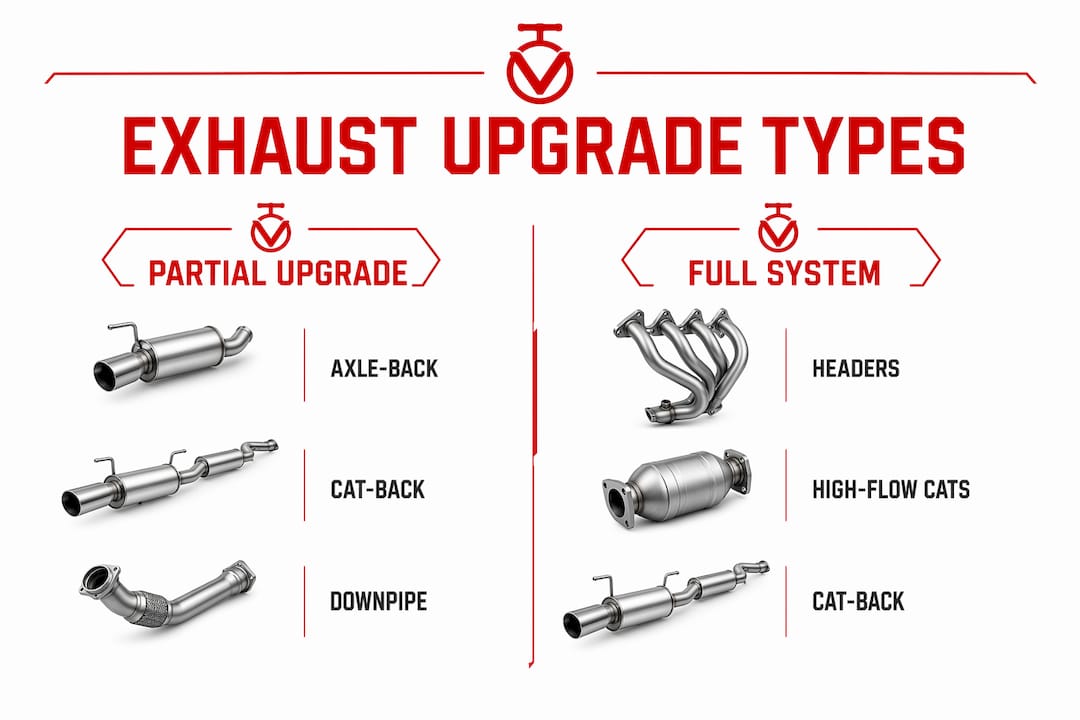
The main components, front to back:
- Headers/exhaust manifold: Primary tubes that collect exhaust from each cylinder. Tuned-length primaries time the pressure pulses for scavenging.
- Collectors: Where primary tubes merge; collector geometry directly affects pulse interaction.
- Downpipe: Critical on turbocharged cars — the first pipe after the turbo outlet. Factory downpipes are often narrow and restrictive.
- Catalytic converter(s): The biggest single restriction on many platforms. High-flow cats can replace stock units while maintaining emissions compliance.
- Mid-pipe/intermediate section: Connects the cat to the cat-back; diameter and bend quality matter here.
- Cat-back: Everything from the catalytic converter rearward, including the muffler and tailpipes.
- Axle-back: Only the section behind the rear axle — essentially a muffler swap.
| Upgrade Type | Sections Replaced | Typical HP Gain | Complexity |
|---|---|---|---|
| Axle-back | Muffler + tips only | 3–5 hp | Low |
| Cat-back | Mid-pipe + muffler + tips | 10–40 hp | Moderate |
| Full system | Headers through tailpipe | 30–50+ hp on V8 naturally aspirated engines | High |
| Turbo-back | Downpipe through tailpipe | 30–80+ hp on forced induction engines (with tune) | High |
A cat-back leaves the headers, downpipe, and cats untouched. Those upstream components are often the worst offenders for restriction. Full systems also frequently use lighter stainless or titanium construction, which reduces overall weight and improves heat management alongside the flow gains.
Why the physics favor whole-system tuning
Scavenging is the mechanism that separates a properly tuned full system from any partial swap. When one cylinder fires, the exhaust pulse traveling down the primary tube creates a high-pressure wave followed by a low-pressure region. That low-pressure window, timed correctly, pulls spent gases from the adjacent cylinder before the piston has to push them out. The result is better volumetric efficiency and more power — but only if the header primaries, collector, and mid-pipe geometry are coordinated to make it happen.
A cat-back cannot fix poorly timed primaries. It can reduce restriction downstream, but the scavenging benefit requires system-level exhaust optimization that starts at the cylinder head.
Backpressure vs. velocity — the tradeoff most people get wrong:
- Low backpressure is good, but low exhaust velocity is not
- Oversized piping on a small-displacement engine drops gas velocity, which collapses the scavenging effect and kills low-end torque
- The goal is the highest velocity with the least restriction — which means matching pipe diameter to engine displacement and target RPM band
On turbocharged platforms, the downpipe is the highest-leverage single component. Replacing a restrictive factory downpipe lowers turbine inlet backpressure, reduces turbine inlet temperature, and shortens spool time — you feel it as quicker mid-range response even before peak numbers change significantly.
Pro Tip: For engines under 3.0L, resist the urge to go with 3-inch piping throughout. A 2.5-inch mid-pipe often preserves better low-end velocity while still flowing well at high RPM. Match diameter to your engine’s actual displacement and power band, not to the largest pipe that fits.
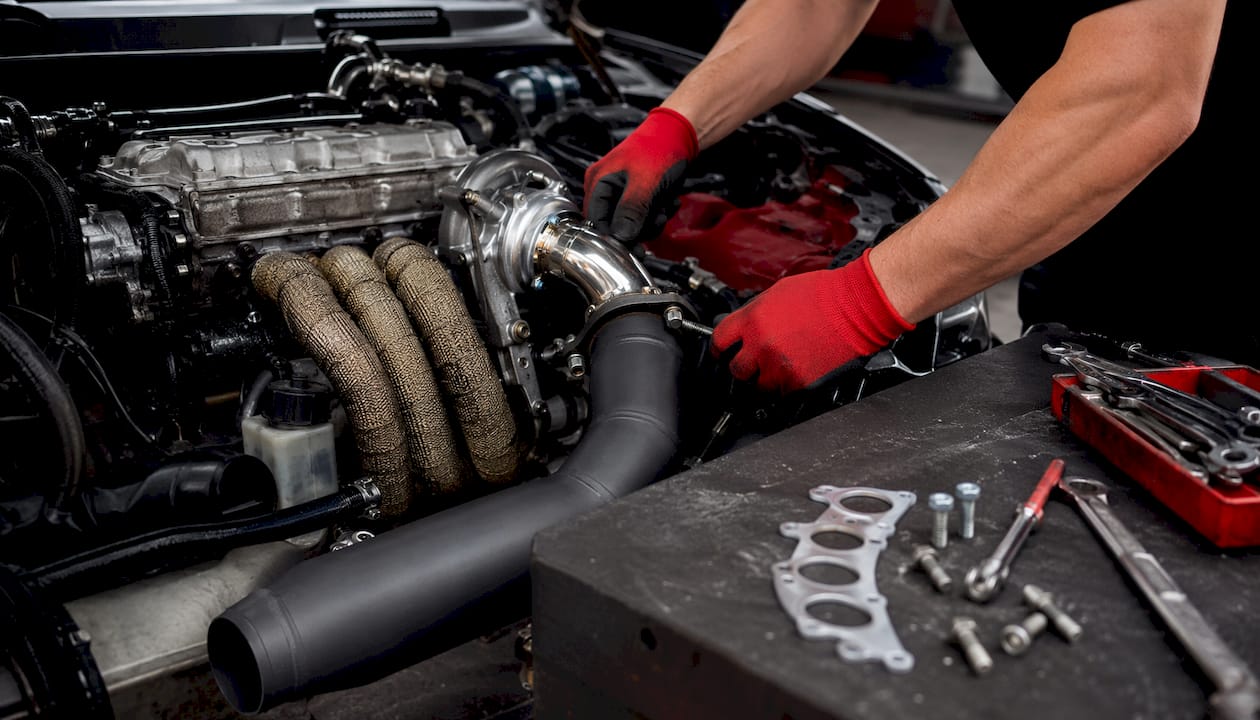
Full systems also produce the best dyno results because headers, high-flow cats, and cat-back amplify each other’s gains rather than working in isolation.
How electronically controlled valved exhausts change the equation
The conventional tradeoff with a full performance exhaust is noise: you gain flow, you gain sound, and your neighbors gain a reason to complain. Valved systems break that tradeoff. An electronically controlled valve in the exhaust path can open fully for maximum flow and aggressive sound on track, then close partially to restore backpressure, reduce volume, and bring the car back to street-civil behavior — all without touching a wrench.
For luxury sports car owners, this is the real argument for a valved full system. You get the system-level scavenging and downpipe gains of a full upgrade, plus the ability to dial the character of the car to match the moment.
How valve placement affects behavior:
- Valves positioned before the muffler affect both tone and backpressure across the RPM range
- Valves after the muffler primarily control volume and resonance character
- Controller programming determines how the valve responds to throttle position, load, and driver input
Valvecontrolexhaust’s systems for platforms like BMW M-series, Ferrari, and Lamborghini are engineered with remote electronic control, letting you switch modes from the cabin. The variable valve advantage over a fixed full system is real: you preserve exhaust civility for daily driving without compromising the flow path that makes the full system worth buying.
Pro Tip: Program valve opening maps to engine load and throttle position rather than RPM alone. An RPM-only threshold opens the valve at the same point regardless of whether you’re cruising or accelerating hard — load-based mapping gives you aggressive response when you want it and quiet cruising when you don’t.
When does a partial system actually make more sense?
A full system is not always the right call. Here are the situations where a partial upgrade is the smarter choice:
- Budget constraints: A quality cat-back runs several hundred dollars installed; a full system with tune can cost significantly more on European platforms.
- Sound-only goals: If you want a better exhaust note without chasing horsepower, a cat-back or axle-back gets you there with less complexity.
- Staged builds: Starting with a cat-back is a practical pathway when headers or downpipe access is difficult or expensive on your platform — reserve the upstream work for when the budget and a tune are both ready.
- Platforms with difficult header access: Some transverse-engine cars make header replacement a major labor job; the cost-benefit math shifts.
Common mistakes to avoid:
- Oversized piping on smaller engines (kills low-end torque, as covered above)
- Removing cats without a proper tune — triggers OBD-II code P0420 and fails emissions
- Skipping a dyno tune after a full-system install on a modern engine, which can cause lean conditions
Installation, ECU tuning, and U.S. emissions rules
A full system on any modern turbocharged engine needs an ECU retune. Factory calibrations assume the stock exhaust restrictions; remove them and the air-fuel ratios shift, knock risk increases, and check-engine lights follow. Running without a tune after a full-system install is one of the most common and expensive mistakes enthusiasts make.
Installation checklist:
- Select a shop with dyno capability and experience on your platform
- Run a dyno baseline before any parts go on — you need a real before number
- Confirm O2 sensor compatibility and wiring for any new mid-pipe or cat configuration
- Install high-flow catalytic converters if you’re replacing stock cats (required for street legality in most U.S. states)
- Schedule an ECU remap immediately after installation — understand how engine mapping works before you book the tune
- Validate with a post-install dyno pull; check AFR and knock data before pushing hard
U.S. legal and emissions notes:
- The EPA prohibits removing or defeating catalytic converters on street-driven vehicles under the Clean Air Act
- California’s CARB rules are stricter — any replacement cat must carry a CARB Executive Order (EO) number to be street-legal in California
- High-flow cats with CARB EO numbers are available for most popular platforms and represent the best compromise between flow and compliance
- De-catting for track-only use is a separate conversation, but the car cannot legally be driven on public roads in that configuration
What owners typically see: gains, costs, and timelines
Results vary significantly by engine type and whether forced induction is involved.
| Configuration | Typical Horsepower Gain | Parts Cost | Shop Time |
|---|---|---|---|
| Axle-back | 3–5 hp | few hundred dollars | 1–2 hours |
| Cat-back | 10–40 hp | several hundred to over a thousand dollars | 2–4 hours |
| Full system (NA V8) | 30–50+ hp | over a thousand dollars | 1–2 days |
| Turbo-back + tune | 30–80+ hp | several thousand dollars | 2–3 days |
Naturally aspirated V8s see the largest absolute gains from a full system. Turbocharged 4-cylinders and V6s often see smaller peak numbers but significant improvements in transient response and mid-range pull — the kind of difference you feel on every on-ramp, not just at redline.
Labor for a full-system install on a European sports car typically runs several hundred dollars at a qualified shop, separate from dyno and tune costs. Budget the full project, not just the parts.
Pro Tip: Always validate with a before-and-after dyno run on the same day under similar conditions. Use wheel horsepower (WHP) numbers consistently — crank figures from different measurement methods are not comparable. On AWD platforms, confirm whether the shop uses AWD or 2WD dyno mode and keep it consistent.
Ready for both track performance and daily civility?
For luxury sports car owners who want real system-level gains without turning their daily driver into a noise complaint, a valved full system is the practical answer. You get the scavenging and downpipe benefits of a complete upgrade, with programmable valve control that lets you choose when to use them.
Purchase checklist:
- Confirm vehicle compatibility for your specific model year and engine variant
- Choose high-flow CARB-compliant cats if you’re in California or a CARB-adopting state
- Schedule a dyno baseline before installation
- Specify valve programming preferences (load-based vs. RPM-based, remote vs. automatic modes)
- Plan the ECU tune as part of the project budget, not an afterthought
How to buy:
- Verify fitment on the Valvecontrolexhaust vehicle compatibility page
- Review controller options and valve placement for your platform
- Ask your installer about O2 sensor wiring requirements before the parts arrive
- Confirm whether your state requires CARB-compliant cats
- Book dyno time before and after installation
Key Takeaways
A full exhaust system outperforms a partial upgrade because only a complete system can coordinate scavenging, matched diameters, and downpipe flow for genuine system-wide gains — and a valved full system adds programmable civility on top.
| Point | Details |
|---|---|
| Full system gains | Headers-to-cat-back upgrades add 30–50+ hp on V8 platforms; turbo-back with tune can reach 30–80+ hp. |
| Partial system limits | Cat-back typically delivers moderate improvement; axle-back results in minor gains — upstream restrictions remain the bottleneck. |
| ECU tune is mandatory | Modern engines need a remap after a full-system install to avoid lean conditions and OBD-II fault codes. |
| U.S. emissions compliance | Street-legal cat replacements require EPA/CARB-compliant high-flow units; de-catting is not legal on public roads. |
| Valvecontrolexhaust | Offers electronically controlled valved full systems for BMW, Ferrari, Lamborghini, and Audi with remote programmable valve control. |
The case for measuring first, modifying second
The part of this conversation that gets glossed over most often is the dyno baseline. Enthusiasts spend thousands on parts and labor, then have no real number to compare against. You end up relying on seat-of-the-pants impressions, which are notoriously unreliable — especially on a car you drive every day and already know well.
The engineering argument for a full system is solid. The physics of scavenging, the downpipe gains on turbo platforms, the matched-diameter advantage — these are real and documented. But the magnitude of those gains on your specific car, with your specific tune, at your altitude and ambient conditions, is something only a dyno can tell you. A full valved system from a quality builder is a meaningful upgrade for a luxury sports car. The measurement is what turns that upgrade into a known quantity rather than a guess.
For owners who alternate between spirited canyon runs and quiet morning commutes, the valved approach also solves a problem that raw performance numbers never address: the car has to be livable. Programmable valve control is not a gimmick — it is the difference between a modification you use every day and one you regret at 7 AM in a residential neighborhood.
Valvecontrolexhaust: full-system performance with programmable control
If you’ve read this far, you already know a cat-back is not the ceiling. The real gains — and the real character shift — come from a complete system with matched geometry from the headers back. Valvecontrolexhaust builds exactly that for European and luxury performance platforms: custom valved full systems for Audi, BMW, Ferrari, Lamborghini, Mercedes-AMG, and Porsche, with remote electronic valve control that lets you switch between track-aggressive and street-quiet modes without touching a wrench.

Broad vehicle compatibility, programmable valve maps, and direct e-commerce checkout mean you can confirm fitment, spec your controller, and order in one session. Check the benefits of a valved system for your platform, then verify your vehicle on the fitment page and get the project started.
Useful sources and further reading
- AmericanMuscle — Maximum Horsepower Gains: Exhaust Systems — HP ranges for axle-back, cat-back, and full systems; staging strategy
- Your Motor Care — Exhaust Mods: Pros and Cons — Turbo platform gains, downpipe effects, tuning and CEL risks, pipe sizing guidance
- AutoExplain — The Benefits of a Performance Exhaust System — Flow physics, mandrel bends, and material comparisons
- Jinsheng Auto Parts — Slip-On vs. Full Exhaust: Technical Comparison — Engineering distinction between partial and full systems
- EGR Performance — Engineering Explained: Exhaust Systems — Scavenging mechanics, velocity vs. restriction, real-world dyno data
- EPA — Clean Air Act: Catalytic Converter Rules — Federal emissions compliance for exhaust modifications
- CARB — Executive Order Search for Aftermarket Parts — California-specific compliance verification for replacement catalytic converters
- Valvecontrolexhaust — Exhaust System Anatomy Explained — Component-level breakdown for buyers
- Valvecontrolexhaust — Electronically Controlled Exhaust: How It Works — Valve hardware and controller logic