

For most U.S. luxury and performance car owners, the strongest practical alternative to the iXsound-style active sound system is a valved aftermarket exhaust with remote or app control. A specialist like Valvecontrolexhaust delivers exactly that: mechanical valve hardware fitted to your actual exhaust piping, giving you real-time sound control without simulating anything through a speaker. Two solid runner-up categories exist for owners who can’t or won’t modify the exhaust itself:
- Speaker-based active sound modules (retrofit transducers or amplified speakers that generate exhaust-like sound inside or outside the cabin, best for EVs or lease vehicles)
- ECU/software or adjustable muffler/flap solutions (either OEM Active Sound Design software or a simple mechanical flap controller, lowest cost but least depth of control)
Before buying anything, check your city’s noise ordinances. SAE International acoustics standards give manufacturers a framework, but local municipal limits vary widely across U.S. states and cities. A system that’s quiet enough in rural Texas may trigger a citation in Los Angeles. Compatibility matters too: EVs almost always need a speaker-based solution, while turbocharged ICE cars can run either valved exhausts or flap controllers depending on budget.
Table of Contents
- What are the best iXsound.eu alternatives for U.S. owners?
- How does each alternative actually create or modify exhaust sound?
- Pros, cons, and best use cases for each approach
- What do these systems cost, and what does U.S. compliance look like?
- How do you choose the right alternative to iXsound for your car?
- Why Valvecontrolexhaust is a top-rated valved exhaust alternative
- Key Takeaways
- The case for valved exhausts over speaker modules
- Valvecontrolexhaust: real valve control for your performance car
- Sources and further reading for U.S. buyers
What are the best iXsound.eu alternatives for U.S. owners?
| Solution type | How sound is created | Authenticity | Best for | Install complexity | Typical cost range | Performance impact | Control options | Compliance risk |
|---|---|---|---|---|---|---|---|---|
| Valved physical exhaust (e.g., Valvecontrolexhaust, Armytrix, Akrapovič, IPE, Ryft) | Mechanical valve changes exhaust gas flow | High — real exhaust tone | ICE luxury/performance cars | Medium to high | — | Slight backpressure reduction possible | Remote, app, ECU | Low if dB-compliant |
| Speaker-based active module (retrofit) | Amplified speaker or transducer generates sound | Low to medium — simulated | EVs, lease cars, daily drivers | Low | — | None | App, button, volume knob | Medium — exterior speaker placement matters |
| Adjustable muffler / flap controller | Mechanical flap opens or closes muffler bypass | Medium — real exhaust, limited range | Budget ICE builds, daily drivers | Low to medium | — | Minimal | Remote, manual | Low to medium |
| ECU / OEM software ASD | Software synthesizes or routes sound via factory speakers | Low to medium — depends on implementation | New OEM vehicles, EVs with factory ASD | Low (OEM) to high (aftermarket ECU tune) | factory ASD costs nothing to activate —+ (tune) | None | OEM controls, ECU map | Low (OEM); medium (tune) |
Statistic callout: Aftermarket exhaust sound testing shows that consistent dB readings depend heavily on measurement point and valve position — a valved system can swing 10–15 dB between open and closed modes, giving drivers meaningful real-world range without a single fixed noise level.
The pricing brackets above reflect hardware plus typical fitment labor. Custom piping for European platforms (Audi, BMW, Ferrari, Lamborghini) often pushes valved-exhaust projects toward the upper end. Speaker modules stay cheap because installation is mostly wiring. ECU-based tunes vary most: factory ASD costs nothing to activate, but a custom aftermarket ECU map for sound routing can run as much as a mid-tier valved system.

How does each alternative actually create or modify exhaust sound?
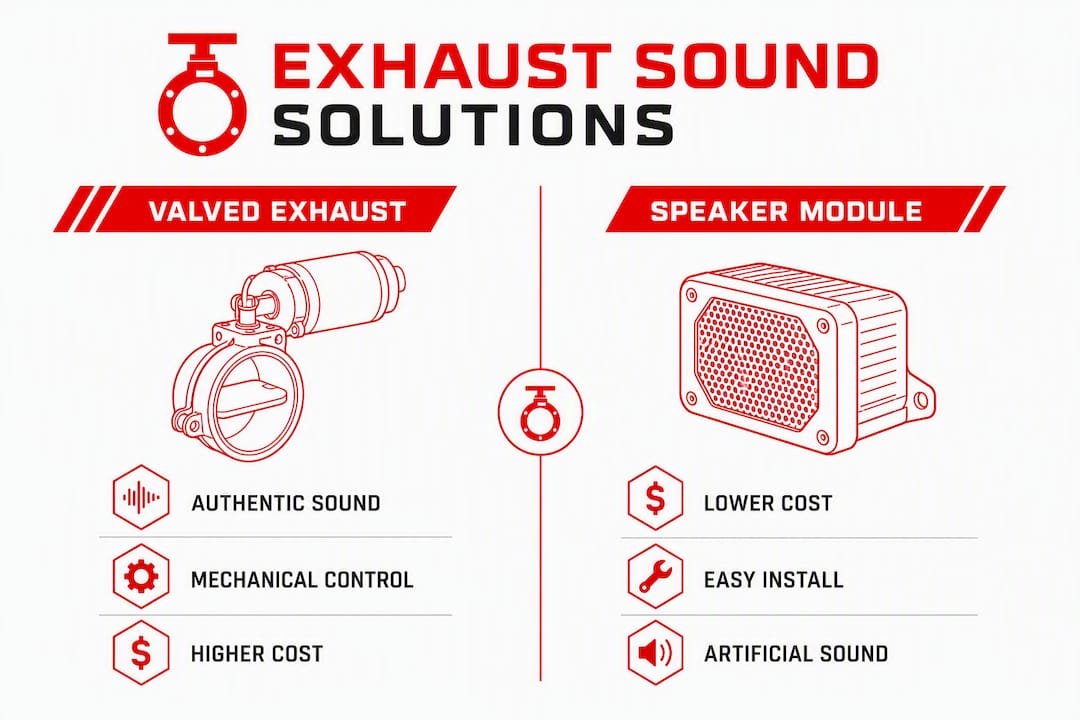
Speaker-based retrofit modules
A retrofit speaker module mounts a transducer or small amplified speaker to the body or exhaust pipe and plays back recorded or synthesized engine sounds. The signal is triggered by RPM data pulled from the OBD-II port. Sound quality depends entirely on the recording and the speaker placement. Exterior placement raises compliance questions; interior placement keeps the effect inside the cabin only. For EVs, this is often the only practical option short of a full acoustic redesign.
Valved physical exhausts
A mechanical valve sits inside the exhaust piping and opens or closes based on a signal from a remote, an app, or the ECU. When the valve opens, exhaust gas flows through a less restricted path, producing a louder, more aggressive tone. Close it, and the gas routes through the muffler’s standard baffles. The result is the actual combustion sound of your engine, shaped by the pipe geometry, not a recording. Valve control technology works this way: the system manipulates real exhaust flow rather than simulating it, which is why the sound character stays consistent with the engine’s actual acoustic signature. Brands like Armytrix, Akrapovič, IPE, Valvetronic, and Ryft all use variations of this approach.
Adjustable mufflers and flap controllers
A flap controller is the mechanical cousin of a full valved exhaust. A simple butterfly valve or flap is added to an existing muffler or mid-pipe, and a remote actuator opens or closes it. Installation is faster and cheaper than a full system swap. The tradeoff is range: you get two modes (open/closed) rather than the graduated control a full valve system offers. For a daily driver on a budget, it works. For a Ferrari or Lamborghini owner who wants precise sound shaping, it falls short.
ECU and OEM Active Sound Design
Müller-BBM Active Sound Technology describes OEM Active Sound Design as primarily software-based, running in many vehicles to reduce unwanted noise and create designed vehicle sounds. Manufacturers use it because it adds no weight and requires no exhaust hardware. The acoustic result routes through the car’s existing speaker system. Aftermarket ECU tunes can replicate or extend this, but the sound still comes from a speaker, not the exhaust. For owners who want the effect without touching the exhaust system, it’s a clean solution. For anyone who has heard a real valved exhaust at full throttle, the difference is obvious.
Pro Tip: Match your solution type to your engine architecture before you buy. Turbocharged engines muffle a lot of the raw exhaust character, so a valved system on a turbo car sounds different than on a naturally aspirated V8 or V10. EVs produce no combustion sound at all, so only speaker-based or OEM ASD solutions apply. Check active exhaust system examples by vehicle type before committing.
Pros, cons, and best use cases for each approach
Speaker modules vs. valved exhausts vs. flap controllers
Speaker modules win on cost and reversibility. Plug them in, set the volume, and you’re done. No exhaust work, no warranty risk, no custom piping. The authenticity ceiling is low, though. A speaker playing back a V8 recording through a BMW M3 sounds like exactly that: a recording. Lease vehicles and EVs are the natural home for this approach.
Valved physical exhausts are the opposite in almost every way. The sound is real because the hardware is real. You get graduated control, a genuine performance character, and the ability to run quiet for the commute and loud for the weekend. The cost is higher, installation takes a professional shop, and you need to confirm fitment for your specific model. For ICE performance and luxury cars, this is the category most owners end up preferring once they hear the difference.
Adjustable mufflers and flap controllers sit in the middle. Real exhaust sound, real hardware, but limited range and fewer control options. Good for budget builds or owners who want a modest upgrade without a full system swap.
ECU/software ASD is best left to OEM implementations or very specific use cases where no hardware modification is possible. Aftermarket ECU tunes for sound carry their own warranty and emissions risks.
| Approach | Daily driver | Track car | EV | Luxury grand tourer |
|---|---|---|---|---|
| Speaker module | Good | Poor | Best fit | Acceptable |
| Valved exhaust | Good (quiet mode) | Excellent | Not applicable | Excellent |
| Flap controller | Good | Acceptable | Not applicable | Acceptable |
| ECU/software ASD | Acceptable | Poor | Good (OEM) | Acceptable |
What do these systems cost, and what does U.S. compliance look like?
Cost and installation at a glance
| Approach | Low end | Mid range | High end | Main cost driver |
|---|---|---|---|---|
| Speaker module | — | $500 | — | Speaker quality, OBD integration |
| Valved exhaust | — | $3,000 | — | Custom piping, valve actuators, labor |
| Flap controller | — | — | — | Muffler compatibility, actuator quality |
| ECU/software tune | factory ASD costs nothing to activate | — | —+ | Tune complexity, ECU access |
The engine response exhaust checklist from Valvecontrolexhaust outlines the typical labor steps for a valve system fitment: actuator wiring, valve positioning, post-install verification, and ECU mapping where required. Expect a professional shop to spend a full day on a valved system for a European platform.
Typical installation timeline
- Speaker module: 2–4 hours (OBD tap, speaker mount, wiring)
- Flap controller: 4–6 hours (muffler removal, flap fitment, actuator wiring, test)
- Valved exhaust system: 6–12 hours (full system removal, custom piping if needed, valve wiring, ECU check)
- ECU/software tune: 2–8 hours depending on dyno time and map complexity
U.S. legal and compliance checklist
Noise laws in the U.S. are local, not federal. The EPA and DOT regulate emissions and safety equipment, not sound levels directly. Municipal ordinances set the actual dB limits, and they vary from city to city. The supercar exhaust decibel management guide covers practical measurement and tuning steps for high-end vehicles. Before installing any system:
- Confirm your city or county’s noise ordinance dB limit (many U.S. cities cap at 95 dB at a set distance)
- Ask your installer whether the system has a quiet/closed-valve mode that keeps you under the local limit
- Check whether the modification affects your vehicle’s emissions equipment (catalytic converters, O2 sensors)
- Verify the system is returnable to stock if you need to pass an inspection or maintain dealer warranty
How do you choose the right alternative to iXsound for your car?
Start with three questions: What vehicle do you drive? What’s your primary goal? What’s your budget ceiling?
Vehicle architecture narrows the field immediately. EVs go speaker-based or OEM ASD. ICE performance cars can run any category, but valved exhausts deliver the most authentic result. Turbocharged platforms need a system tuned for their specific exhaust note, since turbo muffling changes the acoustic character significantly.
The performance exhaust buyer’s guide highlights return-to-stock capability as a key criterion for warranty-sensitive vehicles. Audi, BMW, and Porsche dealers in particular scrutinize aftermarket exhaust modifications during warranty claims.
Red flags to watch for:
- No fitment documentation for your specific model year
- Seller can’t provide dB specs in both valve-open and valve-closed positions
- No warranty on the hardware itself
- Hardwired installation with no return-to-stock path
- Claims of “universal fit” for a valved system on a European platform
Statistic callout: According to Valvecontrolexhaust’s buyer guidance, systems that include a return-to-stock option protect owners during dealer service visits and reduce the risk of warranty disputes on luxury platforms.
Why Valvecontrolexhaust is a top-rated valved exhaust alternative
Valvecontrolexhaust builds and sells valved exhaust systems, downpipes, mufflers, controllers, and performance parts specifically for European and luxury performance vehicles. The compatibility list covers Audi, BMW, Porsche, Ferrari, Lamborghini, and Mercedes-AMG, among others. That specificity matters: a valved system designed for a BMW M4 fits differently than a generic aftermarket unit, and the acoustic result reflects that precision.
The control interface is remote or app-based, letting drivers switch between quiet and aggressive modes without touching the ECU. For daily drivers who need to stay under neighborhood noise limits in the morning and want full sound on a weekend run, that flexibility is the whole point. Exhaust customization for luxury cars explains why owners of high-end platforms consistently prefer hardware-based valve control over software simulation.
Check fitment for your specific model and request a quote directly through Valvecontrolexhaust’s product pages.
Key Takeaways
Valved physical exhausts deliver the most authentic sound enhancement for ICE performance cars, and Valvecontrolexhaust offers a fitment-specific option for European luxury platforms with remote and app control.
| Point | Details |
|---|---|
| Valved exhaust wins on authenticity | Mechanical valve control produces real exhaust sound, not a simulation, for ICE cars. |
| Speaker modules suit EVs and leases | Retrofit speaker systems are the practical choice when exhaust modification isn’t possible. |
| U.S. compliance is local, not federal | Check your city’s noise ordinance dB limit before installing any system. |
| Return-to-stock capability matters | Warranty-sensitive owners on Audi, BMW, or Porsche platforms should confirm this before purchase. |
| Valvecontrolexhaust for European platforms | Fitment-specific valved systems for Audi, BMW, Ferrari, Lamborghini, and more with remote/app control. |
The case for valved exhausts over speaker modules
The speaker module category has improved, but it hasn’t closed the gap that matters most: the sound still doesn’t change when you push the car. A valved exhaust responds to throttle, load, and RPM the way the engine does, because it’s part of the same system. That coherence is what enthusiasts actually notice, especially in a car with a strong acoustic character to begin with.
Speaker modules make sense in two situations: you’re driving an EV and have no exhaust to modify, or you’re on a lease and can’t make permanent changes. Outside those two cases, the authenticity argument for a valved system is hard to counter, especially on a V8, V10, or flat-six platform where the engine note is part of why you bought the car.
Budget is the honest counterargument. A speaker module at $500 installed is a fraction of a valved system at $3,000. If the budget ceiling is firm, a flap controller is a better middle ground than a speaker module for ICE cars: real sound, real hardware, lower cost than a full valved system.
Valvecontrolexhaust: real valve control for your performance car
If you’ve read this far and your car is an ICE-powered Audi, BMW, Ferrari, Lamborghini, Porsche, or Mercedes-AMG, the practical next step is a fitment-specific valved exhaust, not a speaker module. Valvecontrolexhaust sells exactly that: hardware-based valve systems with remote and app control, built for European luxury and performance platforms.

The product range covers valved exhausts, downpipes, mufflers, rear diffusers, tips, and controllers. Every system is designed for a specific vehicle architecture, not a generic fit. Owners who want authentic sound control without touching the ECU or risking factory warranty compliance will find the customizable exhaust options at Valvecontrolexhaust worth a close look. Check your model’s fitment and request a quote at valvecontrolexhaust.com.
Sources and further reading for U.S. buyers
- Müller-BBM Active Sound Technology — OEM Active Sound Design methodology and software-based sound engineering for manufacturers
- iXsound PRO on Google Play — iXsound’s own app description, useful for understanding what the system does and where aftermarket alternatives diverge
- Aftermarket Exhaust Sound Testing: A Complete Guide — measurement methodology and dB comparison best practices
- Supercar Exhaust Decibel Management: 2026 Guide — practical dB targets and tuning steps for luxury and performance cars
- Performance Exhaust Buyer’s Guide: IPE, FI, Armytrix, Akrapovic, Valvetronic & Ryft — fitment checklists and warranty considerations for premium systems
- Examples of Active Exhaust Systems: 2026 Guide — vehicle-archetype recommendations for EV vs ICE applications
- Engine Response Exhaust Checklist for High-Performance Cars — installation steps and post-install verification for valve systems
- Comparing High-End Aftermarket Systems — control options, backpressure, and performance tradeoffs across premium categories
Recommended
- Top 4 xforceusa.com Alternatives 2026
- Evaluating High-Performance Exhausts: IPE, FI, Armytrix, Akrapovic, Valvetronic, and Ryft Compared – Valve Control Exhaust
- Performance and Sound Audit: Evaluating IPE, FI, Armytrix, Akrapovic, Valvetronic & Ryft Exhausts – Valve Control Exhaust
- Decisive Sound and Performance Audit: IPE, FI, Armytrix, Akrapovic, Valvetronic & Ryft Evaluated – Valve Control Exhaust