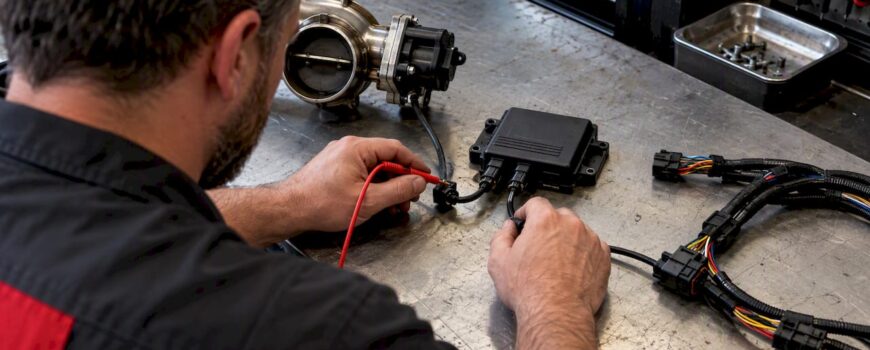
CANbus exhaust control lets you open and close exhaust valves electronically, changing drone, tone, and backpressure on demand instead of living with one fixed exhaust note. The real payoff is a system that talks to your car’s network cleanly, so you get sound and performance tuning without triggering fault codes. Start by confirming your vehicle’s actuator type and CAN protocol, then choose a programmable controller or a vehicle-specific installer built for that fit.
TL;DR:
- Using a plug-and-play kit limits tuning options but allows for quick installation on compatible vehicles.
- Programmable controllers provide full customization, especially suited for owners wanting to switch sound modes dynamically.
- OEM-style modules maintain factory diagnostics and are best for passing inspections or preserving warranty conditions.
- Confirm actuator type, CAN protocol, and wiring details before installation to avoid triggering fault codes or damaging the system.
- Always verify vendor support for CAN message documentation and vehicle fitment to ensure proper integration and functionality.
Table of Contents
- Types of canbus valve controllers and which fits your car
- How a canbus exhaust controller actually talks to your car
- What to check before you install a valve control system
- How to choose a canbus exhaust controller that actually fits
- Why Valve Control Exhaust fits this checklist
- What installers see go wrong on real cars
- Where to find the right parts and get a fitment check
- Sources
- FAQ
Types of canbus valve controllers and which fits your car
Three approaches dominate the market, and picking the wrong one costs you time and money later.
Plug-and-play sensor and controller kits are the easiest entry point. They connect to existing valve actuators with minimal wiring and often ship with preset modes, but customization stops where the factory software does.
Programmable aftermarket controllers give you the most control. You set valve behavior by RPM, throttle position, or driving mode, and many pair with a phone app or physical remote so you can flip between quiet and aggressive on the fly.
OEM-style integrated modules sit closest to factory engineering. They preserve diagnostic behavior and mimic how the manufacturer intended the valves to respond, which matters if you want the car to pass inspection or keep warranty-adjacent diagnostics intact.
- Plug-and-play kits: fast install, limited tuning depth.
- Programmable controllers: full customization, more wiring and setup time.
- OEM-style modules: factory-like reliability, narrower vehicle compatibility.
Sound tuning itself, including how valve position shapes tone and drone at different RPM, is covered in more detail in how exhaust valves shape your drive.
How a canbus exhaust controller actually talks to your car
A canbus exhaust controller sits between the valve actuator and your vehicle’s CAN network, reading messages and sending commands that move the valve open or closed. The signal path runs from the controller to the actuator, then back through CAN messages that the ECU can read, which is why a mismatched message ID or wiring error shows up as a dashboard warning instead of just a quiet exhaust.
Before buying, confirm the physical and electrical interfaces: CAN High and CAN Low lines, a clean power feed, a solid ground, and a dedicated actuator control line. Get any of these wrong and the controller either fails to respond or sends conflicting signals that confuse the ECU. The role of an exhaust controller module covers this signal chain in more depth if you want the full breakdown.

Many controllers also pull from sensor inputs like exhaust gas temperature and pressure to adjust valve behavior safely. Plug-and-play EGT hardware, like the Holley 8-channel CANbus EGT kit, shows how manufacturers package temperature sensing alongside CAN output for exactly this kind of integration. A similar approach appears in the AEM 8-channel EGT CAN module, which pairs thermocouple inputs with CAN messaging for engine monitoring.
Integration quality matters beyond convenience. An SAE technical article on particulate filter diagnostics found that active exhaust valves can change downstream backpressure enough to interfere with pressure-based diagnostics on vehicles with gasoline particulate filters. A poorly mapped controller can mask a real filter fault instead of flagging it.
What to check before you install a valve control system
Compatibility checks save you from a wiring job you have to undo. Start with the actuator itself: confirm whether your vehicle uses a motor-driven flap, a vacuum-actuated valve, or a solenoid, since each needs different control logic and power.
- Match the actuator type and voltage to the controller’s rated output.
- Confirm whether a vehicle-specific harness exists or whether you need a generic splice kit.
- Check OBD and CAN access points, and verify the controller does not block normal diagnostic traffic.
- Review how valve position affects backpressure and whether that shifts any sensor readings tied to emissions monitoring.
- Ask whether the installer or manufacturer documents the CAN messages used, not just the physical wiring.
Pro Tip: Capture your vehicle’s CAN traffic in the mode you plan to use before wiring anything in, so you know which message IDs control the valve before you touch a single wire.
Backpressure changes from active valves are not cosmetic. As the SAE research above notes, control strategy needs to account for valve position when particulate filters sit downstream, or you risk missing a real fault. Setting up OBD integration walks through the practical wiring side of this for several common platforms.
There is a legal dimension too. A NHTSA interpretation on vehicle alterations explains that modifying a certified vehicle in ways that affect its configuration can create recertification obligations, and commercial installers may be treated as manufacturers in some circumstances. Never knowingly disable emissions equipment, and keep documentation of what was changed.
For most owners, a plug-and-play kit on a well-documented platform is a weekend project. Anything involving a custom harness, splicing into OEM CAN lines, or a vehicle without existing aftermarket support is better handled by a professional who can verify fitment first.
How to choose a canbus exhaust controller that actually fits
A good decision comes down to six checks before you spend anything.
- Fitment: confirm the controller is listed for your exact make, model, and year.
- Protocol support: verify it speaks your vehicle’s CAN variant without needing a workaround.
- Programmability: decide if you want app-based mapping, remote control, or both.
- Interface: check whether the control method (app, button, remote) matches how you actually drive.
- Support: ask if the vendor provides CAN message documentation and install support.
- Warranty: confirm coverage length and what voids it.
When you talk to a vendor, ask direct questions: which CAN messages does the controller send and receive, how does it interact with the ECU during a fault condition, and what installation support comes with the purchase. A vendor who cannot answer the first two questions clearly is a red flag, regardless of price.
Pricing and service tiers vary widely by vehicle and feature set, so treat a quote without documentation as incomplete. How to choose the right valve control exhaust walks through this checklist against specific product lines.
Why Valve Control Exhaust fits this checklist
Valve Control Exhaust sells customizable valved exhaust systems, downpipes, mufflers, rear diffusers, tips, and controllers built for remote electronic valve control, with compatibility across brands like Audi, BMW, Porsche, Ferrari, Lamborghini, and Mercedes-AMG. The company only sells genuine products sourced direct from authorized manufacturers, and the real-time control technology lets you adjust sound and performance by driving condition rather than locking in one setting.
- Extensive compatibility across luxury and performance vehicle brands.
- Direct sourcing from authorized manufacturers, not gray-market parts.
- Real-time valve control built into the product line rather than bolted on.
| What you need | How Valve Control Exhaust addresses it |
|---|---|
| Vehicle-specific fitment | Compatibility across Audi, BMW, Porsche, Ferrari, Lamborghini, Mercedes-AMG |
| Genuine parts sourcing | Direct purchase from authorized manufacturers |
| Sound and performance tuning | Remote electronic valve control built into product lines |
For owners who want a system matched to their exact platform rather than a generic splice kit, that vehicle-specific approach is the practical starting point.
What installers see go wrong on real cars
Most problems trace back to two things: CAN message conflicts from untested wiring, and actuators swapped for the wrong type. Bench-test CAN messages before final install, use a prebuilt harness when one exists, and bring in a professional once the job involves splicing into factory CAN lines.
— Info
Where to find the right parts and get a fitment check
If you are ready to move past research, the fastest path is checking what fits your car. Browse Exhaust Parts for valved systems and components, Down Pipe options for a full performance upgrade, or Accessories if you need actuators, harnesses, or remotes without a complete system swap.

Every listing is matched to specific makes and models, so you are not guessing at compatibility before you buy. Start by checking fitment for your vehicle at Valve Control Exhaust and get a parts list built around your exact platform.
Sources
- A unique application of gasoline particulate filter pressure sensing diagnostics (SAE)
- NHTSA interpretation on vehicle alterations and FMVSS compliance
- Holley EFI 8 Channel CANbus Exhaust Gas Temperature (EGT) Kit, Plug & Play – (EFI-554-186)
FAQ
What does a canbus exhaust control system actually do?
It lets you open and close exhaust valves electronically through your vehicle’s CAN network, changing exhaust tone and backpressure on command. Most systems pair a controller with existing actuators and let you switch modes by RPM, throttle input, or a remote.
Will a canbus exhaust controller trip check engine lights?
A poorly integrated controller can interfere with pressure-based diagnostics, particularly on vehicles with gasoline particulate filters, according to SAE research on active exhaust valves. Choosing a vehicle-specific controller with documented CAN mapping avoids this in most cases.
Is it legal to modify my exhaust with a valve control system?
Altering a certified vehicle’s configuration can create recertification obligations under NHTSA rules, and emissions equipment should never be knowingly disabled. Check your local regulations and keep documentation of any changes made.
How long does installation and calibration take?
A plug-and-play kit on a well-supported vehicle can be a weekend project, while a custom harness or CAN line splice often needs a professional. Calibration, meaning setting valve thresholds by RPM or mode, usually happens after wiring is confirmed stable.
Does the company offer vehicle-specific installation support?
The company sells valved exhaust systems and controllers built for compatibility across multiple luxury and performance brands, sourced from authorized manufacturers. Check the Exhaust Parts catalog for options matched to your specific model.