No, your engine doesn’t need backpressure. Backpressure is resistance in the exhaust path, and resistance always costs power by increasing pumping losses. What mechanics and old-timers call “a little backpressure” helping performance is almost always exhaust velocity or scavenging doing the work, two entirely different mechanisms that just happen to get lumped in with the wrong word. The sections below break down the physics, the history of the confusion, and what to actually change on your car.
TL;DR:
- Backpressure is the pressure drop across the exhaust system, always costing horsepower by increasing pumping losses, not something the engine benefits from.
- Improving low-end torque through narrow pipes is due to increased exhaust velocity and scavenging effects, not backpressure, which harms high-RPM performance.
- Proper exhaust tuning relies on pressure wave timing and header sizing, not restricting flow to create beneficial backpressure.
- Turbocharged engines have separate drive pressure and backpressure, with excessive backpressure behind the turbine reducing boost and increasing fuel consumption.
- Accurate diagnostics using pressure gauges and exhaust temperature checks are essential before modifying exhaust components or size to avoid performance degradation.
Table of Contents
- What Backpressure Really Is (And Why Scavenging Isn’t the Same Thing)
- Where the “Some Backpressure Is Good” Idea Came From
- The Mechanics That Actually Determine Power
- Why Turbocharged Engines Complicate the Conversation
- How to Diagnose and Reduce Harmful Backpressure
- What the Dyno Curves and Technical Sources Actually Show
- When Valved Exhausts Actually Help (and What They’re Really Doing)
- A Mechanic’s Checklist for Cutting Through the Noise
- Sources
- FAQ
- The Trade-Off Nobody Explains Correctly
What Backpressure Really Is (And Why Scavenging Isn’t the Same Thing)
Backpressure is the pressure drop measured across the exhaust system, from the exhaust port to the tailpipe. Every muffler, catalytic converter, bend, and foot of pipe adds resistance the engine has to push against on the exhaust stroke, and technical literature defines backpressure specifically as that pressure drop rather than anything the engine benefits from. Higher backpressure means the piston works harder shoving spent gases out, full stop.
Scavenging is a completely different phenomenon. When an exhaust valve opens, a pulse of high pressure gas rushes down the pipe. That pulse creates a low pressure region behind it, timed correctly, that low pressure region can actually help pull the next cylinder’s exhaust gases out and even assist intake charge filling during valve overlap. This is wave dynamics, not resistance. Reflected pressure waves traveling up and down a properly sized runner or header pipe are what tuners are actually chasing when they talk about “tuned length” exhaust systems, a concept rooted in basic pressure wave propagation physics.
Here’s where the confusion starts. A narrower exhaust pipe increases gas velocity at low RPM, which can genuinely improve scavenging and make an engine feel stronger off idle. But that same narrow pipe becomes a bottleneck at high RPM, where the engine is trying to move far more volume per second. The pipe did not get better, it just happened to help in one narrow window while quietly increasing pressure drop everywhere else.
A few things worth separating clearly:
- Backpressure: resistance to flow, always a power cost.
- Exhaust velocity: gas speed through the pipe, which affects scavenging quality.
- Scavenging: the actual removal of spent gas using pulse timing, not pressure.
- Pressure wave tuning: deliberately sizing header runners so reflected waves arrive at useful moments in the cycle.
None of these four things are interchangeable, even though shop talk treats them like synonyms.
Where the “Some Backpressure Is Good” Idea Came From
The myth has a traceable history, and it’s not entirely mechanics making things up.
- Glass-pack mufflers and shop lore. Decades of shops replaced stock exhaust with cheap, small-diameter glass packs and noticed seat-of-the-pants low-RPM punch. The explanation that stuck was “it needs backpressure,” when the real driver was increased velocity at low engine speed.
- Misread dyno tests. Older tests comparing pipe diameters sometimes showed smaller pipes producing more low-end torque. That result got attributed to backpressure instead of the scavenging and velocity effects actually responsible, a misattribution Road & Track has specifically called out.
- Forum shorthand. Complex, RPM-dependent fluid dynamics don’t compress well into a forum post. “You need some backpressure” became the simplified rule of thumb, even though it flattens a nuanced trade-off into a false absolute.
Once repeated enough times across enough forums and shop counters, the shorthand hardened into accepted wisdom. It never had experimental backing that actually isolated backpressure as the beneficial variable.
The Mechanics That Actually Determine Power
Four mechanisms explain nearly everything that matters here, and none of them is “engines like resistance.”
Pumping losses. The piston spends energy pushing exhaust gas out against whatever resistance sits downstream. More backpressure means more of the piston’s work goes into overcoming that resistance instead of turning the crankshaft. Added exhaust resistance wastes horsepower by increasing these pumping losses, and it can lower volumetric efficiency at the same time, meaning less fresh air and fuel makes it into the cylinder on the next intake stroke.
Residual gas retention. High backpressure leaves more spent exhaust gas trapped in the cylinder after the exhaust stroke. That residual gas dilutes the incoming air-fuel charge and raises combustion temperatures, neither of which helps power or engine longevity.
Pulse timing. Properly designed header runners use the pressure wave from one cylinder’s exhaust pulse to help scavenge the next. This only works within a specific RPM range because wave travel time is fixed by runner length and gas temperature, while the engine’s firing rate constantly changes. That’s the actual science behind exhaust pulse tuning, and it has nothing to do with restricting flow.
Sizing and geometry. Pipe diameter, bend radius, and even interior surface finish all change how efficiently gas moves through the system.
- Mandrel bends preserve cross-sectional area through a turn; crush bends choke it.
- Undersized piping raises velocity but also raises backpressure at high RPM.
- Oversized piping can drop velocity enough to hurt scavenging at low RPM.
- Rough interior surfaces add friction losses that compound with distance.
Pro Tip: If you’re chasing a specific RPM range for a power gain, look at header runner length before you look at pipe diameter. Diameter affects the whole rev range; runner length is what actually times the scavenging pulse.
Why Turbocharged Engines Complicate the Conversation
Turbo engines split “backpressure” into two distinct pressures that behave differently, and conflating them is where a lot of turbo tuning advice goes wrong.
Drive pressure is the pressure at the turbine inlet, upstream of the turbine wheel. This is what spins the turbine and builds boost. Backpressure, in the turbo context, refers to pressure downstream of the turbine, in the rest of the exhaust system after the turbine has already extracted its energy. High drive pressure relative to boost pressure (a high drive ratio) actually hurts the engine by increasing exhaust manifold pressure relative to intake, which raises pumping losses on the exhaust stroke and can hurt spool response rather than help it.
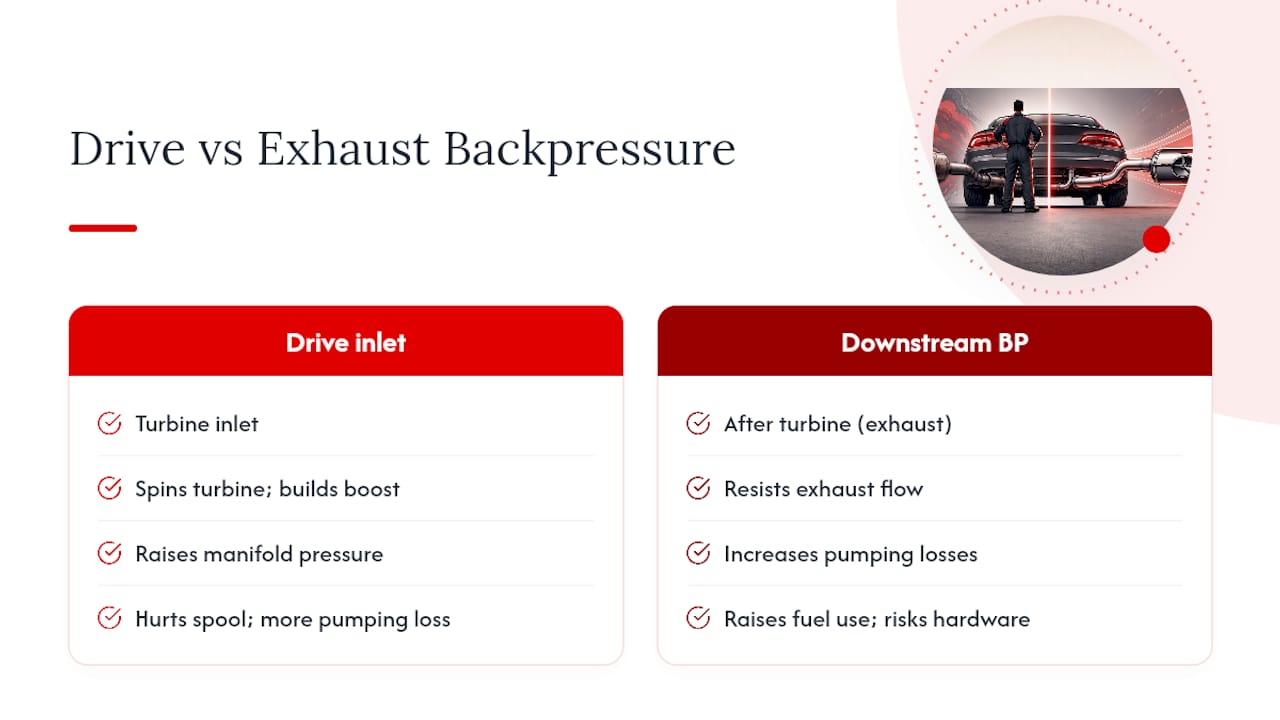
A DPF or catalytic converter placed after the turbine adds real backpressure that the turbine has already done its work past, but the engine still has to push against it. DPF pressure drop stays small when the filter is clean but climbs substantially as soot accumulates, and manufacturers set maximum allowable backpressure limits specifically because excessive backpressure raises fuel consumption and emissions while risking turbocharger and valve seat damage. Those limits exist to protect hardware, not because engineers think some backpressure improves performance. Understanding how exhaust behavior affects turbo spool matters more here than chasing a vague backpressure number.
How to Diagnose and Reduce Harmful Backpressure
Start with measurement, not parts shopping. Guessing which component is restrictive wastes money and sometimes makes things worse.
- Measure pressure drop directly. A backpressure gauge threaded into the exhaust manifold or a bung ahead of the catalytic converter gives you a real number. Compare it at idle and at wide-open throttle across the RPM range, since restriction that’s invisible at idle can be severe at high RPM.
- Check exhaust gas temperatures. Abnormally high EGTs alongside high backpressure readings often point to a clogged catalytic converter, collapsed internal muffler baffle, or a failing DPF.
- Decide between pipe changes and a retune. If pressure drop is high and consistent across the RPM band, larger diameter piping or a less restrictive muffler is the fix. If the engine loses drivability after you remove restriction (hesitation, flat spots, poor idle), the problem is usually a tuning mismatch, not a lack of backpressure, since shop-level testing consistently shows drivability issues after removing restrictive parts trace back to velocity and fueling mismatches rather than any missing resistance.
- Treat catalytic converters and DPFs carefully. Modifying or removing them isn’t just a performance question, it’s a legal and warranty one in most markets, and DPF soot loading specifically needs proper regeneration cycles rather than physical removal.
- Watch for red flags. Overheating exhaust valves, a flat top end that wasn’t there before, or a check engine light tied to catalyst efficiency codes all point back to excessive backpressure somewhere in the system.
Pro Tip: Mandrel-bent piping sized to your engine’s actual displacement and RPM ceiling will almost always outperform “going bigger everywhere.” Oversizing past what your engine can use drops velocity and can hurt low-end response, which is the same mistake as staying too restrictive, just in the other direction. Reducing restrictive components correctly is a big part of why aftermarket exhaust systems improve throttle response when sizing is done right.
What the Dyno Curves and Technical Sources Actually Show
Modern testing lines up consistently against the myth, once you separate velocity effects from backpressure itself.
- EngineLabs’ own dyno-based analysis concludes that added exhaust resistance costs horsepower through increased pumping losses, not through any beneficial effect.
- Road & Track’s technical explainer makes the same point for a general enthusiast audience: gains attributed to “a little backpressure” in older tests came from velocity and scavenging effects of smaller pipes at low RPM, not the resistance itself.
- DieselNet’s technical reference recommends engineers use the terms “pressure drop” or “pressure loss” for specific components rather than the vaguer “backpressure,” precisely because the vague term invites this kind of confusion.
When you read a dyno chart, look at the area under the curve across the full RPM range, not a single torque spike at one point. A pipe that shows a bump at 3,000 RPM but chokes flow above 5,500 RPM isn’t a win, it’s a trade-off that only looks good if you stop reading the chart early.
When Valved Exhausts Actually Help (and What They’re Really Doing)
Adjustable valve systems don’t work by adding beneficial backpressure. They work by changing the exhaust’s effective geometry on the fly, routing gas through a more restrictive or less restrictive path depending on what the RPM and driving mode call for.
- At low RPM or in quiet mode, a partially closed valve path can route gas through a smaller effective diameter, raising velocity and preserving the scavenging benefit that a narrow pipe provides in that range.
- At high RPM or in performance mode, the valve opens a larger flow path, cutting the pressure drop that would otherwise choke output.
- This is managing pulse timing and flow trade-offs dynamically rather than accepting one fixed compromise across the whole rev range, which is the real advantage over a fixed-diameter system.
- Hardware changes like this often need an ECU tune or remap to follow, since fueling and ignition maps calibrated for stock exhaust geometry may not suit the new flow characteristics at every valve position.
Adjustable exhaust systems are built around this principle: adjustable geometry that favors scavenging where it matters and flow where it matters, rather than any attempt to trap pressure the engine has to fight against.
A Mechanic’s Checklist for Cutting Through the Noise
Measure before you touch anything. A backpressure gauge and an EGT reading tell you more in ten minutes than a decade of forum threads. Match pipe sizing to your engine’s actual displacement and the RPM range you drive in most, not the biggest diameter you can find. Favor mandrel-bent piping and properly sized valving over any part marketed as adding resistance for its own sake. If you’re working with a turbocharged engine, a major header change, or modifying a DPF-equipped diesel, bring in a tuner before you finalize the parts list. Guessing on forced induction setups gets expensive fast.
Sources
- Is Exhaust Backpressure Really Beneficial? — EngineLabs
- What Is Exhaust Backpressure, And Why Is it Bad for Horsepower? — Road & Track
- Engine exhaust pressure and backpressure — DieselNet
- Fluid dynamics and pressure-wave concepts — Colorado State University engineering notes
Ready to move past fixed-geometry compromises? Valve Control Exhaust’s variable valve systems are built to manage scavenging and flow across the RPM band instead of forcing you to pick one trade-off and live with it. Browse how the valve toggling actually works to see what fits your car.
FAQ
How much exhaust backpressure is acceptable?
Acceptable backpressure varies by engine and manufacturer specification, but excessive pressure drop raises fuel consumption and emissions and can exceed the maximum limits manufacturers set to protect turbochargers and valve seats. A backpressure gauge reading compared against your engine’s spec sheet is the only reliable way to know where you stand.
Is exhaust backpressure good or bad for my engine?
Backpressure is bad for engine performance because it increases pumping losses and can reduce volumetric efficiency, according to dyno-based analysis from EngineLabs. Any perceived benefit people credit to “backpressure” is actually exhaust velocity or scavenging at work, not resistance itself.
How do you get rid of excess exhaust backpressure?
Measure pressure drop and EGTs first to find the restrictive component, then address it directly: replace a clogged catalytic converter, swap crush bends for mandrel bends, or upsize piping that’s genuinely undersized for your engine’s displacement. Retune the ECU afterward if drivability changes, since the issue is often a fueling mismatch rather than the hardware itself.
What happens when exhaust backpressure is low?
Low backpressure generally means less resistance and better high-RPM airflow, but if pipe diameter is oversized for the engine, gas velocity can drop enough to weaken low-RPM scavenging and hurt off-idle response. The goal is correctly sized flow paths across the RPM range, not simply minimizing pressure at all costs.
The Trade-Off Nobody Explains Correctly
Most exhaust advice treats backpressure like a dial you can turn up or down for effect, when it’s really just friction the engine has to overcome. The actual engineering trade-off is timing, getting exhaust pulses to arrive at the right moment to help the next cylinder breathe, and that has almost nothing to do with how much resistance sits in the pipe.
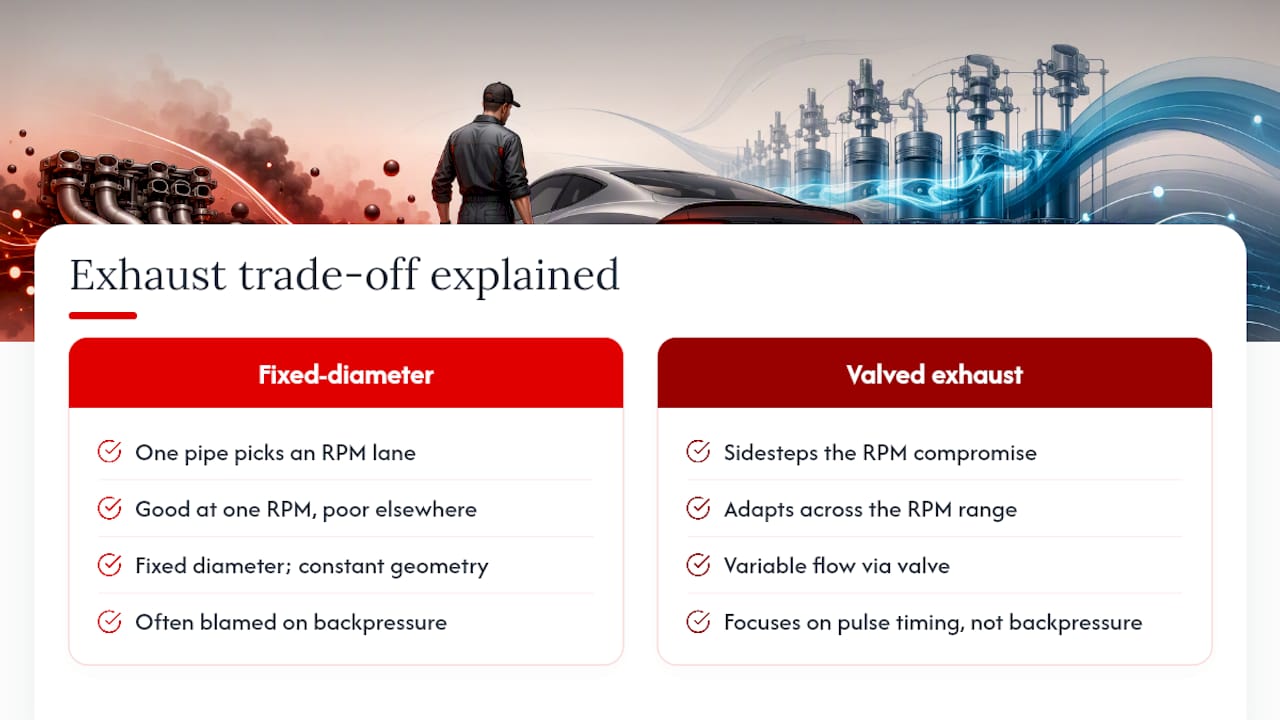
What gets underestimated is how much of “exhaust tuning” is really RPM-range management in disguise. A header that scavenges beautifully at 4,000 RPM might be doing nothing useful at 6,500 RPM, and a straight-through muffler that feels flat at idle might be exactly what a high-revving engine needs. Fixed-diameter systems will always pick a lane. That’s not a flaw in the parts, it’s a limitation of building one pipe to serve every RPM at once.
Where this gets genuinely interesting is valve technology, because it sidesteps the compromise instead of trying to split it evenly. A gauge and a dyno chart will tell you more truth about your exhaust system than any shop legend ever has.
— Info