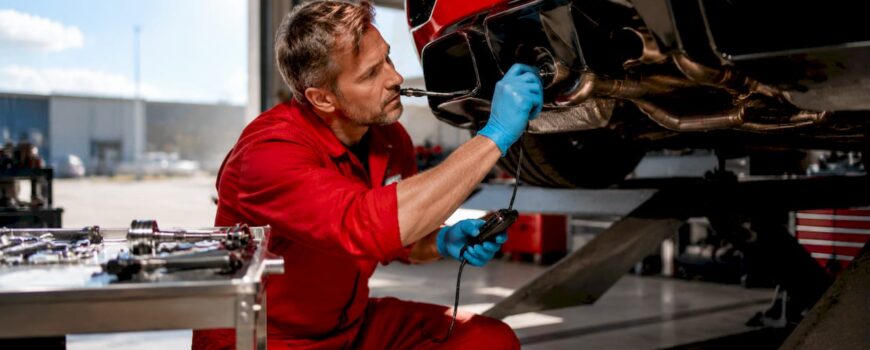
Common exhaust sound issues in supercars are caused by specific mechanical failures or system malfunctions that alter the expected acoustic profile of these high-performance vehicles. Recognizing the difference between a designed aggressive note and a genuine fault can save you from expensive repairs or, worse, engine damage. Models like the Ferrari F430, Audi R8, and Mercedes-Benz vehicles equipped with M254 and M256 engines each present distinct exhaust sound problems tied to their engineering. This guide covers the most frequent supercar exhaust problems, their causes, and how to diagnose them accurately.
1. Common exhaust sound issues supercars: rattling at specific RPMs
Rattling noises at around 1,100 RPM in V10 supercars are most often caused by loose exhaust valve plates or manifold resonance, not internal engine faults. That distinction matters because owners frequently dismiss these sounds as normal character, delaying a repair that only gets worse.
What causes the rattle?
- Loose valve plates inside the exhaust butterfly valves vibrate at specific harmonic frequencies tied to engine speed.
- Manifold resonance amplifies at low RPM when exhaust gas pulses align with the natural frequency of the pipe structure.
- Diesel particulate filter (DPF) resonance can mimic valve rattle in certain configurations.
- Drive mode changes (Sport vs. Comfort) shift valve position and can either reveal or mask the rattle.
To isolate the source, cycle through drive modes while holding a steady 1,100 RPM. If the rattle disappears in one mode but returns in another, the exhaust valve position is the likely culprit. A rattle that persists across all modes points more toward manifold vibration.
Pro Tip: Record the sound on your phone with the hood open and the cabin closed. The acoustic difference between a valve rattle and a heat shield vibration is clear when you compare recordings at 900 RPM versus 1,300 RPM.
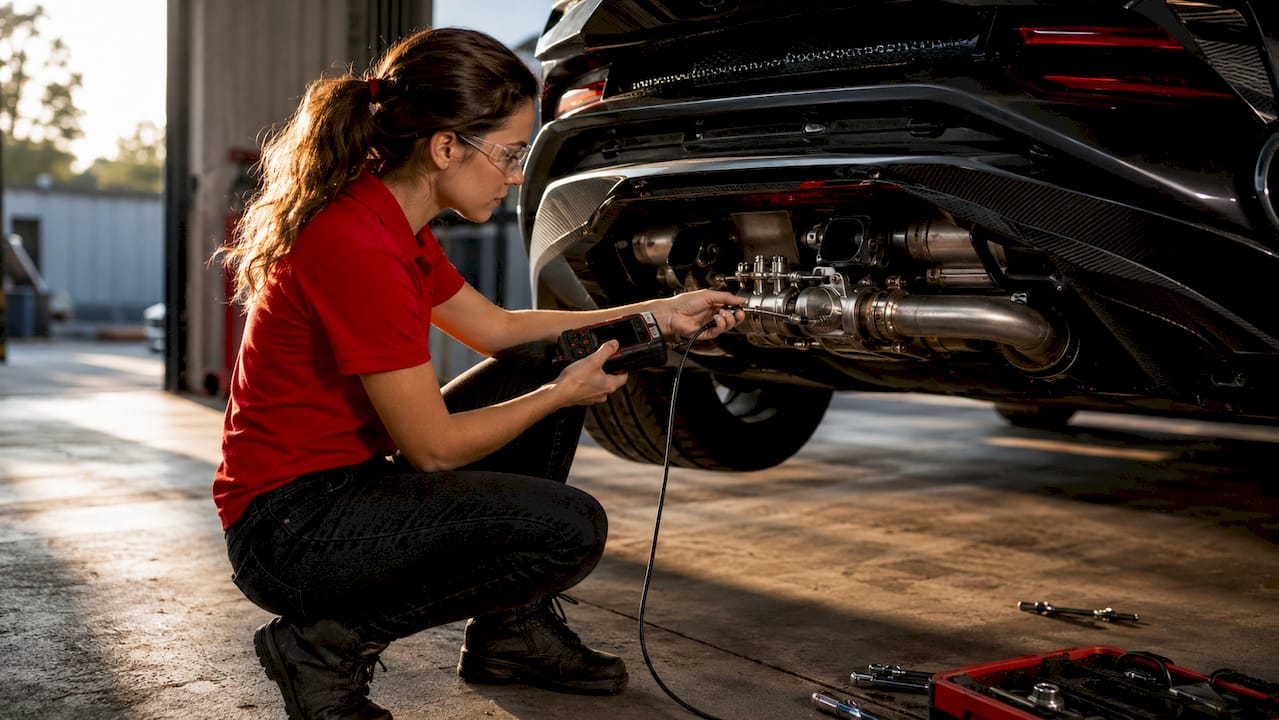
A critical repair nuance: factory exhaust valves on many supercars cannot be replaced as standalone components. Valve failure typically requires replacing the entire exhaust section or switching to an aftermarket system. Owners who face repeated valve rattle often choose aftermarket upgrades specifically to bypass this limitation.
2. Exhaust leaks causing louder or raspier sounds
An exhaust leak changes the sound profile of your car immediately and noticeably. The exhaust note becomes raspier, louder near specific sections of the car, or gains a hissing quality that was not there before.
How to find the leak:
- Let the engine reach full operating temperature, then shut it off.
- Inspect manifold flanges, gasket joints, and flex pipes visually for soot deposits. Black carbon streaks around a joint confirm escaping gas.
- Restart the engine and apply a soap-water spray to accessible exhaust joints while it idles. Bubbling at any point identifies the exact leak location.
- Listen from the front, middle, and rear of the car separately. Leaks near the manifold produce a sharp ticking or hissing; mid-pipe leaks create a broader rasp.
- Check for any exhaust smell entering the cabin with windows closed. Fumes inside the car indicate a serious leak that requires immediate attention.
Common leak locations on supercars include the exhaust manifold-to-head gasket, collector flanges, and flex pipe joints. Flex pipes are particularly vulnerable on low-slung cars that scrape speed bumps.
Pro Tip: Do the soap-water test cold if you suspect a small crack. Thermal expansion seals minor cracks when the metal heats up, making them invisible during a warm inspection.
Hissing or popping sounds paired with a drop in fuel efficiency or a check engine light signal serious issues like manifold gasket failure. Never treat these as cosmetic problems.
3. What are the signs of a cracked exhaust manifold?
A cracked exhaust manifold in a high-performance car produces a cold-start ticking noise that typically fades after the engine warms up. That pattern is the clearest early warning sign.
Symptoms to watch for:
- A metallic ticking sound at cold start that diminishes within 5–10 minutes of driving.
- A faint exhaust smell inside or near the engine bay, especially noticeable right after shutdown.
- Visible hairline cracks or carbon scoring on the manifold surface during visual inspection.
- Fault codes appearing for oxygen sensors or air-fuel ratio sensors located near the manifold.
- Discoloration or heat staining on surrounding wiring harnesses and vacuum lines.
The Ferrari F430 is a well-documented example. Cracked manifolds on the F430 cause cold-start ticking and faint exhaust smells that degrade surrounding engine components if left unaddressed. The problem starts as a noise and ends as an engine repair bill.
Repair strategies for exotic vehicle exhaust manifold issues must cover the entire system, not just the cracked section, to prevent quick recurrence and collateral component damage.
Manifold cracks can cause catastrophic engine damage through metallic fragment migration into the combustion path and degradation of sensor wiring from sustained heat exposure. Catching the crack at the ticking stage is always the cheaper outcome.
4. How muffler and resonator failures change your exhaust note
Mufflers and resonators serve different acoustic functions. A muffler reduces overall sound volume through absorption and reflection chambers. A resonator cancels specific harmonic frequencies using tuned pipe geometry. When either fails, the sound change is distinct.
| Component | Failure symptom | Typical RPM range |
|---|---|---|
| Muffler | Louder overall volume, hollow tone | All RPM ranges |
| Resonator | Deep droning, cabin vibration | 1,800–2,500 RPM |
| Internal baffle | Rattling or loose metallic sound | Mid to high RPM |
Resonator failure produces a deep, low-frequency drone during highway cruising. That drone is distinct from muffler problems, which alter the overall character of the sound rather than adding a specific frequency. Knowing which component is failing saves you from replacing the wrong part.
Internal baffle breakage inside a muffler creates a loose metallic rattle that moves with exhaust gas pulses. You can often hear it shift when you blip the throttle. Corrosion is the most common cause on older systems; on newer supercars, high exhaust temperatures from track use accelerate baffle fatigue.
Pro Tip: A deep highway drone that appears above 70 mph and disappears at lower speeds almost always points to the resonator, not the muffler. Test by holding a steady speed in a tunnel where the acoustic environment isolates the frequency.
5. Electronic exhaust flap malfunctions and fault codes
Electronic exhaust flap systems give supercars their variable sound character, but they are also a source of specific, diagnosable failures. Mercedes-Benz vehicles with M254 and M256 engines are a clear example.
Service bulletin LI49.10-P-080201 documents exhaust flap malfunctions in 2024–2026 Mercedes-Benz models. The fault codes involved are P13C273, P13C278, and P140473. Software updates A2549022611 and A2549022811 address these faults in many cases without physical part replacement.
Symptoms of flap failure:
- The exhaust note sounds the same regardless of drive mode selection.
- A check engine light appears alongside an exhaust-related fault code.
- The exhaust sounds louder or quieter than expected in a specific mode.
- Physical binding of the flap causes a grinding or scraping sound during mode transitions.
- Actuator failure results in the flap defaulting to one fixed position.
Diagnostic procedure:
| Step | Action | Expected result |
|---|---|---|
| 1 | Read fault codes with a compatible scan tool | P13C273, P13C278, or P140473 present |
| 2 | Command flap open and closed via live data | Flap moves freely with no binding |
| 3 | Apply software update if codes match bulletin | Codes clear and do not return |
| 4 | Inspect actuator physically if codes persist | No corrosion, secure connector |
If the software update does not resolve the fault, physical flap inspection and actuator replacement are the next steps. Understanding exhaust sound customization at the system level helps you evaluate whether a flap repair restores the sound profile you expect or whether an aftermarket valve system is a better long-term solution.
6. Popping and banging: normal feature or exhaust problem?
Popping and banging on overrun is a designed feature in many supercars. It results from unburned fuel igniting in the exhaust during deceleration. The question is whether the pops you hear match the character of your car’s design or signal something wrong.
OEM exhaust systems in supercars balance sound, emissions compliance, and noise regulations. Louder sounds are sometimes by design. The key diagnostic question is whether the sound changed suddenly or has always been present. A sudden increase in popping, especially with a check engine light, points to a fueling or ignition fault rather than a designed feature.
Excessive popping at idle or during light throttle application is not normal. That pattern typically indicates a lean fuel mixture, an exhaust leak near the oxygen sensor, or a misfiring cylinder. Each of these causes a different repair path, so accurate diagnosis matters before any parts are ordered.
7. Heat shield vibration: the most misdiagnosed exhaust rattle
Heat shields are thin metal panels that protect surrounding components from exhaust heat. They loosen over time as the fasteners corrode or the metal fatigues from thermal cycling. The resulting rattle is the most frequently misdiagnosed exhaust sound in supercars.
A heat shield rattle sounds similar to a loose valve plate rattle but behaves differently. It appears and disappears based on temperature rather than RPM or drive mode. The rattle is often loudest when the exhaust is warming up and fades once the metal expands and the shield tightens against its mounts.
To confirm a heat shield as the source, press firmly on the shield with a gloved hand while the engine idles. If the rattle stops, the shield is the culprit. Tightening the fasteners or adding a small weld bead resolves the issue permanently. Replacing an entire exhaust section for a heat shield rattle is an expensive mistake that happens more often than it should.
Understanding why exhaust sound matters for performance vehicles helps you approach these diagnostics with the right framework. Sound is data. Every change in acoustic profile tells you something specific about the system’s condition.
Key takeaways
Diagnosing unusual exhaust sounds in supercars requires matching each distinct sound to its mechanical cause before any repair work begins.
| Point | Details |
|---|---|
| Rattling at low RPM | Loose valve plates or manifold resonance at ~1,100 RPM; cycle drive modes to isolate the source. |
| Exhaust leaks | Soot deposits and soap-water bubbling identify exact leak locations before sounds worsen. |
| Cracked manifolds | Cold-start ticking that fades after warm-up is the earliest and most actionable warning sign. |
| Resonator vs. muffler | Highway drone at 1,800–2,500 RPM points to resonator failure; overall volume change points to the muffler. |
| Electronic flap faults | Mercedes-Benz M254/M256 fault codes P13C273 and P13C278 are often resolved by a software update, not part replacement. |
What I’ve learned diagnosing supercar exhaust sounds
The most expensive mistake I see supercar owners make is treating every new exhaust sound as either normal character or a catastrophic problem. The reality sits in between, and the difference comes down to one question: did this sound appear suddenly, or has it always been there?
Supercars are engineered with acoustic compromises baked into the OEM exhaust. The aggressive pops, the low-RPM burble, the mode-dependent volume changes are all intentional. What is never intentional is a sound that changes overnight. A rattle that appears after a track day, a drone that starts after highway miles, a tick that shows up on cold mornings in january. Those are your signals.
My strongest advice: inspect the whole system, not just the component making noise. A cracked manifold that gets patched without checking the surrounding oxygen sensors and wiring will fail again within months. The same logic applies to valve rattle. If the valve is loose, the entire exhaust section’s condition needs evaluation before you commit to a repair strategy.
Aftermarket valve control systems resolve a specific category of OEM limitations. When factory valves cannot be replaced individually and the entire section costs more than a quality aftermarket system, the upgrade path is the rational choice. The sound improvement is a bonus. The reliability gain is the real reason to make the switch.
— Info
Upgrade your supercar’s exhaust sound and reliability

If your supercar’s exhaust is producing sounds that don’t match its design intent, the fix is rarely just tightening a bolt. Valvecontrolexhaust builds adjustable valve exhaust systems for Audi, BMW, Ferrari, and Lamborghini that give you real-time control over sound and performance. When OEM valves fail and factory replacements require full section swaps, a Valvecontrolexhaust system solves the root problem and adds sound customization that no stock system offers. Read the critical analysis of leading valved systems to compare options, or explore how top aftermarket brands compare across sound, build quality, and value before you decide.
FAQ
What causes a rattling exhaust noise at low RPM in supercars?
Rattling at around 1,100 RPM in supercars is most often caused by loose exhaust valve plates or manifold resonance. Cycling through drive modes helps isolate whether the valve position or the pipe structure is the source.
How do I know if my supercar has an exhaust leak?
Look for black soot deposits around exhaust joints and apply a soap-water solution to joints while the engine idles. Bubbling at any point confirms a leak at that location.
Is cold-start ticking always a sign of a cracked manifold?
Cold-start ticking that fades after 5–10 minutes of driving is a strong indicator of a cracked exhaust manifold, as seen in the Ferrari F430. Persistent ticking that does not fade points to a different mechanical source.
What is the difference between a muffler failure and a resonator failure?
Muffler failure raises overall exhaust volume across all RPM ranges. Resonator failure creates a deep, low-frequency drone specifically at highway speeds in the 1,800–2,500 RPM range.
Can Mercedes-Benz exhaust flap faults be fixed with a software update?
Yes. Fault codes P13C273, P13C278, and P140473 on Mercedes-Benz M254 and M256 engines are addressed by software updates documented in service bulletin LI49.10-P-080201, often without physical part replacement.