
The exhaust tip diameter standard is defined as matching the tip’s inlet diameter precisely to your vehicle’s tailpipe outside diameter (OD), creating a secure, leak-free fit. Get this wrong and you face vibration, exhaust leaks, and a tip that rattles loose at highway speeds. Sizing depends on engine displacement and tailpipe OD, with consumer vehicles typically ranging from 2 inches (50.8 mm) to 4 inches (101.6 mm). Whether you drive a turbocharged hatchback or a V8 muscle car, understanding what is exhaust tip diameter standard before you buy saves you time, money, and frustration.
What is exhaust tip diameter standard and why it matters
The exhaust tip diameter standard is not a universal number stamped in a catalog. It is a fitment principle: the tip’s inlet must match your tailpipe’s outside diameter. Tip inlet size must equal tailpipe OD for a secure fit, with a slip-on clearance of 0.25 to 0.5 inches to allow clamping without gaps. Ignore this and the tip either falls off or sits so tight it cracks the pipe.
The consequences of improper sizing go beyond aesthetics. A tip inlet that is too large allows exhaust gases to escape around the joint, creating a hissing leak and a sulfur smell inside the cabin at idle. A tip that is too small simply will not slide on, forcing you into grinding or costly pipe modification. Neither outcome is acceptable on a performance vehicle.
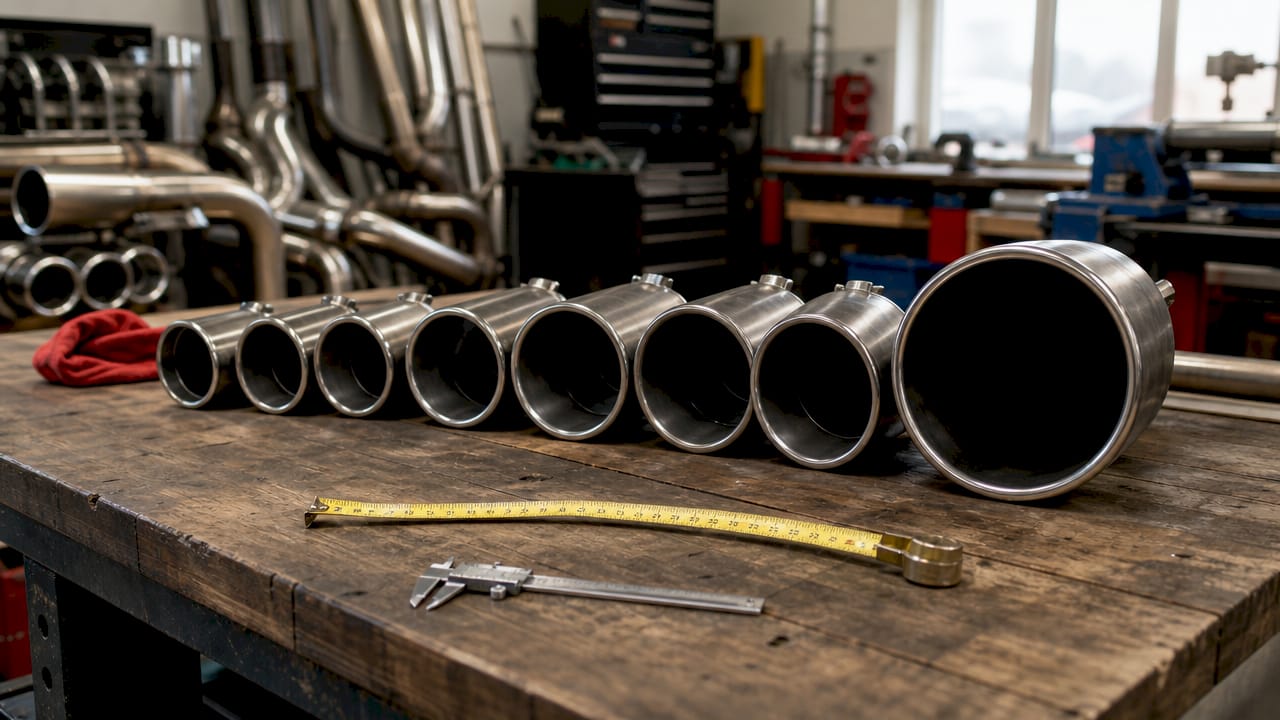
Three measurement tools cover every situation: vernier calipers for precision on straight pipes, a fabric measuring tape for a quick wrap-around check, and the string method for angled or oval tips where calipers cannot get a clean reading. Each method targets the same number: the outside diameter of the tailpipe, not the inside.
How to measure your exhaust tailpipe outside diameter correctly
Accurate measurement is the single step that separates a clean installation from an expensive mistake. Follow this sequence every time.
- Let the exhaust cool completely. Hot metal expands slightly, and burns are avoidable. Wait at least 30 minutes after the engine has been running.
- Locate the end of the tailpipe. Measure as close to the pipe’s exit as possible, where the tip will actually sit.
- Use vernier calipers for straight pipes. Open the jaws, place them across the widest point of the pipe’s outer wall, and read to the nearest 0.5 mm or 0.01 inch. This is your OD.
- Use the string method for angled or oval tips. Wrap a piece of string around the pipe’s circumference, mark where it meets itself, then measure that length with a ruler. Divide by 3.14159 to get the diameter.
- Record in both millimeters and inches. Aftermarket tip manufacturers list sizes in both units, and having both prevents ordering errors.
The most common mistake is measuring internal diameter instead of OD. The internal diameter is always smaller by the pipe wall thickness, typically 1.5 mm to 3 mm on steel exhaust pipes. A tip sized to your pipe’s ID will be too tight to slip on.
Pro Tip: Measure at three points along the last 50 mm of the tailpipe. Older pipes distort from heat cycling, and a single measurement at the very tip can be misleading. Use the largest reading as your OD.
Common exhaust tip diameter standards by engine size and vehicle type
There is no single universal size, but clear patterns exist across engine categories. The table below maps engine displacement to typical tailpipe OD and the recommended tip inlet range.
| Engine displacement | Typical tailpipe OD | Recommended tip inlet | Common outlet size |
|---|---|---|---|
| 1.0L to 1.6L naturally aspirated | 50.8 mm (2 in) | 51 to 57 mm | 76 to 89 mm (3 to 3.5 in) |
| 1.6L to 2.0L turbocharged | 63.5 mm (2.5 in) | 64 to 70 mm | 89 to 102 mm (3.5 to 4 in) |
| V6 and 2.5L to 3.5L | 76.2 mm (3 in) | 76 to 83 mm | 102 to 114 mm (4 to 4.5 in) |
| V8 and performance cars | 88.9 to 101.6 mm (3.5 to 4 in) | 89 to 102 mm | 114 to 127 mm (4.5 to 5 in) |
| Heavy-duty trucks and diesel | 101.6 mm (4 in) or larger | 102 to 114 mm | 127 mm or larger (5 in+) |
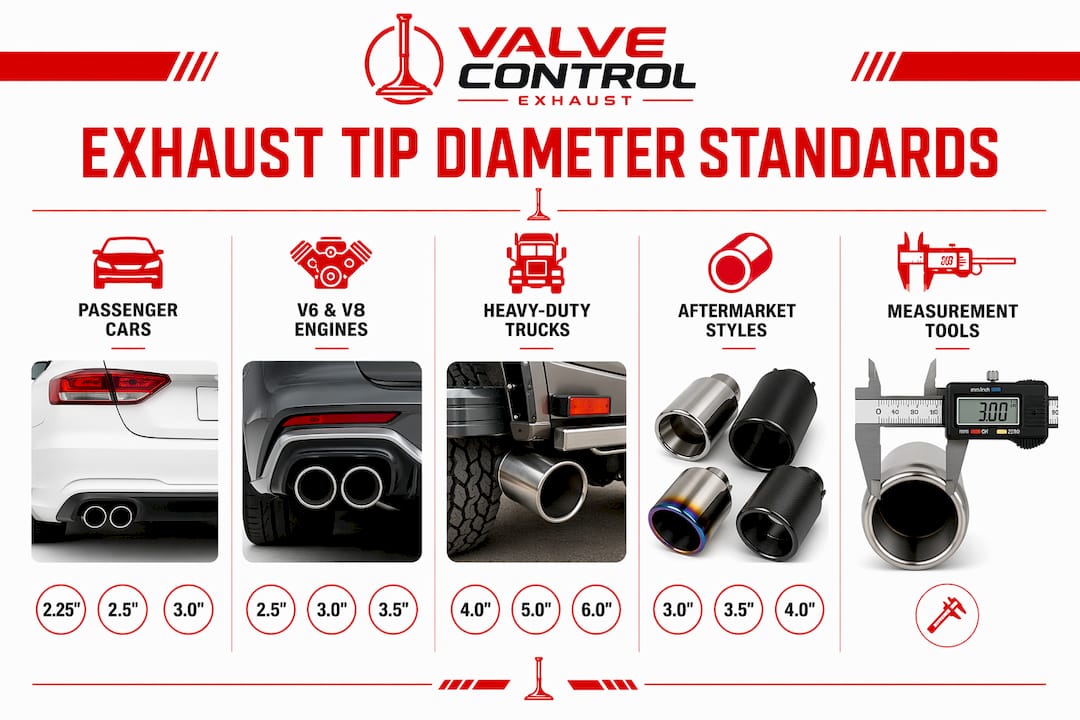
V6 and V8 tailpipe OD typically falls between 76 mm and 102 mm, which is why tip inlet diameters in the 3 to 4 inch range dominate the aftermarket for performance vehicles. Brands like Armytrix, Akrapovic, and IPE engineer their tips to these exact increments because they align with factory pipe sizing on BMW, Audi, and Ferrari platforms.
Aftermarket tip outlet diameters for styling purposes commonly range from 3 inches to 5 inches, with smaller cars using 3 to 4 inch outlets and performance or heavy-duty trucks opting for larger sizes. The outlet diameter is what you see from behind the car, so it carries the most visual weight. Tip lengths typically run 6 to 14 inches, and longer tips shift the resonance frequency of the exhaust note slightly toward a deeper tone.
Heavy-duty trucks and diesel applications break from the passenger car pattern. Their exhaust systems run larger bore pipes from the factory, and tips sized below 4 inches create a visible mismatch that also restricts flow. High-performance vehicles like the Lamborghini Huracán and Ferrari 488 use dual or quad tip configurations, each pipe typically running 76 to 89 mm OD, so each tip inlet must match that individual pipe rather than a combined measurement.
How does exhaust tip diameter affect sound and performance?
Tip diameter shapes your exhaust note more than most owners realize, and the relationship between outlet diameter and exhaust pitch is direct. A larger outlet lowers the pitch and produces a deeper, more resonant sound without replacing the muffler or cat-back system. This is why a 4 inch tip on a 2.5 inch pipe sounds noticeably different from a 3 inch tip on the same pipe.
The inlet diameter tells a different story. Upsizing tip inlet diameter beyond the tailpipe OD disrupts exhaust gas velocity and backpressure, which is particularly harmful for naturally aspirated engines that depend on precise scavenging. Upsizing the outlet by one increment is generally safe and acoustically beneficial. Upsizing the inlet is where problems start.
- A tip inlet that is too large creates a turbulent dead zone between the pipe exit and the tip wall, generating drone at 2,500 to 3,500 RPM on highway cruises.
- A tip inlet that matches OD exactly maintains exhaust velocity through the transition, preserving torque in the mid-range.
- Improper installation, meaning a loose clamp or no sealant on a slip-on tip, causes rattling that is often mistaken for a heat shield problem.
- Larger outlet diameters on performance vehicles like the aftermarket exhaust response on BMW M3 or Audi RS platforms produce a more aggressive note without sacrificing low-end torque when the inlet is correctly sized.
“Exhaust tip sizing is a simple and effective sound tuning tool. Larger tips can deepen sound without a system overhaul, but correct fit is non-negotiable to prevent rattling.” — SPELAB Autoparts
Pro Tip: After installing a new tip, run the engine through its full RPM range in a safe location and listen at 2,000, 3,000, and 4,500 RPM. Drone or buzzing at a specific RPM band signals a resonance mismatch, usually caused by a tip outlet that is too large for the pipe’s flow volume.
Choosing the right exhaust tip diameter for fit and style
Selecting the right tip involves balancing three factors: fitment accuracy, clearance from the bumper, and the visual proportion of the outlet relative to the rear valance.
- Match inlet to OD first. The tip inlet must equal your tailpipe OD. A slip-on clearance of 0.25 to 0.5 inches is acceptable for clamp-on installation.
- Check bumper clearance. Allow at least 20 mm clearance between the tip’s exit and the bumper or rear valance to prevent heat damage and discoloration.
- Choose outlet size for aesthetics. A tip outlet that is 25 to 38 mm larger than the inlet creates a noticeable flare without looking disproportionate on most vehicles.
- Consider tip length for drone. Longer tips, above 10 inches, can amplify resonance at certain RPMs. Shorter tips, 6 to 8 inches, are safer for daily drivers.
- Decide on installation method. Clamp-on tips work for most street applications and allow removal. Welded tips provide a permanent, vibration-free fit preferred on track cars and high-performance builds.
- Avoid excessive protrusion. A tip that extends more than 50 mm beyond the bumper edge creates a safety hazard and may fail visual inspection in some states.
For exhaust tip aesthetics on luxury vehicles, the outlet diameter should be proportional to the car’s rear diffuser width. A 127 mm (5 inch) tip on a compact sedan looks oversized. The same tip on a Lamborghini Urus or BMW X5 M reads as factory-correct because the rear fascia is designed to accommodate that scale.
Key takeaways
The exhaust tip diameter standard is defined by one rule: the tip inlet must match your tailpipe’s outside diameter, and every other sizing decision flows from that measurement.
| Point | Details |
|---|---|
| OD is the only measurement that matters | Always measure tailpipe outside diameter, never internal diameter, to select the correct tip inlet. |
| Engine size determines standard ranges | Tailpipe OD runs from 50.8 mm for small engines to 101.6 mm or larger for V8s and trucks. |
| Outlet size shapes sound | Upsizing the outlet by one increment deepens the exhaust note without disrupting flow or backpressure. |
| Clearance prevents heat damage | Maintain at least 20 mm between the tip exit and the bumper to avoid discoloration and warping. |
| Inlet upsizing harms performance | Oversizing the inlet disrupts exhaust velocity and causes drone, especially in naturally aspirated engines. |
Why most exhaust tip fitment problems are self-inflicted
After years of working with performance exhaust systems on vehicles from BMW M4s to Ferrari 458s, the pattern is consistent: the majority of fitment failures trace back to one error. The owner measured the internal diameter of the tailpipe and ordered a tip sized to that number. The tip arrives, will not slide on, and the owner assumes the product is wrong. The product is fine. The measurement was wrong.
The second most common mistake is treating the outlet diameter as the only number that matters. Enthusiasts focus on how the tip looks from behind the car and ignore whether the inlet actually seals against the pipe. A 5 inch tip with a 3 inch inlet on a 3 inch pipe sounds great in theory. In practice, the gap between the inlet and the pipe wall creates a turbulent pocket that generates drone at exactly the RPM you cruise at most.
My honest advice: measure twice, in millimeters, at three points on the pipe. Then add 3 to 6 mm to that OD reading to find your ideal tip inlet size. That small clearance is what makes a clamp-on tip grip without cracking. For turbo applications, also check how exhaust sizing affects turbo spool before committing to a larger outlet diameter. The tip is the last component in the system, but it still influences what happens upstream.
— Info
Upgrade your exhaust system with Valvecontrolexhaust

Valvecontrolexhaust specializes in performance exhaust systems built for vehicles like Audi, BMW, Ferrari, and Lamborghini, where tip sizing and exhaust note are part of the engineering, not an afterthought. Their clamp-on tip options are sized to match factory tailpipe ODs across all major luxury platforms, making installation straightforward once you have your OD measurement in hand. For owners who want to go further, their valve-controlled systems let you adjust exhaust sound and flow in real time from the cabin. Browse the performance exhaust buyer’s guide at Valvecontrolexhaust to find the right tip diameter, system configuration, and sound profile for your specific vehicle.
FAQ
What is the standard exhaust tip diameter for most cars?
There is no single standard. Consumer vehicle tip inlets range from 2 inches (50.8 mm) for small engines to 4 inches (101.6 mm) for V8s, based on tailpipe outside diameter.
How do I measure my exhaust tip size correctly?
Use vernier calipers to measure the outside diameter of your tailpipe, not the inside. Take readings at three points near the pipe exit and use the largest measurement as your OD.
Will a larger exhaust tip improve performance?
Exhaust tips do not add horsepower on their own. A larger outlet can deepen the exhaust note, but upsizing the inlet beyond the tailpipe OD disrupts exhaust velocity and can reduce mid-range torque.
What clearance should I leave between the tip and the bumper?
Allow at least 20 mm between the tip exit and the bumper or rear valance. Less than that risks heat discoloration and can warp plastic bumper components over time.
Can I install an exhaust tip without welding?
Yes. Clamp-on tips work reliably for street use when the inlet matches the tailpipe OD with 0.25 to 0.5 inches of slip clearance. Welded tips are preferred for track use where vibration loads are higher.