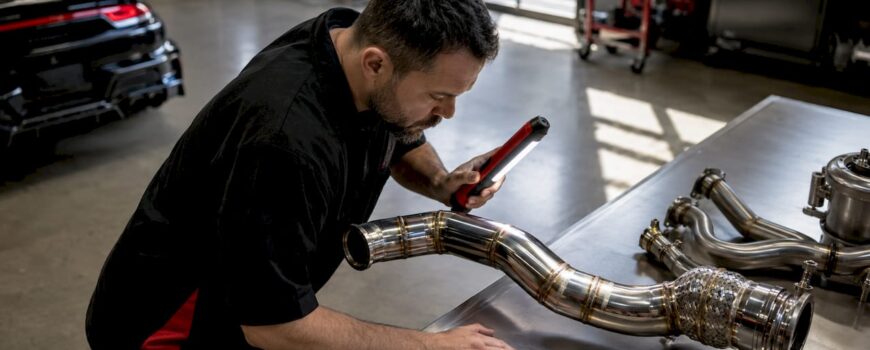
Turbo exhaust efficiency improvement is the process of optimizing exhaust flow and turbine performance to convert wasted exhaust energy into usable power and faster spool. The right combination of high-flow downpipes, variable turbine geometry (VTG) turbos, and ECU recalibration can transform a sluggish turbocharged engine into a responsive, high-output machine. This guide covers the specific hardware upgrades, turbine geometry choices, backpressure management strategies, and tuning steps that performance vehicle owners need to extract real gains. Whether you drive a BMW M3, Porsche 718, or Audi S4, the principles here apply directly to your build.
What are the best exhaust system upgrades for turbo efficiency?
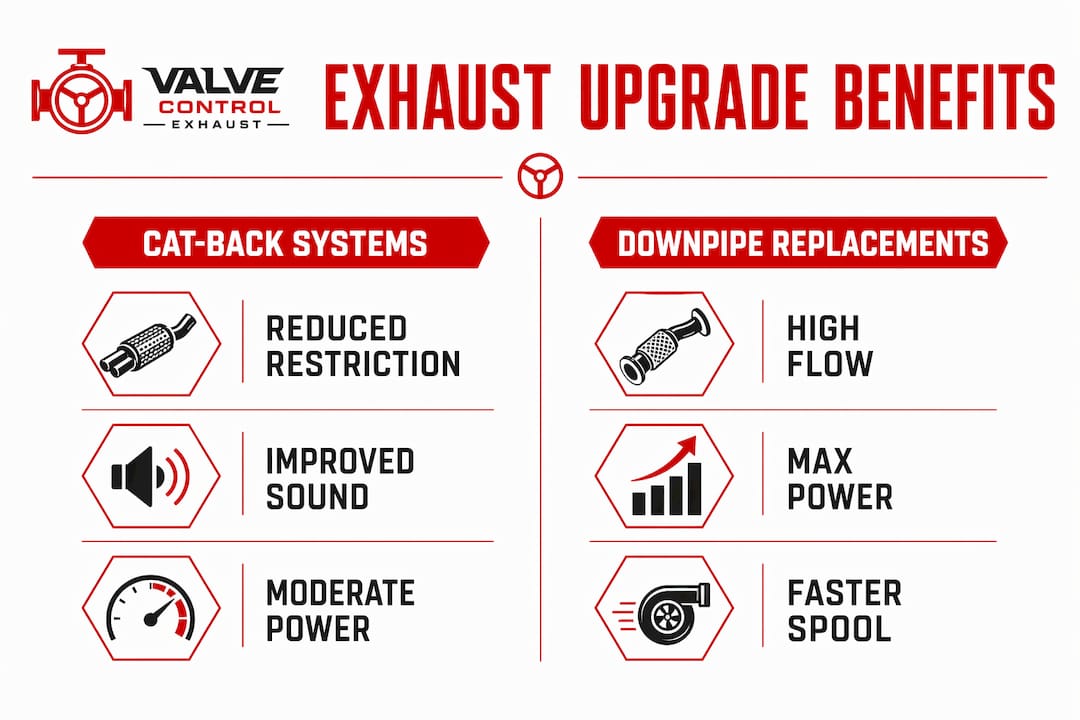
The two most impactful exhaust system upgrades for turbocharged engines are cat-back systems and downpipe replacements. They target different parts of the exhaust path and deliver very different results.
Cat-back exhaust systems replace everything from the catalytic converter back to the tips. They reduce restriction in the mid and rear sections of the exhaust, improving throttle response and sound. According to EuroSport Tuning, cat-back systems add 5–15 hp, while downpipes add 20–50 hp with tuning. Cat-back upgrades are the easier starting point. They are generally emissions-legal and require no ECU tune to install safely.
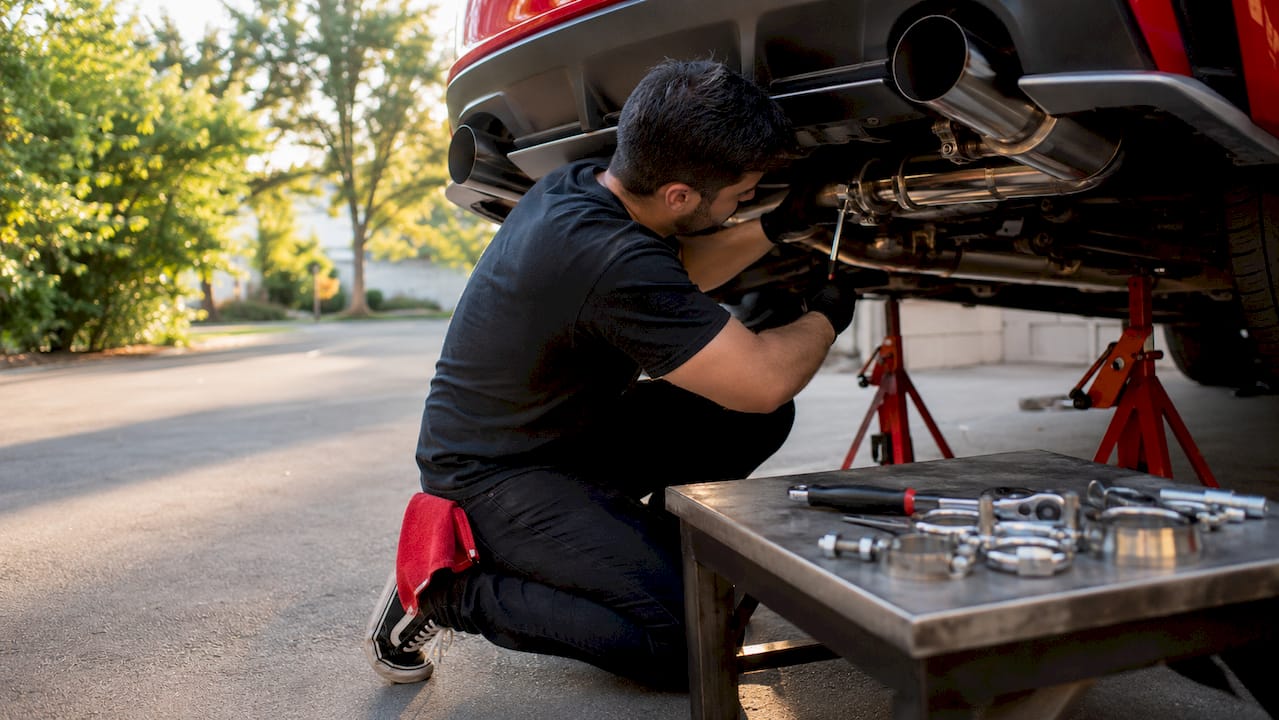
Downpipe upgrades attack the most restrictive section of the exhaust: the pipe connecting the turbocharger outlet to the catalytic converter. A high-flow downpipe reduces backpressure at the turbine exit, which lets the turbine wheel spin up faster and spool boost sooner. The result is quicker throttle response and larger power gains than any cat-back can deliver.
Here is a quick breakdown of what each upgrade delivers:
- Cat-back system: 5–15 hp gain, improved sound, emissions-legal, no tune required
- High-flow downpipe (catted): 20–40 hp gain, faster spool, requires ECU tune, emissions-legal with high-flow cat
- Catless downpipe: 30–50 hp gain, maximum flow, requires ECU tune, not street-legal in most U.S. states
- Full turbo-back system: Combines downpipe and cat-back for maximum total flow improvement
Real-world results confirm the downpipe’s value. Garrett Motion reported in April 2026 that a G-Series II CHRA swap added 170 WHP and 176 lb-ft torque at 45 psi boost on a BMW S58. That kind of gain requires the exhaust side to flow freely. A restrictive stock downpipe would have choked the result.
Pro Tip: If you drive on public roads in California or other CARB-regulated states, choose a 200-cell high-flow catalytic downpipe. Options like the FI Exhaust Sport 200 Cell Catalyst Downpipe for Porsche 718 deliver real performance gains while keeping you compliant.
How does turbo sizing and turbine geometry affect exhaust efficiency?
Choosing the wrong turbo size is one of the most common mistakes performance builders make. A turbo that is too large for your current engine output will spool late and deliver power in a narrow, hard-to-use band. A turbo that is too small will hit its flow limit early and cap your peak power.
The key metric is the compressor map. Operating in 65–75% efficiency islands on the compressor map produces the best balance of spool speed, power output, and heat management. Staying in this zone means your turbo is working efficiently rather than fighting against its own limits.
Turbine a/r ratio: small vs. large
The turbine housing A/R ratio controls how quickly exhaust gas reaches the turbine wheel. Here is how the two ends of the spectrum compare:
| A/R Ratio | Spool Speed | Peak Power | Best For |
|---|---|---|---|
| Small (0.60–0.70) | Fast | Moderate | Street driving, low-RPM torque |
| Large (0.82–1.00) | Slower | High | Track use, high-RPM power |
A small A/R ratio accelerates exhaust gas velocity, which spins the turbine wheel faster at low RPM. A large A/R ratio flows more volume at high RPM, supporting bigger peak power numbers. Most street builds benefit from a mid-range A/R that keeps spool under 3,500 RPM.
Variable turbine geometry: the best of both worlds
Variable turbine geometry turbos solve the A/R trade-off directly. VTG turbos use adjustable vanes that tighten the exhaust gas path at low RPM for fast spool, then open up at high RPM for maximum flow. The result is small-turbo responsiveness combined with large-turbo peak power in one unit. Porsche has used VTG technology in the 911 Turbo for years, and the technology is now appearing in hybrid platforms where an electric motor assists spool during transients.
Pro Tip: Size your turbo for the power level you are running now, not the power level you plan to reach in two years. Matching turbo size to your current build keeps you in the efficient compressor map zone and avoids the lag penalty of an oversized unit.
What role does backpressure management play in turbo efficiency?
Exhaust backpressure is the resistance that exhaust gases encounter as they exit the engine. Traditional thinking treats all backpressure as harmful. The reality is more specific.
Excessive backpressure forces the turbo to work harder against its own exhaust stream, reducing turbine efficiency and increasing heat. Removing all restriction, however, drops exhaust gas velocity and can actually slow spool on smaller turbines. The goal is controlled backpressure, not zero backpressure.
Research published in April 2026 demonstrates this precisely. Backpressure supercompensation strategies combined with VTG lowered specific fuel consumption by up to 7.93% and increased maximum power by 11.04%. That is a meaningful gain from managing the exhaust pressure window rather than simply eliminating it. The data shows that tuned backpressure, applied at the right RPM range, can improve both economy and output simultaneously.
VTG turbos are particularly effective here. By adjusting vane angle in real time, a VTG system maintains the optimal pressure ratio across the turbine at every RPM. Paired with a properly sized downpipe, this approach keeps the turbo operating in its efficiency window from idle to redline. Upgraded exhausts also improve fuel consumption by enabling better air-fuel ratios and more complete combustion. The power gains and fuel economy benefits are not mutually exclusive.
How to integrate exhaust upgrades with ECU tuning for maximum gains
Physical exhaust modifications change the pressure and flow conditions that your engine management system was calibrated for. Skipping the ECU tune after a downpipe install is the single most common mistake enthusiasts make.
Here is the correct sequence for integrating exhaust upgrades with engine software:
- Install the hardware first. Complete the downpipe or cat-back installation before any tuning session. The tuner needs to see the actual conditions the engine is running in.
- Baseline dyno pull. Run a baseline pull to document current power, torque, and air-fuel ratio curves. This gives the tuner a reference point.
- Recalibrate air-fuel ratios. A high-flow downpipe changes exhaust scavenging and can shift the air-fuel ratio lean or rich. Failing to recalibrate after hardware changes can cause check engine lights and suboptimal power.
- Adjust boost targets. With less backpressure at the turbine exit, the turbo can build boost faster. The ECU tune should reflect updated boost targets that match the new hardware capability.
- Verify knock and ignition timing. More airflow and altered combustion conditions can push the engine toward knock. A proper tune advances timing to the safe limit for maximum power.
Pro Tip: If you are running a Honda Civic Type R FK8 or a Subaru BRZ and adding a catless downpipe, pair it with a professional ECU flash or piggyback tune before your first hard pull. A catless downpipe for the FK8 changes exhaust dynamics enough that the stock tune will leave significant power on the table.
Common installation mistakes to watch for include exhaust leaks at the downpipe flange, which introduce false oxygen sensor readings and confuse the ECU. Torque all flanges to spec and check for leaks before the tune session. Also confirm that your oxygen sensors are compatible with the new downpipe. Some aftermarket units reposition the bung, which can affect sensor placement and signal accuracy.
Key takeaways
Turbo exhaust efficiency improvement requires matching hardware upgrades, turbine geometry, and ECU calibration to work together as a system rather than as isolated modifications.
| Point | Details |
|---|---|
| Downpipes deliver the biggest gains | High-flow downpipes add 20–50 hp and faster spool, but require an ECU tune to realize full benefits. |
| Match turbo size to current power | Operating in the 65–75% compressor map efficiency zone maximizes spool and power without lag. |
| Controlled backpressure improves output | VTG combined with tuned exhaust can cut fuel consumption by up to 7.93% and raise peak power by 11.04%. |
| ECU tuning is non-negotiable | Recalibrating air-fuel ratios and boost targets after hardware changes prevents power loss and engine faults. |
| Cat-back is the low-risk starting point | Cat-back systems add 5–15 hp, improve sound, and are emissions-legal without requiring a tune. |
Why i think most enthusiasts upgrade in the wrong order
Most people buy the loudest exhaust they can find, then wonder why their turbo still feels lazy. The order of upgrades matters more than the parts themselves.
My recommendation is always the same: start with the downpipe, tune it properly, then add the cat-back. The downpipe is where the turbo breathes out. Getting that section right first gives you a real baseline to build from. Adding a cat-back to a stock downpipe is like unclogging the drain while the pipe is still blocked.
The VTG conversation is where things get interesting in 2026. Electric-assist VTG systems in hybrid platforms like the new Porsche 911 GTS Hybrid are showing that the lag problem is essentially solved when you combine adjustable vane geometry with instant electric torque fill. For street builds, this means the technology gap between a well-tuned conventional turbo and a hybrid system is narrowing fast. If you are building a track car today, a properly sized single turbo with a quality VTG housing and a full ECU tune will still outperform a lazy hybrid system on a closed circuit.
The trade-off between sound, emissions, and performance is real, and nobody should pretend otherwise. A catless downpipe on a track-only car is a legitimate choice. On a daily driver in a CARB state, it is a liability. Know your use case before you buy. The exhaust customization decisions that make sense for a weekend Audi RS3 build are completely different from what works on a Ferrari 488 that sees track days twice a year.
The uncomfortable truth is that most enthusiasts underestimate how much the ECU tune matters relative to the hardware. A mediocre downpipe with an excellent tune will outperform a premium downpipe on a stock map every time. Spend the money on the tune first if you have to choose.
— Info
Upgrade your turbo exhaust system with Valvecontrolexhaust
Valvecontrolexhaust specializes in high-performance exhaust systems built for turbocharged platforms including Audi, BMW, Ferrari, and Lamborghini. Their catalog covers cat-back systems, high-flow downpipes, and valve-controlled setups that let you adjust exhaust behavior in real time based on driving conditions.

If you are comparing premium systems from brands like IPE, FI Exhaust, Armytrix, Akrapovic, Valvetronic, and Ryft, Valvecontrolexhaust has put together a detailed performance exhaust comparison guide that breaks down real-world performance, sound profiles, and tuning compatibility across each brand. For buyers who want a structured decision framework, the performance exhaust buyer’s guide covers everything from downpipe selection to valve system integration.
FAQ
What is the fastest way to improve turbo spool speed?
Installing a high-flow downpipe is the single most effective hardware change for faster turbo spool. It reduces turbine exit backpressure, which allows the turbine wheel to accelerate more quickly at low RPM.
Do cat-back exhausts require an ECU tune?
Cat-back exhaust systems generally do not require an ECU tune because they do not significantly alter the pressure conditions upstream of the oxygen sensors. Downpipe upgrades do require tuning to recalibrate air-fuel ratios and boost targets.
What is variable turbine geometry and why does it matter?
VTG turbos use adjustable vanes inside the turbine housing to control exhaust gas velocity at different RPM ranges. This delivers fast spool at low RPM and strong flow at high RPM, eliminating the trade-off that fixed-geometry turbos force you to make.
Can exhaust upgrades actually improve fuel economy?
Yes. Research shows that optimized exhaust flow improves combustion efficiency, which can lower fuel consumption alongside power gains. The two outcomes are not mutually exclusive when the system is properly tuned.
How do i know if my exhaust diameter is too large?
An oversized exhaust diameter reduces gas velocity, which increases turbo lag and kills low-end torque. If your car feels sluggish below 3,000 RPM after an exhaust upgrade, the tubing diameter may be too large for your current power level.