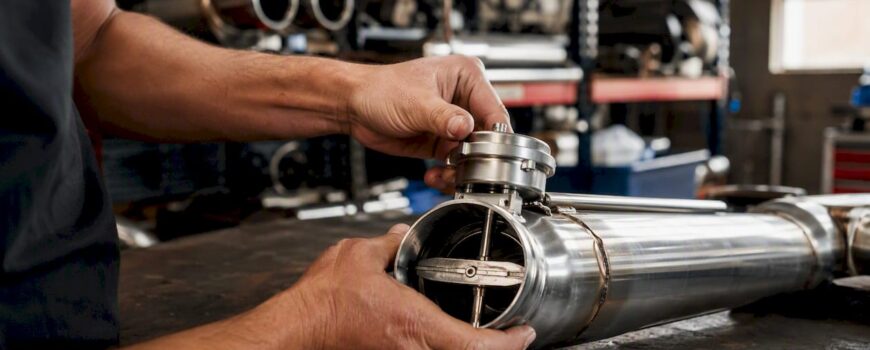
City driving calls for a closed or near-closed valve to cut drone and keep exhaust legal near residential areas, and it rarely needs a tune. Highway cruising works best partly open for a deeper note without cabin fatigue, also usually tune-free. Track days want valves fully open paired with a dyno-verified tune, since flow changes shift air-fuel ratios enough to matter. Rain, snow, and low-visibility driving all call for closed valves. Traction and predictable throttle response matter more than sound, and FHWA data shows why: adverse weather contributes to roughly 12% of U.S. crashes and over 3,800 weather-related deaths a year, averaged across 2019 to 2023. Towing sits closer to highway settings, partly open, with attention to exhaust gas temperature. Off-road use depends on ground clearance and debris risk more than sound preference, often landing on partly open for a middle ground.
Here’s the condensed version before you get into the details:
- City: Closed valve, no tune needed
- Highway: Partly open, no tune needed
- Track: Open valve, tune required (or strongly recommended)
- Rain: Closed valve, no tune needed
- Snow/ice: Closed valve, no tune needed
- Low visibility: Closed valve, no tune needed
- Towing: Partly open, tune optional depending on downpipe changes
- Off-road: Partly open to open, tune depends on parts changed
A system like Valve Control Exhaust lets you switch between these positions from the driver’s seat or a phone app, which matters more than most owners realize once they’ve actually driven the same car through all eight conditions above. The rest of this guide walks through why each recommendation holds up, when a tune becomes mandatory rather than optional, and how to validate your setup without guessing.
Key Takeaways
Matching valve position to driving conditions protects both drivability and safety, while a tune becomes mandatory only when flow changes upstream of the O2 sensors alter fueling.
| Point | Details |
|---|---|
| City and adverse weather | Keep the valve closed for drone control and predictable traction in rain, snow, or low visibility. |
| Highway and towing | Run partly open to manage heat and sound without triggering resonance at cruising RPM. |
| Track use | Open the valve fully and pair it with a dyno-verified tune before pushing sustained high-load pulls. |
| Tune necessity | Cat-back systems rarely need tuning; downpipes, headers, and cat-deletes usually do. |
| Validate before finalizing | Log wideband AFR and fuel trims over 100 to 150 miles before trusting any new setting. |
| Choose adjustable control | A Valve Control Exhaust system lets you switch between safe defaults and performance settings without swapping hardware. |
Table of Contents
- Exhaust Tuning Driving Conditions List: Condition-by-Condition Guidance
- Do You Need an ECU Tune After an Exhaust Change?
- Noise Laws, Police Stops, and Safety-First Valve Settings
- How Valve Position Affects Torque, Heat, and Engine Longevity
- How to Set Up Condition-Based Valve Control
- Testing and Validating Your Valve and Tune Settings
- Maintenance and Common Valve System Problems
- What Actually Matters Once You’ve Lived With a Valved System
- Get Your Exhaust Set Up Right for Every Condition
- Sources
Exhaust Tuning Driving Conditions List: Condition-by-Condition Guidance
City driving. Keep the valve closed. Stop-and-go traffic means low RPM cruising where an open valve produces resonance and drone inside the cabin, not the aggressive note you get at higher RPM on an open road. Closed valves also keep you under the radar in residential zones where noise complaints turn into real problems. No tuning is needed here because closed valve mode typically routes exhaust through a quieter path that doesn’t change backpressure enough to affect factory-calibrated air-fuel ratios.
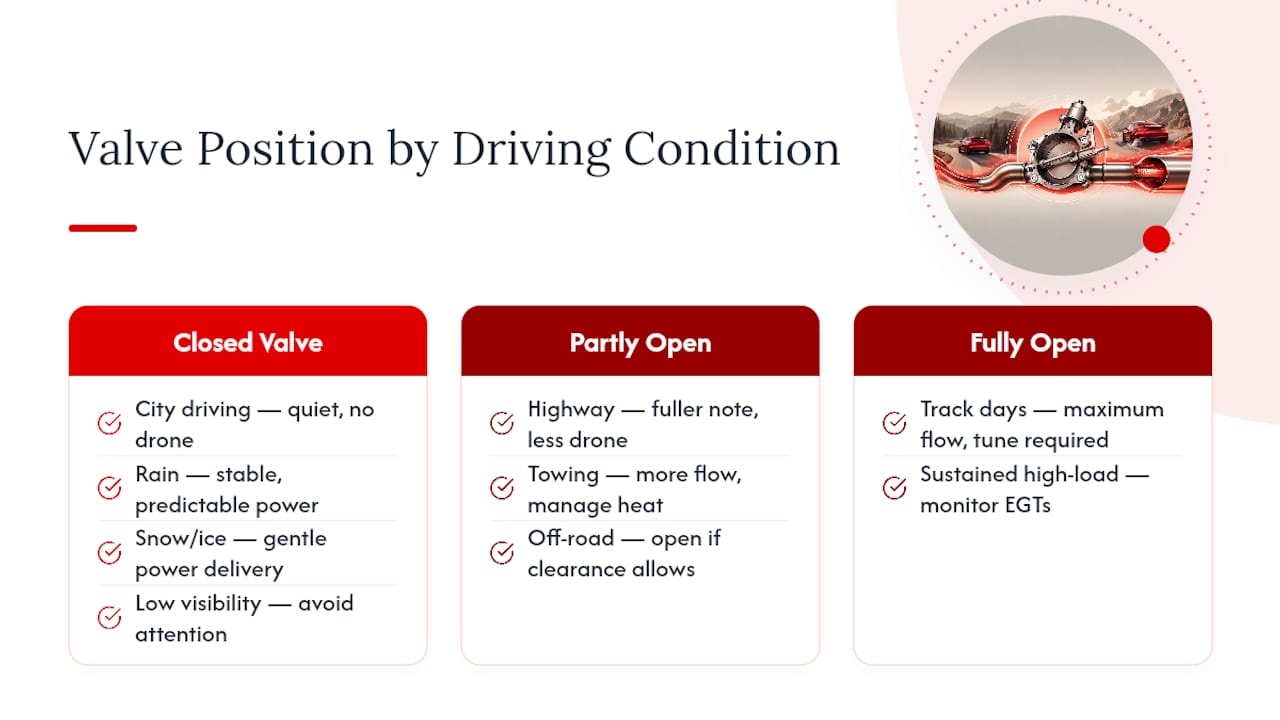
Highway driving. Partly open is the sweet spot. You get a fuller exhaust note at sustained higher RPM without the drone that plagues fully open setups during 65 to 80 mph cruising. Listen for resonance between 2,000 and 3,000 RPM. If it shows up, that’s your cue to close the valve slightly further. This setting is still tune-free on most cat-back or axle-back configurations.
Track days. Go fully open. You want maximum flow and minimum backpressure when you’re chasing lap times, and this is the one condition where a tune isn’t optional if you’ve changed anything upstream of the muffler. Monitor exhaust gas temperatures during sustained pulls. Sustained high-load driving is where poor tuning shows up fastest, often as a hesitant throttle or a check-engine light mid-session.
Rain. Closed valve, full stop. This isn’t about sound. It’s about traction and predictable power delivery. Precipitation increases crash probability meaningfully, particularly in single-vehicle crashes at higher speeds, and a closed valve setting tends to smooth out throttle response by keeping backpressure consistent with what your ECU expects.
Snow and ice. Same logic as rain, closed valve, but with more emphasis on gentle power application. This is not the setting to experiment with open-valve pops and crackles.
Low visibility (fog, dusk, heavy traffic). Closed valve. Weather-related low-visibility conditions account for a real slice of weather crashes, and this is a scenario where drawing attention to your car with an aggressive exhaust note works against you rather than for you.
Towing. Partly open, leaning toward closed if you’re hauling near your vehicle’s rated capacity. Heat management becomes the priority. Extended load raises EGTs, and a partly open valve helps exhaust flow move heat out of the system rather than let it soak into components near the rear axle.
Off-road. Partly open to open depending on ground clearance and how much debris exposure your exhaust tips see. Some drivers keep it closed simply to protect against water crossings triggering unexpected valve behavior.
Pro Tip: *Set up your valve modes around 2,500 to 3,500 RPM first.
Do You Need an ECU Tune After an Exhaust Change?
The part you changed determines the answer more than anything else.
- Cat-back or axle-back systems rarely require a tune. These modifications sit downstream of the oxygen sensors that matter most to fueling, so the ECU rarely notices a meaningful difference in backpressure.
- High-flow catted downpipes usually need at least a partial recalibration. Modern ECUs are calibrated around factory backpressure, and a downpipe swap changes that enough to shift air-fuel ratios, especially under load.
- Headers and long-tube setups almost always require tuning. The O2 sensor placement relative to the header collector changes exhaust gas composition readings enough to trigger fuel trim adjustments or a check-engine light.
- Cat-deletes require tuning close to 100% of the time, both for drivability and to avoid a code for catalyst efficiency below threshold.
Three tuning paths cover most situations. A full ECU flash rewrites the factory map and gives the most precise control, best suited for headers, downpipes, or cat-deletes. A piggyback or OBD2 adaptive device intercepts sensor signals and adjusts on the fly. These devices typically stabilize their adjustments over a 50 to 150 mile drive cycle, which makes them a reasonable middle ground for downpipe-only builds. A standalone engine management system replaces the ECU entirely and is overkill unless you’re building a dedicated track car with extensive other modifications.
Whichever path you choose, run a diagnostic scan before and after the install, watch wideband O2 readings during the first few drives, and track short and long-term fuel trims for at least 100 miles before calling the tune finished.
Noise Laws, Police Stops, and Safety-First Valve Settings
Noise ordinances vary by city and state, and most set a decibel limit measured at a specific distance and RPM rather than banning aftermarket exhaust outright. This is exactly why a switchable valve system has practical value beyond sound preference: you can run open on a closed course and closed the moment you’re back on public roads.
Officers can and do stop drivers for exhaust noise that violates local decibel limits, and in most jurisdictions that’s a legitimate basis for a stop regardless of whether other modifications are present. A car running a documented, adjustable valve system with a closed default gives you a straightforward answer if questioned: point to the setting, not an argument about interpretation.
- Keep dyno sheets and before-and-after decibel readings from your installer.
- Save your install certificate or invoice showing the specific parts fitted.
- Default to closed valve mode in residential areas, at night, and near schools or hospitals.
- Never assume a valve system alone satisfies emissions requirements. Catalytic converter presence and function are separate legal issues.
By the numbers: Weather-related crashes account for about one in eight of all U.S. vehicle crashes, with rain and mist causing the majority of those incidents. That statistic alone is a strong argument for treating rain and low-visibility settings as safety decisions, not sound preferences.
How Valve Position Affects Torque, Heat, and Engine Longevity
Exhaust flow is a balance between velocity and volume, not a simple “more flow is better” equation. A closed or partly closed valve raises backpressure slightly, which can actually help low-end torque by preserving exhaust gas velocity and scavenging efficiency at lower RPM. Wide open flow favors top-end power but can leave a flat spot down low if the rest of the system, particularly pipe diameter, isn’t matched to it.
Pipe sizing matters more than most owners assume. Oversized piping reduces gas velocity and hurts scavenging, which is why sizing guides recommend roughly 2.00 to 2.25 inches for sub-200 horsepower applications and closer to 2.5 inches in the 200 to 350 horsepower range. Going bigger than your power level supports doesn’t add performance. It usually costs you low-end response.
- Sustained open-valve driving without a matching tune can raise EGTs enough to stress the catalytic converter or nearby heat shielding.
- Unmonitored flow increases sometimes trigger O2 sensor readings that push the ECU into a protective, reduced-power mode.
- Partly closed settings during towing or hard acceleration in hot climates help manage heat soak around the rear axle and fuel lines.
- Fully open settings are appropriate for sustained high-load driving only when paired with a tune that accounts for the new flow characteristics.
How to Set Up Condition-Based Valve Control
Start with the hardware. A dedicated controller, such as Valve Control Exhaust’s remote system, gives you manual override plus programmable modes rather than relying on factory-limited settings tied only to drive mode selection. Wiring typically taps into a switched power source with either a simple analog signal or a CAN bus interface, depending on the vehicle.
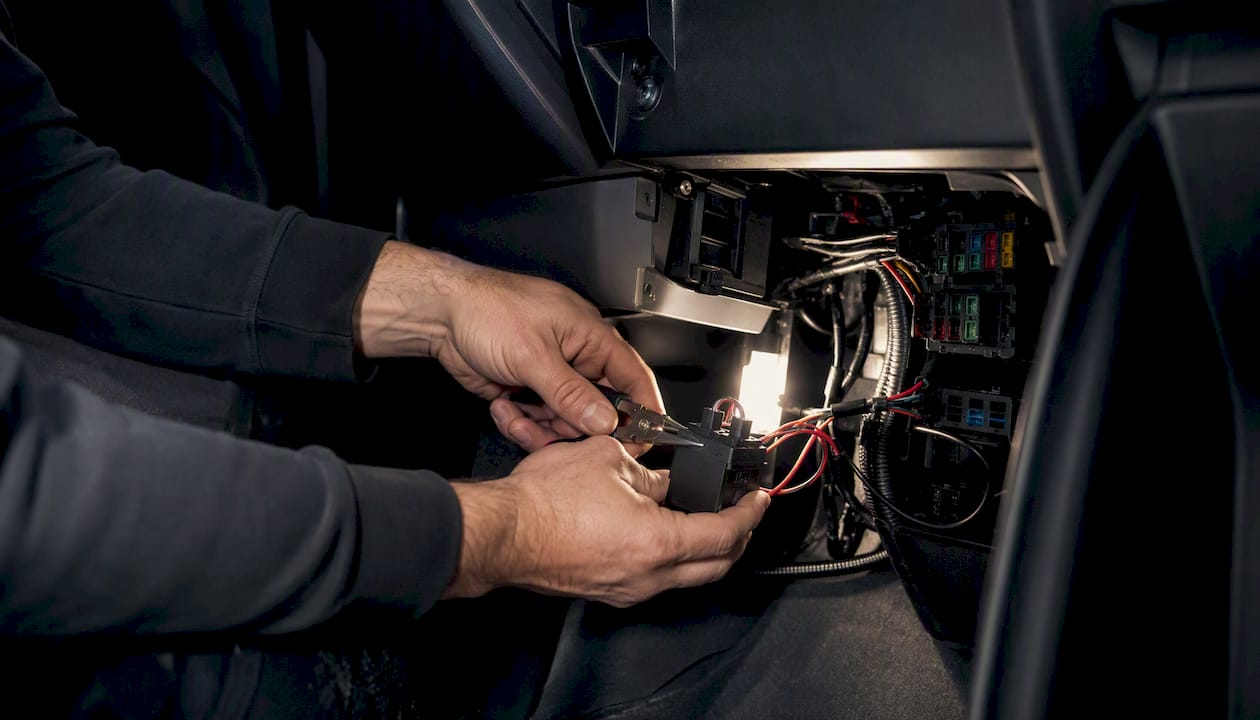
Build at least three modes rather than a simple on/off toggle. A Closed/Eco mode for city and adverse weather, a Partly Open/Highway mode for cruising and towing, and an Open/Performance mode reserved for track use and dry, open roads. If you’ve paired the valve system with a tune, map ignition timing and AFR targets specifically to the flow characteristics of the open setting rather than assuming the factory-adaptive strategy will cover the gap.
Build in fail-safes. A default closed position on startup or loss of signal prevents an open exhaust from becoming the default state during a service visit or inspection. Some setups also tie valve position to an EGT threshold, automatically closing if temperatures climb past a safe range during sustained hard driving.
| Setup Type | Pros | Cons | Best For |
|---|---|---|---|
| Basic remote controller | Simple install, immediate manual control | No automatic adaptation to load or RPM | Daily drivers wanting sound control only |
| OBD2-adaptive device | Real-time fuel trim adjustment, moderate cost | Less precise than a full flash, needs 50 to 150 mile calibration drive | Downpipe-only builds |
| Full ECU flash | Most precise tuning, handles major flow changes | Higher cost, needs a qualified tuner | Headers, long-tube systems, track builds |
Pro Tip: Wire your valve controller through a relay tied to your ignition switch, not a constant-power source. It’s a small step that prevents a dead battery from an open valve left in performance mode overnight.
Testing and Validating Your Valve and Tune Settings
- Baseline dyno pull before any changes, recording horsepower, torque, and AFR across the full RPM range.
- Install the exhaust and valve controller, checking for leaks and confirming valve actuation at low RPM with the engine off and on.
- Repeat the dyno pull in the same conditions, comparing the curve shape, not just peak numbers, since a flatter or dipped low end signals a scavenging problem.
- Log wideband O2 readings during a standardized road test covering city, highway, and at least one hard acceleration pull.
- Measure sound levels with a decibel meter at a fixed distance and RPM, matching the method your local ordinance specifies if one exists.
- Drive 100 to 150 miles across mixed conditions before finalizing any tune, watching for fuel trim drift or intermittent codes.
Maintenance and Common Valve System Problems
Stuck valves are the most common complaint, usually from carbon buildup or a failing actuator rather than a wiring fault. A valve that hangs partway open or closed often responds to a manual cycle test with the controller before you assume the actuator itself has failed.
Rattles almost always trace back to hangers, not the valve mechanism. Standard rubber hangers can struggle under the added vibration and thermal expansion of an upgraded system, and swapping to a higher-durometer polyurethane hanger solves a surprising number of “mystery rattle” complaints. Slip joints and flexible sections also need periodic inspection since they absorb thermal expansion and are the first place a leak tends to develop.
- Check hanger condition and gasket torque every 5,000 to 7,500 miles for street use, more often for track cars.
- Inspect valve actuator wiring connectors for corrosion, especially in climates with road salt exposure.
- Treat a P0420 or P0430 code as a signal to check for exhaust leaks near the O2 sensors before assuming catalytic converter failure.
- Cycle the valve manually every few weeks if a car sits for extended periods, preventing carbon from locking it in one position.
What Actually Matters Once You’ve Lived With a Valved System
Most owners overcorrect toward open valve settings early on, chasing sound over drivability. That fades fast once you’ve dealt with a drone complaint from a passenger on a two-hour highway drive or gotten a curious knock on the window from a neighbor at 6 AM. My honest recommendation for daily driving is closed by default, partly open only when you’re actually enjoying a specific stretch of road, and reserve open for genuine track sessions or closed courses.
The clearest real-world case for condition-based switching isn’t performance at all. It’s the ability to run aggressive on a Saturday track day and completely reasonable on a Monday commute without swapping hardware. That flexibility is the actual value proposition, more than any single decibel figure or torque curve.
Respect towing capacity limits and inspection requirements regardless of how good a partly open setting sounds under load. A valve system that can’t default to a legal, quiet state when you need it to isn’t solving the problem it claims to solve.
Get Your Exhaust Set Up Right for Every Condition
Valve Control Exhaust builds remote-controlled valve systems specifically so you’re not locked into one exhaust note regardless of whether you’re crawling through city traffic or opening it up on a track day. Compatibility spans Audi, BMW, Porsche, Ferrari, Lamborghini, and Mercedes-AMG platforms, with safety defaults built in so the system closes automatically if signal is lost or thermal limits are exceeded.

If you’re deciding between a basic remote setup and something closer to a full adaptive system, start with the exhaust system anatomy breakdown to understand which components you’re actually working with, or go straight to the valved exhaust system benefits page to see how the controller and safety defaults work together. From there, request fitment guidance for your specific model and get a kit built around how you actually drive, not a one-size-fits-all sound profile.
Sources
- How Do Weather Events Affect Roads? — Road Weather, FHWA
- The combined effect of traffic volume and meteorological parameters on crash risk — European Transport Research Review
- ECU Tuning and Exhaust Upgrades: The Best Order for Power Gains | Monte Tuning Blog
- Exhaust Sizing Guide: How to Pick the Right Pipe and Header Size | Mechanics Calculator