A cat-back exhaust typically adds a modest amount of peak horsepower, and where it shows up depends on the engine. The published dyno numbers are small: a couple of horsepower on a high-revving naturally aspirated engine, a few percent in the midrange on another. The bigger wins are weight, sound and, on turbocharged cars, how little back pressure the system puts on the engine. A valved cat-back lets you choose between quiet cruising and a fully open system, so you get the flow when you want it and the calm when you don’t. We build our catalog around that idea.
TL;DR
- A cat-back replaces everything from the catalytic converter rearward: mid-pipes, resonators, mufflers and tips. Its power effect depends on how restrictive the stock parts were.
- Measured gains are real but modest. A Honda S2000 test showed 2.5 hp and 2 lb-ft, and a Honda Integra test showed about 2.6% to 3.1% quicker acceleration in the midrange.
- Weight matters too: the same S2000 system saved about 34 lb over the stock exhaust.
- Turbocharged engines are the most sensitive to restriction after the turbo, which is where an open valve pays off.
- If the biggest restrictions sit upstream, in the header or downpipe, pair the cat-back with those parts.
Table of Contents
- What a cat-back actually changes
- What dyno tests have measured
- Why gains differ from car to car
- How to read a dyno claim
- Where a valved cat-back fits
- Choosing the right setup for your goal
- Fitment, tune and registration
- Where to buy
- Our point of view
- FAQ
- Sources
What a cat-back actually changes
The name says it: everything behind the catalytic converter. That covers the mid-pipe, the resonators, the mufflers and the tips. The converter itself, the downpipe and the header or manifold stay where they are. If you want a plain walk through each section, our exhaust system anatomy guide covers it.
Three things can change when you swap that section:
- Flow. Larger, smoother piping and a freer-flowing muffler reduce the pressure the engine has to push against.
- Weight. Lighter materials and simpler construction take mass off the back of the car.
- Sound. Tone, volume and character change, usually the most noticeable difference.
Only the first of these is directly about horsepower, and it is the one that depends most on the car.
What dyno tests have measured
Numbers beat opinions here, so here are the tests worth knowing.
Honda S2000: small peak gain, once VTEC engaged
Engineering Explained’s dyno test of a Honda S2000 with a titanium cat-back, reported by Motor Authority, showed a gain of 2.5 horsepower and 2 lb-ft of torque. The gain appeared once VTEC engaged, meaning the high-cam, high-rpm part of the powerband where the engine moves the most air and the exhaust has the most work to do.
The same report puts the new system at 15.8 lb against 50 lb for the stock exhaust, a saving of 34 lb. For a car that is judged on balance and response, that is a meaningful change on its own. We go deeper on this in our piece on performance exhaust weight reduction.
Honda Integra: gains in the midrange
Another Engineering Explained test, summarized by Car Throttle, compared a stock 1.8-inch exhaust with a 2.25-inch cat-back on an Integra and averaged three acceleration runs in each condition. The cat-back car was 0.73% slower at low rpm, but 2.59% quicker in the midrange and 3.09% quicker from 2,000 to 6,000 rpm in first gear.
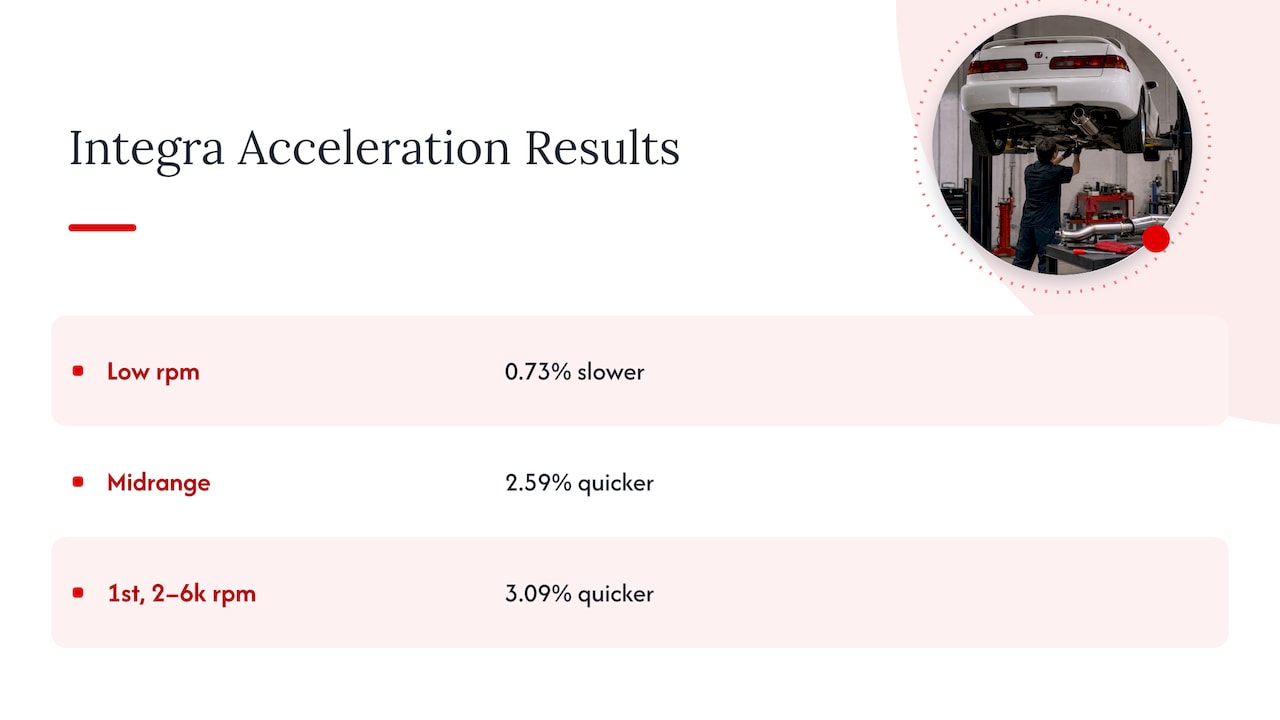
The lesson is where the gain lives. Pipe diameter is a trade-off: smaller piping keeps exhaust velocity up at low rpm, while larger piping gives the engine room to breathe higher in the rev range. A cat-back sized for the engine pays off where the engine is working hardest, which is why a car that mostly lives in traffic feels the effect less than one on a back road or a track.
Why peak horsepower is only part of the picture
A dyno plots power across the whole rev range, and the single peak number hides the shape of the curve. A system that adds a few horsepower through the midrange can feel stronger on the road than one that adds the same figure only at redline. Look at the full curve before and after, not just the headline figure.
Sound is the other half. In the S2000 test, the new system showed similar decibel levels to stock but sounded crisper to the tester. Character, not just volume, is what many owners are buying.
Why gains differ from car to car
The same part can do very different things on two engines. Four factors explain most of the spread.
Where the stock restriction sits
A cat-back only helps where the stock cat-back section was the bottleneck. On the Scion FR-S, Speed Academy’s dyno test of a 2.5-inch cat-back pointed to the catted header and catted front pipe as the main points of restriction in the stock exhaust. On a car like that, the exhaust path upstream is where the airflow is held back, so the greatest gains come from parts that deal with it.
That is why we stock the upstream parts for these platforms alongside the rear section. For the FR-S, that means a non-equal length header and a catless downpipe. The Subaru BRZ, its twin, has a catless downpipe as well. A catless part is built for track and off-road use, so check the emissions rules where the car is registered before you buy.
Forced induction versus naturally aspirated
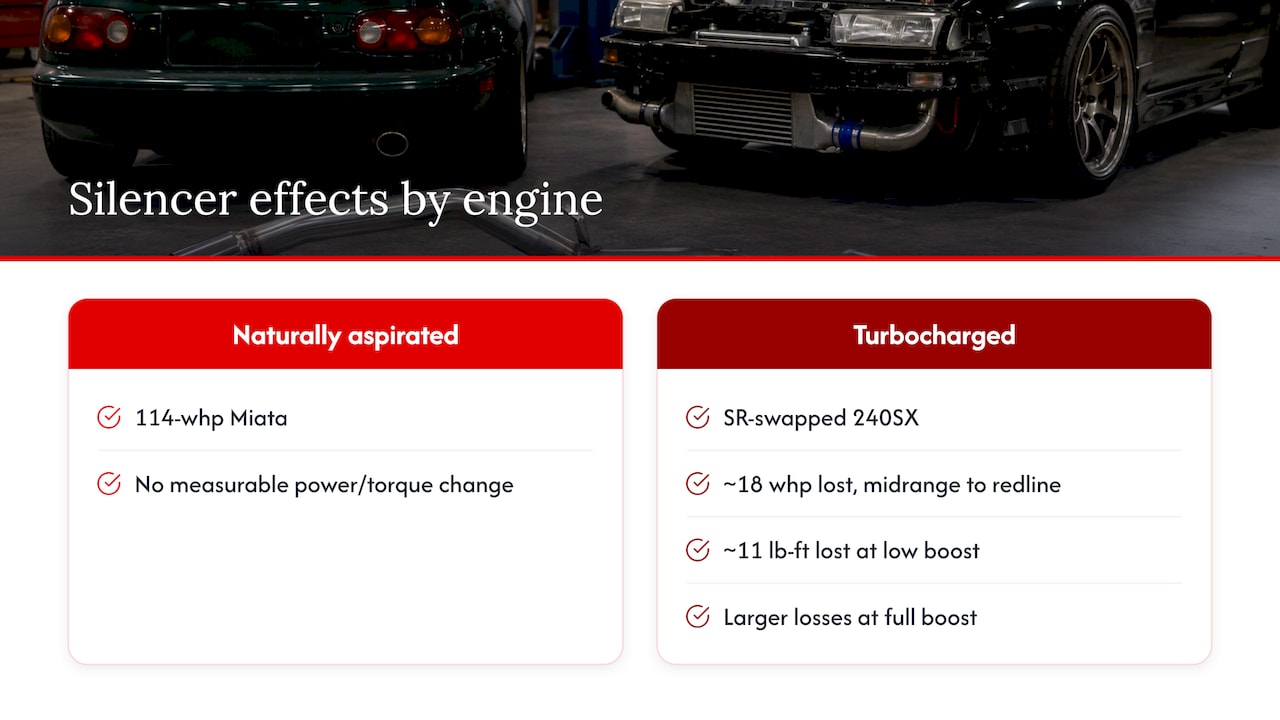
A turbocharged engine uses the exhaust gas to spin the turbine, so anything that raises pressure after the turbo works against it. Motor Trend’s 2009 test, Exhaust Silencer Power Loss, shows the contrast clearly. On a 114-wheel-horsepower naturally aspirated Miata, fitting a silencer in a cat-back made no measurable difference to power or torque. On a turbocharged, SR-swapped Nissan 240SX, the silencer cost about 18 wheel horsepower from midrange to redline and 11 lb-ft at low boost, with larger losses at full boost.
The practical reading: the more boost and airflow an engine makes, the more it rewards a free-flowing rear section. That is also the strongest argument for a valve you can open. With the valve open, the exhaust gas has a straighter, freer path out, and the silencing only comes into play when you close it.
Tune and calibration
Dyno comparisons only mean something when everything else stays equal. Kenne Bell’s component testing on a Camaro held ignition timing and air/fuel ratio constant, so hardware effects were not mixed up with calibration changes. When you read a gain claim, ask whether the tune changed between runs. If it did, the number describes the tune as much as the exhaust.
Pipe diameter and the engine’s modifications
An engine with a bigger turbo, a supercharger or a cam swap moves more air and needs more exhaust capacity. A stock engine can be fully served by a modest diameter. Matching the diameter to the build, rather than going as big as possible, is what keeps low-rpm response intact.
How to read a dyno claim
When a listing or a forum post quotes a number, run it through this short check:
- Same dyno, same day. Before and after runs on the same machine, ideally back to back, in similar temperatures.
- Averaged runs. Single pulls vary. The Integra test averaged three runs per condition for that reason.
- Same tune. Timing and air/fuel held constant, as in the Camaro tests.
- Wheel or crank. Wheel horsepower (whp) is measured at the tires and is lower than crank horsepower, so do not compare one with the other.
- The whole curve. A graph that shows where the gain sits beats a single peak number.
A fair expectation for most cars is a modest, well-placed gain plus the weight and sound changes. Our comparison of cat-back versus axle-back systems explains how far each section can take you, and when a valve makes the difference.
Where a valved cat-back fits
A fixed cat-back makes one decision for you: how much silencing you live with. A valved system splits that decision in two. Closed, it behaves like a refined, quieter exhaust for the commute, the neighbors and the highway drone. Open, it gives the engine the freer flow and the full voice for a spirited drive or a track day.
That is what we mean by real-time control. Our systems offer remote electronic valve control, so you adjust the sound and the flow based on preference and driving conditions, rather than committing once at the point of purchase. For more on how it works day to day, see why a variable valve exhaust outperforms fixed systems and how exhaust valves toggle automatically.
It also changes how you think about the turbo case above. The 240SX lost power with a silencer fitted. A valve gives the silencer a bypass: open it when you want the engine unrestrained, close it when you want quiet.
Choosing the right setup for your goal
| Your goal | What to look at first |
|---|---|
| Sound and character with everyday manners | A valved cat-back, so you can switch between quiet and loud |
| Lower weight at the rear | A lightweight cat-back in titanium or thin-wall stainless |
| More power on a turbocharged car | Downpipe and cat-back together, with the valve open when you want it |
| More power on a naturally aspirated car with restrictive manifolds | Header and front pipe first, then the cat-back |
| A full build on a European exotic | Matched downpipe and rear section for your exact model |
On the downpipe side, we carry platform-specific parts for cars including the BMW X6 40i, the Honda Civic Type R FK8, the Porsche 718 Boxster and Cayman with a sport-cat option, and the Ferrari F430.
Fitment, tune and registration
A few practical points keep the project clean:
- Match the exact model and year. Gasoline particulate filter (OPF) cars and non-OPF cars of the same model use different parts, so confirm the variant before ordering.
- Consider a tune with upstream changes. A downpipe or header changes how much air the engine moves, and a calibration lets the engine use it. A cat-back by itself leaves the factory settings alone.
- Check local emissions rules. Catless parts are for off-road and track use. In the US, requirements differ by state, so check yours before you fit anything upstream.
- Use a lift and a good installer. A cat-back is a bolt-on job in principle, but hangers, clamps and heat shields reward a shop that works on your platform every week.
Where to buy
We sell genuine parts sourced directly from authorized manufacturers, with wide coverage across Audi, BMW, Porsche, Ferrari, Lamborghini, Mercedes-AMG and other performance brands. Start in exhaust parts for the rear section and valved systems, move to downpipes for the upstream side, and see accessories for controllers and finishing parts.

Pick your make and model, add the system and its controller to your cart, and you are set for the weekend.
Our point of view
We look at horsepower gain as one result of an exhaust, not the whole point. The tests are consistent on a few things: weight comes off, the midrange can pick up a few percent, and turbocharged engines care most about what sits behind the turbo.
That is why we put so much weight on valve control. A fixed system picks a compromise on day one. With adjustable valves and a remote controller, you pick again every time you drive: quiet through town, open when the road clears. The flow you want and the manners you need stop being a trade-off.
We only sell genuine products from authorized manufacturers, and we cover a wide range of luxury and performance brands, so the part you order is made for your car. Combine the rear section with the right downpipe or header and you address the whole exhaust path, which is where the real numbers come from.
Info
FAQ
Does a cat-back exhaust add horsepower?
It can. A Honda S2000 test measured 2.5 horsepower and 2 lb-ft with a titanium cat-back, and an Integra test measured midrange acceleration up by roughly 2.6% to 3.1%. The size of the gain depends on how restrictive the stock rear section was and on the engine.
Which engines benefit most from a cat-back?
Engines that move a lot of air gain the most: turbocharged engines, high-revving engines and modified builds. A turbocharged 240SX lost about 18 wheel horsepower with a silencer fitted in Motor Trend’s test, which shows how sensitive boosted engines are to restriction after the turbo.
Do I need a tune after a cat-back?
A cat-back alone typically leaves the engine’s airflow close to stock, so most owners fit it for sound, weight and flow. When you add a downpipe or header, a calibration helps the engine use the extra airflow, so plan the tune with those parts.
Is a cat-back or a downpipe the better first upgrade for power?
For power on a turbocharged car, the downpipe is usually the first piece, since it sits right after the turbo. The cat-back follows it and completes the path. If you want sound and weight savings first, the cat-back comes first. Our team can pair the two for your model.
Sources
- Can a catback exhaust actually make your car faster? (Motor Authority, 2017)
- Exhaust Silencer Power Loss: Fact or Fiction (Motor Trend, 2009)
- Engineering Explained: Exhaust Systems and How to Increase Performance (Car Throttle, 2024)
- Dyno Tested: Scion FR-S Corsa Performance exhaust (Speed Academy)
- Dyno Tests, Bolt Ons & Types of Gas (Kenne Bell, 2015)