BMW exhaust modes work by electronically controlling butterfly valves inside the exhaust system, adjusting sound and backpressure based on the drive mode you select and real-time engine data. This is the core of what BMW calls its active exhaust technology. Understanding how exhaust modes work on a BMW tells you exactly why your M3 sounds subdued on a Sunday morning commute and absolutely alive at full throttle on an on-ramp. Factory systems, aftermarket valve controllers from brands like Valvecontrolexhaust, and hardware upgrades like catless downpipes each play a distinct role in shaping that experience.
How do BMW exhaust valves work technically?
BMW factory exhaust valves are butterfly-style bypass valves controlled by the ECU, opening or closing based on drive mode and real-time engine data. A butterfly valve is simply a flat disc that rotates inside the exhaust pipe. When it rotates open, exhaust gases flow freely. When it closes, gases are redirected through a quieter bypass path.
The ECU reads throttle position, RPM, gear selection, and the active drive mode simultaneously. It uses that data to decide how far to open or close each valve at any given moment. This is not a simple on/off switch. The valve position changes continuously as you drive.
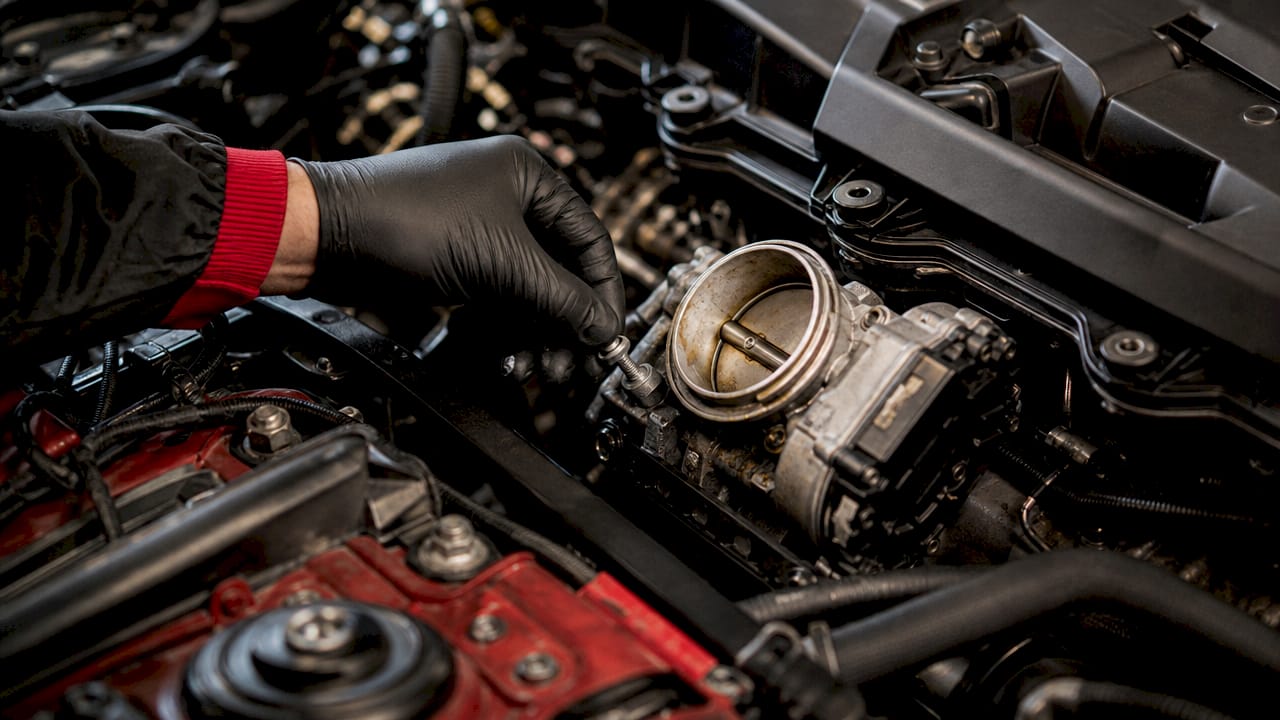
Exhaust valve actuators on BMWs may be electric motors or vacuum-operated servos, with electric actuation being faster, more reliable, and preferred in modern systems. Vacuum systems are slower to respond and more prone to failure over time. Most BMW M models produced after 2018 use electric actuators for this reason.
The butterfly valve’s opening changes exhaust backpressure, affecting the torque curve and throttle responsiveness. This gives the valve a dual role. It shapes both the sound you hear and the performance you feel through the pedal.
Key inputs the ECU uses to control valve position:
- Drive mode selected (Comfort, Sport, Sport+, Individual)
- Engine RPM (valves typically open wider above 3,500 RPM)
- Throttle position (aggressive inputs trigger faster valve opening)
- Gear position (lower gears in Sport+ often hold valves open longer)
- Vehicle speed (highway cruising may trigger partial closing to reduce drone)
Pro Tip: If you want the loudest sound without changing modes, select Sport+ and use manual gear hold in a lower gear at high RPM. The ECU will read the combined inputs and hold the valves open longer than it would in automatic shift mode.
Factory vs. aftermarket exhaust valve controllers: what’s the difference?
The factory system is intelligent but conservative. In Comfort mode, valves remain mostly closed for noise reduction. In Sport and Sport+ modes, they open automatically to enhance sound and performance. The factory logic also accounts for legal noise limits and emissions requirements, which means the valves do not stay fully open even when you want them to.
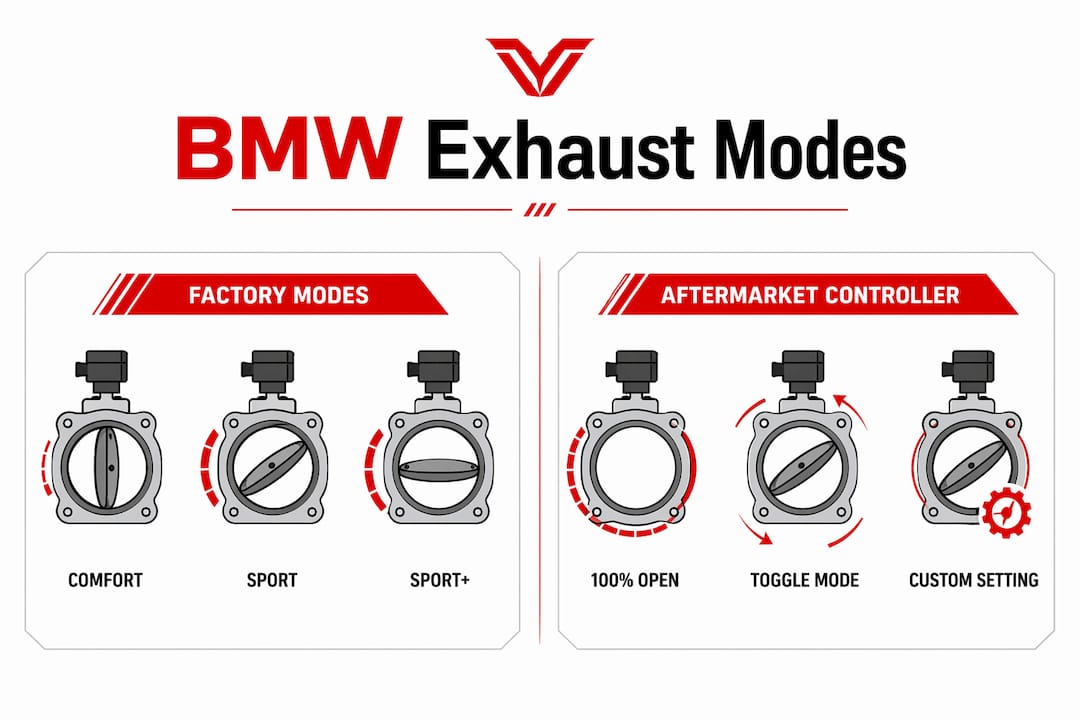
Aftermarket exhaust valve controllers allow BMW owners to override factory logic with four primary valve modes for consistent sound control. These controllers sit inline with the factory valve motor harness. No wires are cut. No ECU reprogramming is needed.
| Mode | Valve behavior | Best for |
|---|---|---|
| 100% Open | Valves stay fully open at all times | Track days, maximum sound |
| OEM Logic | Factory ECU behavior preserved | Daily driving with stock feel |
| Toggle/Balanced | Switches between open and closed on demand | Flexible everyday use |
| Closed | Valves stay fully shut at all times | Quiet neighborhoods, early mornings |
Valve controllers provide a plug-and-play installation process connecting inline with factory valve motor harnesses without cutting wires, preserving vehicle warranty and OEM system integrity. Installation typically takes 30–60 minutes. That is a meaningful advantage for owners who want customization without voiding their warranty.
What aftermarket controllers do not do is add horsepower. Performance gains come more from catless downpipes and tuning than from valve controllers, which primarily affect exhaust sound, not engine power. A valve controller changes what you hear. A downpipe with a tune changes what the engine actually produces.
The right approach depends on your goal. For sound customization with zero permanent modification, a valve controller is the correct tool. For real power gains, you need hardware changes paired with ECU tuning.
How do exhaust modes affect your daily and spirited driving?
The difference between Comfort and Sport+ is not just volume. It is a completely different driving character. In Comfort mode, the closed valves create higher backpressure, which softens throttle response slightly and keeps the exhaust note flat and quiet. That is exactly what you want at 7 a.m. in a residential neighborhood.
Switch to Sport mode and the valves open partially. The exhaust note sharpens. Throttle response tightens because the engine is breathing more freely. The car feels more alive without being antisocial.
Sport+ opens the valves further and holds them open more aggressively. Here is the part most owners get wrong:
- Sport+ does not mean fully open valves at all times. The ECU still closes them intermittently to manage drone and meet noise regulations.
- Highway cruising in Sport+ often triggers partial valve closing. The ECU detects steady-state throttle and reduces valve opening to prevent the cabin drone that ruins long drives.
- Cold starts briefly open valves before closing them to balance backpressure management and noise control, mimicking intelligent factory behavior.
- The most aggressive sound comes at high RPM under load, not at idle, regardless of mode selected.
Stock BMW active exhaust systems balance aggressive sound and noise regulations. This means valves do not remain fully open permanently, contrary to what many owners assume. That misconception leads to frustration when Sport+ does not sound as loud as expected on a highway cruise.
Pro Tip: For track use, pair Sport+ with an aftermarket valve controller set to 100% Open. The controller overrides the ECU’s conservative valve logic while you keep Sport+ for the sharper throttle map and transmission behavior.
For daily driving, Sport or Individual mode with a balanced valve controller setting gives you the best of both worlds. You get a richer sound when you want it and quiet operation when you need it. Check out the BMW M exhaust setup guide for model-specific configuration advice.
What are common BMW exhaust valve problems and how do you fix them?
Exhaust valve problems on BMWs show up in predictable ways. Knowing the symptoms saves you from an unnecessary dealer visit and an inflated diagnostic bill.
Common symptoms of a failing exhaust valve:
- No sound change when switching from Comfort to Sport or Sport+ mode
- Warning light on the dashboard (often an emissions or engine management light)
- Rough idle caused by uneven backpressure from a stuck-open or stuck-closed valve
- Rattling or ticking noise from the exhaust at idle or low RPM
- Valve position that appears fixed regardless of drive mode selected
Malfunctioning exhaust valves can cause warning lights and rough idling. Repairs range from simple resets to motor replacements depending on the actuator type. A stuck valve caused by carbon buildup may only need cleaning. A failed electric actuator motor requires replacement.
Diagnosing the issue starts with checking whether the actuator responds to ECU signals. On electric systems, a multimeter test on the motor connector confirms whether the motor is receiving voltage. On vacuum systems, inspect the vacuum lines for cracks or disconnections first. Those lines are the most common failure point on older BMW models.
Exhaust valve actuators may be electric motors or vacuum-operated servos, with vacuum systems being more prone to failure. If your BMW is a pre-2018 model with vacuum actuation, budget for actuator replacement as a likely maintenance item. Electric actuator replacements on newer M models cost more per unit but fail far less often.
For preventive maintenance, inspect valve linkages and actuator connections during every major service interval. Carbon buildup around the valve disc is the leading cause of stuck valves on high-mileage BMWs. A professional exhaust cleaning service every 30,000–40,000 miles keeps the valves moving freely. For a detailed maintenance breakdown, the exhaust valve maintenance guide covers BMW-specific service intervals and repair costs.
Key Takeaways
BMW exhaust modes control butterfly valves via the ECU, shaping both sound and backpressure across Comfort, Sport, and Sport+ settings, with aftermarket controllers adding fixed-position override capability for consistent sound customization.
| Point | Details |
|---|---|
| Valve type and control | BMW uses butterfly valves actuated by electric motors or vacuum servos, controlled by the ECU. |
| Mode behavior | Comfort keeps valves closed; Sport and Sport+ open them progressively based on RPM and throttle. |
| Sport+ misconception | Valves do not stay fully open in Sport+; the ECU closes them intermittently to manage drone and noise limits. |
| Aftermarket controllers | Plug-and-play controllers add four fixed valve modes without ECU remapping or warranty impact. |
| Power vs. sound | Valve controllers change sound only; real power gains require downpipes and ECU tuning. |
Why I think most BMW owners are tuning their exhaust modes wrong
Most owners I talk to set Sport+ and leave it there, assuming that is the loudest and best option. The reality is more nuanced. The factory ECU is actively working against you in Sport+ at highway speeds, closing valves to reduce drone. You are getting a fraction of the sound the system is capable of delivering.
The smarter move is a valve controller set to Toggle mode for daily driving. You get quiet operation by default and full valve opening on demand. That flexibility eliminates the drone problem that causes so much owner regret. Excessive exhaust drone is the leading cause of owner regret. Experts recommend balancing valve openness with quiet cruising modes for everyday comfort.
Where I see the biggest mistakes is when owners go straight to a fully open catback without addressing valve control first. The result is a car that sounds great for a week and becomes exhausting to live with. Start with a valve controller. Learn what sound level you actually want to live with daily. Then decide if a catback or downpipe upgrade makes sense on top of that foundation.
True horsepower gains require hardware changes like catless downpipes and ECU tuning. A valve controller alone will not move the power needle. But it will transform how much you enjoy the power you already have. That is an underrated value proposition that most performance exhaust marketing completely ignores.
— Info
Valvecontrolexhaust has the exhaust valve solutions BMW owners need
Valvecontrolexhaust specializes in exhaust valve systems built for high-performance vehicles including BMW, Audi, Ferrari, and Lamborghini. Their valve controllers connect directly to factory harnesses, preserve OEM integration, and give you real-time control over valve position without touching the ECU.

For BMW owners ready to move beyond factory mode limitations, Valvecontrolexhaust offers valve controllers, cat-back systems, and downpipe upgrades with full compatibility across major BMW platforms. Their aftermarket exhaust system comparison covers IPE, FI Exhaust, Armytrix, Akrapovic, Valvetronic, and Ryft side by side, so you can make an informed decision before spending a dollar. Browse the full catalog at valvecontrolexhaust.com/shop to find the right fit for your model.
FAQ
What does Comfort mode do to BMW exhaust valves?
In Comfort mode, the ECU keeps the exhaust valves mostly closed to reduce cabin and exterior noise. This increases backpressure slightly and produces a quieter, more subdued exhaust note.
Can I keep my BMW exhaust valves fully open all the time?
The factory ECU will not allow permanently open valves, even in Sport+ mode. An aftermarket valve controller set to 100% Open mode is the only way to hold the valves fully open at all times.
Do exhaust valve controllers add horsepower to a BMW?
No. Valve controllers change exhaust sound by adjusting valve position. Actual power gains require hardware changes like catless downpipes combined with an ECU tune, which can add 20–40 horsepower on turbocharged BMW engines.
How long does it take to install a BMW exhaust valve controller?
Most plug-and-play valve controllers install in 30–60 minutes with no permanent modifications. They connect inline with the factory valve motor harness and require no wire cutting or ECU reprogramming.
What causes a BMW exhaust valve to stop working?
The most common causes are a failed electric actuator motor, cracked vacuum lines on older vacuum-operated systems, or carbon buildup locking the valve disc in place. Symptoms include no sound change between drive modes and a dashboard warning light.