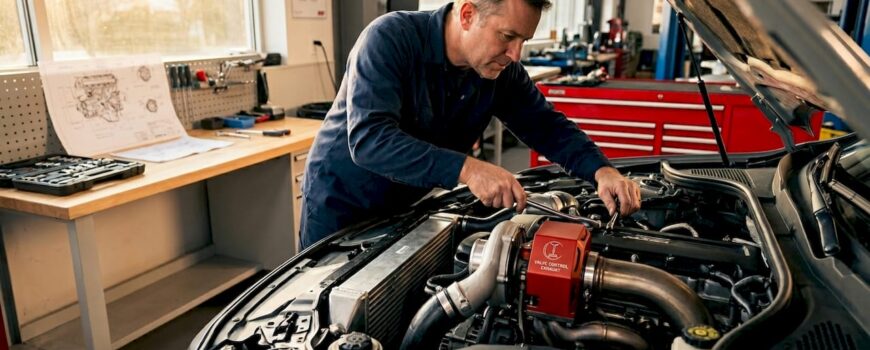
Most performance enthusiasts know that exhaust tuning changes the sound and feel of a turbocharged build. Fewer understand exactly how exhaust affects turbo spool at a mechanical level. The relationship goes well beyond pipe diameter or muffler choice. Exhaust gas velocity, manifold geometry, upstream leaks, and backpressure dynamics all interact with the turbine wheel in ways that can either sharpen your boost response or kill it entirely. This guide breaks down every layer of that relationship so you can make informed decisions rather than expensive guesses.
Table of Contents
- Key takeaways
- How exhaust affects turbo spool: the fundamentals
- Why pre-turbo leaks cripple your build
- Exhaust pipe sizing: velocity versus backpressure
- The non-linear reality of exhaust backpressure
- Practical steps for optimizing exhaust to improve spool
- My take on exhaust tuning for turbo builds
- Upgrade your exhaust with spool performance in mind
- FAQ
Key takeaways
| Point | Details |
|---|---|
| Exhaust velocity drives spool | Higher gas velocity at the turbine inlet accelerates the wheel faster and cuts spool time. |
| Pre-turbo leaks are critical | Even small leaks before the turbine can drop boost by 3 to 5 PSI and dramatically extend spool lag. |
| Bigger pipes are not always better | Oversized exhaust reduces gas velocity and kills scavenging effects, hurting low-end torque and spool. |
| Backpressure has a nuanced role | Under specific load conditions, some backpressure can transiently improve efficiency rather than harm it. |
| Manifold and up-pipe matter most | Changes upstream of the turbo have far greater impact on spool than cat-back modifications. |
How exhaust affects turbo spool: the fundamentals
The turbocharger turbine wheel spins because exhaust gases push against its blades. The faster and more energetically those gases arrive, the quicker the wheel accelerates to the speed needed to generate boost. This is the core of turbo spool time, and your exhaust system controls it from the moment gases leave the combustion chamber.
Three exhaust properties determine how effectively energy reaches the turbine: gas velocity, pressure differential across the turbine, and the coherence of pressure pulses traveling through the manifold runners. When any of these degrades, spool suffers.
Exhaust restrictions lower both turbine and compressor pressure ratios, which reduces turbine speed and compressor output simultaneously. The result is turbo lag and measurable power loss, confirmed through experimental testing. Restrictions also raise exhaust gas temperatures, putting additional thermal stress on turbo components.
Here is what directly affects this energy delivery upstream of the turbine:
- Manifold runner length and diameter: Shorter, equal-length runners improve pulse timing and help each cylinder’s exhaust event contribute cleanly to turbine spin.
- Bend radius in the up-pipe: Tight bends interrupt flow and decrease flow velocity, which directly increases spool time.
- Surface finish inside the exhaust path: Rough welds and casting imperfections create turbulence and rob velocity before gases reach the wheel.
- Turbine inlet gasket and flange integrity: Even minor seepage here redirects exhaust energy away from the turbine.
Pro Tip: Wrap your exhaust manifold in a quality thermal blanket. Heat retention keeps exhaust gas density lower and velocity higher, sending more energy to the turbine wheel rather than losing it to the engine bay.
Manifold and up-pipe leaks or restrictions have significantly greater impact on spool than cat-back changes. If your turbo feels sluggish and you just installed a new axle-back system, do not expect a transformation. The work that changes spool happens closer to the turbine inlet.
Why pre-turbo leaks cripple your build
This is the section most enthusiasts skip because pre-turbo leaks are not dramatic. They do not sound like a blown gasket. They do not produce clouds of smoke. They quietly steal exhaust energy before it ever reaches the turbine, and your ECU has no direct way to tell you they exist.
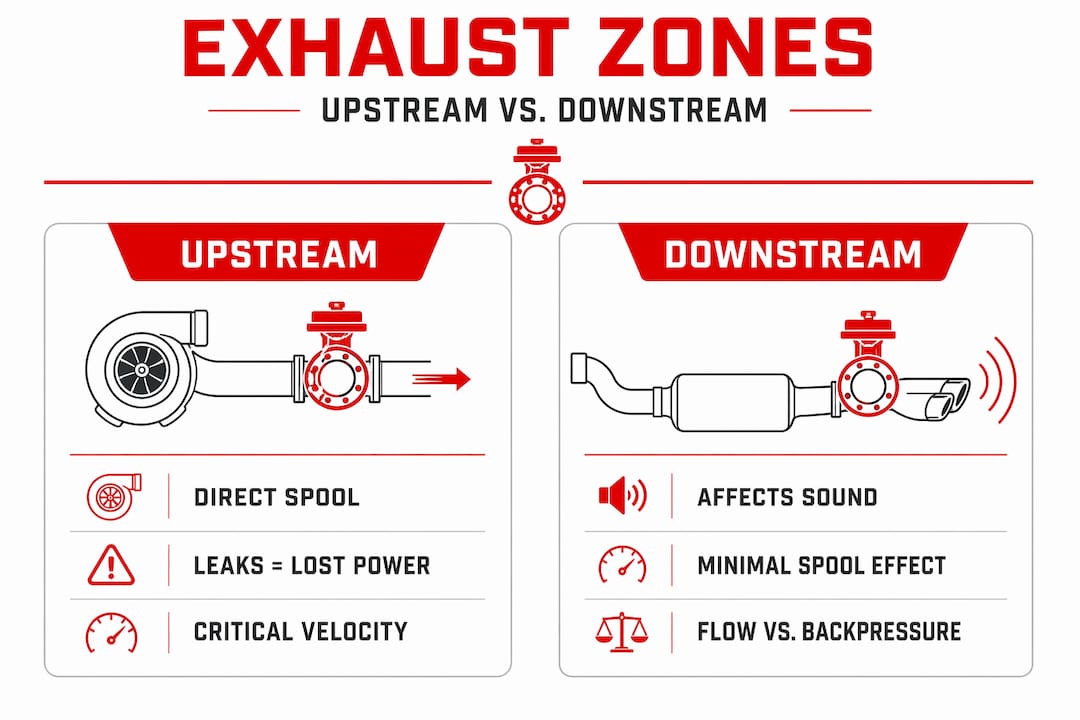
The exhaust system has two distinct functional zones relative to your turbo. Everything upstream of the turbine inlet, including the manifold, up-pipe, and inlet gasket, is the pre-turbo segment. Everything after the turbine, including the downpipe and cat-back, is post-turbo. The physics treat these zones completely differently.
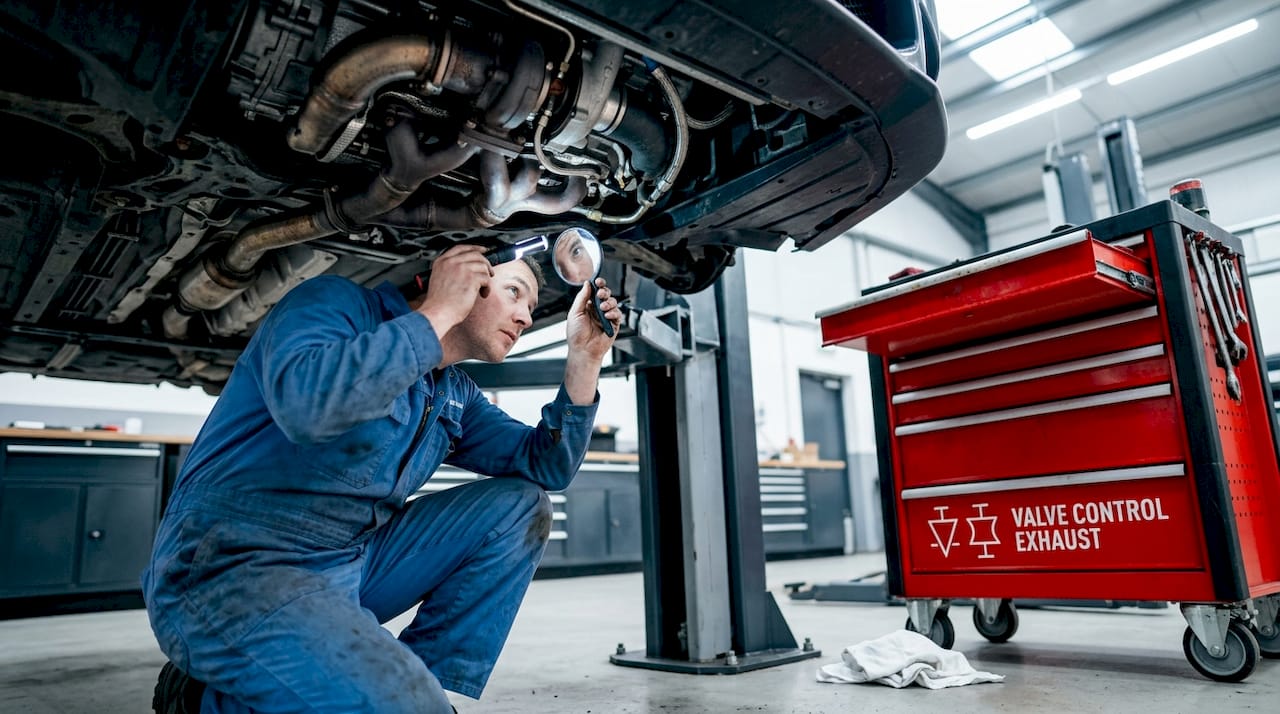
Post-turbo leaks reduce sound and can affect downstream flow but do not directly rob the turbine of energy. Pre-turbo leaks do. When gases escape through a cracked up-pipe weld or a blown gasket at the manifold flange, that energy bypasses the turbine wheel entirely.
Moderate pre-turbo leaks can reduce boost by 3 to 5 PSI or more and cause noticeable increases in spool lag. Fuel economy worsens because the engine compensates by running richer or at higher throttle angles to hit the same power target. Exhaust temperatures also climb, which accelerates wear on turbo seals and the wastegate actuator.
The diagnostic challenge is real. These leaks often do not trigger a check engine light. Common misdiagnoses include:
- Suspected turbo failure or worn bearing
- Faulty boost control solenoid
- Clogged intercooler or charge pipes
- Wastegate not sealing properly
Pre-turbo leaks are frequently mistaken for turbo failure, which leads owners down an expensive path replacing the wrong components. Before condemning the turbo itself, pressure test the full pre-turbo exhaust path. A smoke machine test through the up-pipe is one of the most cost-effective diagnostic steps available.
Exhaust pipe sizing: velocity versus backpressure
The instinct to go bigger with exhaust pipes is understandable. More airflow means more power, right? The reality is more specific than that, and getting sizing wrong in either direction costs you performance.
Exhaust gas velocity is the variable that ties everything together. Optimal exhaust velocity targets fall between 60 m/s and 100 m/s, with backpressure increasing proportionally to velocity squared. Push above 100 m/s and you are generating unnecessary backpressure. Drop below 60 m/s and you lose the scavenging effect that pressure pulses create to help evacuate cylinders more completely.
Here is how pipe sizing plays out in practice:
| Pipe condition | Effect on velocity | Effect on backpressure | Spool impact |
|---|---|---|---|
| Too small | Very high | Very high | Turbo spools against excess resistance |
| Slightly undersized | High | Moderate | Good velocity but elevated pumping loss |
| Optimal diameter | Target range | Minimal | Fastest spool, best torque |
| Slightly oversized | Low-moderate | Very low | Reduced pulse energy, slower low-rpm spool |
| Too large | Very low | Near zero | Severe velocity loss, weak scavenging |
Oversized post-turbo pipes reduce gas velocity and pulse coherence, while undersized pipes create excessive backpressure that raises pumping losses. Neither extreme is acceptable for a performance-focused build. The optimal point depends on your engine’s specific displacement, target RPM range, and turbo matching.
Pro Tip: Use an exhaust diameter calculator based on your engine’s peak flow rate rather than copying a build from social media. A Toyota Supra B58 and a BMW M3 S58 have very different optimal exhaust sizing despite sharing a platform generation. What works for one build can actively hurt another.
Smooth, mandrel-bent tubing matters as much as diameter. Crush-bent pipes create oval cross-sections at each bend, which disrupts laminar flow and creates local high-pressure zones. For a build focused on reducing turbo lag, mandrel bending throughout the exhaust path is non-negotiable.
The non-linear reality of exhaust backpressure
Here is where exhaust tuning gets genuinely counterintuitive. The commonly repeated rule, “less backpressure always equals better performance,” is incomplete. It holds true under most street and track driving conditions, but it does not represent the full physics picture.
Research into turbo compound systems has identified what is called the backpressure supercompensation effect. At specific operating windows, increasing exhaust backpressure can actually improve fuel efficiency and transient power output rather than hurting it. At 5000 rpm and 25% load, specific fuel consumption improved by up to 7.93%, with an 11% power increase, despite elevated backpressure conditions.
“The relationship between exhaust backpressure and turbocharger efficiency is system-specific and load-dependent. Building an exhaust strategy around a single operating point will always leave performance on the table elsewhere.” — Backpressure Supercompensation Research, MDPI Energies
This does not mean you should deliberately add backpressure to your build. What it means is that chasing the absolute minimum backpressure number without considering where your engine spends most of its time operating can produce a setup that feels fast on a dyno and flat on the street. Turbo matching, the relationship between your engine’s operating line and the turbo’s efficiency island, plays a large role in how backpressure affects real-world responsiveness.
The practical takeaway is to measure and datalog rather than assume. A wideband and a boost logger across your normal driving conditions will tell you far more than any generic rule of thumb about what your specific build needs.
Practical steps for optimizing exhaust to improve spool
Knowing the theory is useful. Having a sequenced plan to act on it is better. Here are the priorities in order of impact on turbo spool time:
- Eliminate pre-turbo leaks first. Inspect every weld, gasket, and flange from the manifold to the turbine inlet. Pressure test with a smoke machine if you cannot visually confirm a seal. This single step has more impact than any other exhaust upgrade.
- Optimize your up-pipe. For forced induction applications, the up-pipe routing and integrity directly determine how much exhaust energy reaches the turbine. A high-quality up-pipe with smooth bends and confirmed gasket integrity is the most underrated upgrade in turbo builds.
- Match downpipe diameter to your turbo’s housing. The turbine outlet transitions into the downpipe. Mismatched sizing creates turbulence at the flange and reduces exhaust exit velocity. Match the downpipe inlet to the turbine housing outlet closely.
- Choose mandrel-bent tubing throughout. Crush bends kill velocity at every corner. Mandrel-bent pipes maintain consistent cross-sectional area through each bend, keeping gases moving at their target velocity.
- Consider a high-flow catalytic converter. Stock cats can be a significant restriction, particularly on high-output builds. A high-flow downpipe reduces this restriction while maintaining emissions compliance in many regions.
- Insulate the manifold and turbine housing. Heat retention aids faster spool response by keeping turbine inlet temperatures higher and exhaust gas density lower, preserving more energy for turbine acceleration.
- Verify with datalogs after each change. Boost onset RPM, peak boost values, and boost ramp rate are all measurable. Make one change at a time and log before moving to the next step.
Pro Tip: A turbo blanket is one of the cheapest performance gains available. It typically runs under $150, retains turbine inlet heat effectively, and reduces engine bay temperatures as a bonus. Run one before spending money on larger exhaust components.
My take on exhaust tuning for turbo builds
I have spent considerable time evaluating builds where the owner is convinced the turbo is underperforming, only to find the exhaust system is the actual problem. The pattern repeats: an enthusiast upgrades the intercooler, installs a larger turbo, and maps the ECU, then wonders why spool time barely changed. Nine times out of ten, the up-pipe is cracked, the manifold gasket is seeping, or the downpipe is crush-bent from the factory.
What I have learned from looking at real builds rather than theory sheets is that the exhaust system upstream of the turbine deserves more attention than almost anything else in forced induction tuning. It is not glamorous work. Nobody posts photos of their up-pipe gasket on social media. But fixing that gasket often produces more measurable spool improvement than a $3,000 intercooler upgrade.
The other thing I would push back on is the obsession with cat-back systems for spool improvement. Post-turbo exhaust system tuning improves sound, reduces weight, and can help at very high power levels where the stock system becomes a genuine restriction. But if you are buying a cat-back specifically to tighten up spool response, your money is misallocated. Do the unsexy work first.
My actual recommendation: smoke test the pre-turbo system, mandate proper sizing from manifold to downpipe, and use datalogs to verify every change. Exhaust tuning done right is methodical, not intuitive.
— Info
Upgrade your exhaust with spool performance in mind
If you are ready to act on what you have learned here, Valvecontrolexhaust has done the research work for you. Their performance exhaust buyer’s guide covers top-tier systems from IPE, Armytrix, Akrapovic, Fi EXHAUST, Valvetronic, and Ryft, evaluated specifically for turbocharger responsiveness and exhaust flow characteristics on platforms like Audi, BMW, Ferrari, and Lamborghini.

Valvecontrolexhaust specializes in valve-controlled exhaust systems that allow real-time adjustment of flow and sound characteristics. For turbo builds where you want both faster spool under hard driving and a quieter profile on the street, this kind of adjustability is genuinely useful. Explore their valve control system benefits to see how active exhaust management translates to performance gains and a more engaging driving experience.
FAQ
How does exhaust backpressure affect turbo spool time?
Higher backpressure downstream of the turbine reduces the pressure differential across the turbine wheel, which slows its acceleration and increases spool time. Minimizing backpressure through properly sized, mandrel-bent exhaust tubing keeps the turbine spinning up faster.
Do pre-turbo exhaust leaks really affect boost that much?
Yes, significantly. Pre-turbo leaks can reduce boost by 3 to 5 PSI or more and increase spool lag noticeably, and they are often misdiagnosed as turbo failure because they do not always trigger fault codes.
Will a larger cat-back exhaust improve turbo spool?
Rarely in isolation. Downpipe and cat-back changes generally show far less impact on spool compared to up-pipe and manifold improvements. If spool is the priority, focus on the pre-turbo exhaust path first.
What is the optimal exhaust pipe diameter for a turbo build?
It depends on your engine’s displacement and peak flow rate, but optimal exhaust velocity targets between 60 m/s and 100 m/s give a starting point. Use a flow-based calculator specific to your engine rather than copying another build’s sizing.
Can insulating the exhaust manifold genuinely speed up spool?
Yes. Thermal insulation on the manifold and turbine housing keeps exhaust gas energy from dissipating into the engine bay. Heat retention increases turbine energy and measurably reduces spool time, making turbo blankets one of the highest-value upgrades per dollar spent.