
A race exhaust system is a high-performance exhaust setup engineered to maximize engine output by removing restrictive components like mufflers and catalytic converters, optimizing exhaust gas expulsion, and reducing backpressure. Understanding what does race exhaust system mean separates enthusiasts who chase real power gains from those who simply want louder pipes. These systems are built for off-road and track environments where emissions regulations do not apply, and they require professional ECU tuning to deliver their full potential without causing engine damage.
What does a race exhaust system mean for your engine?
A race exhaust system is defined as a performance upgrade that maximizes exhaust gas velocity and eliminates backpressure by stripping out every component that slows exhaust flow. That includes mufflers, catalytic converters, and resonators. The result is a direct path from the engine’s exhaust ports to the atmosphere, with minimal resistance.
Standard factory exhaust systems are engineered around noise regulations, emissions compliance, and broad drivability. They sacrifice flow for legal compliance. A race system reverses that priority entirely, treating power output as the only goal.
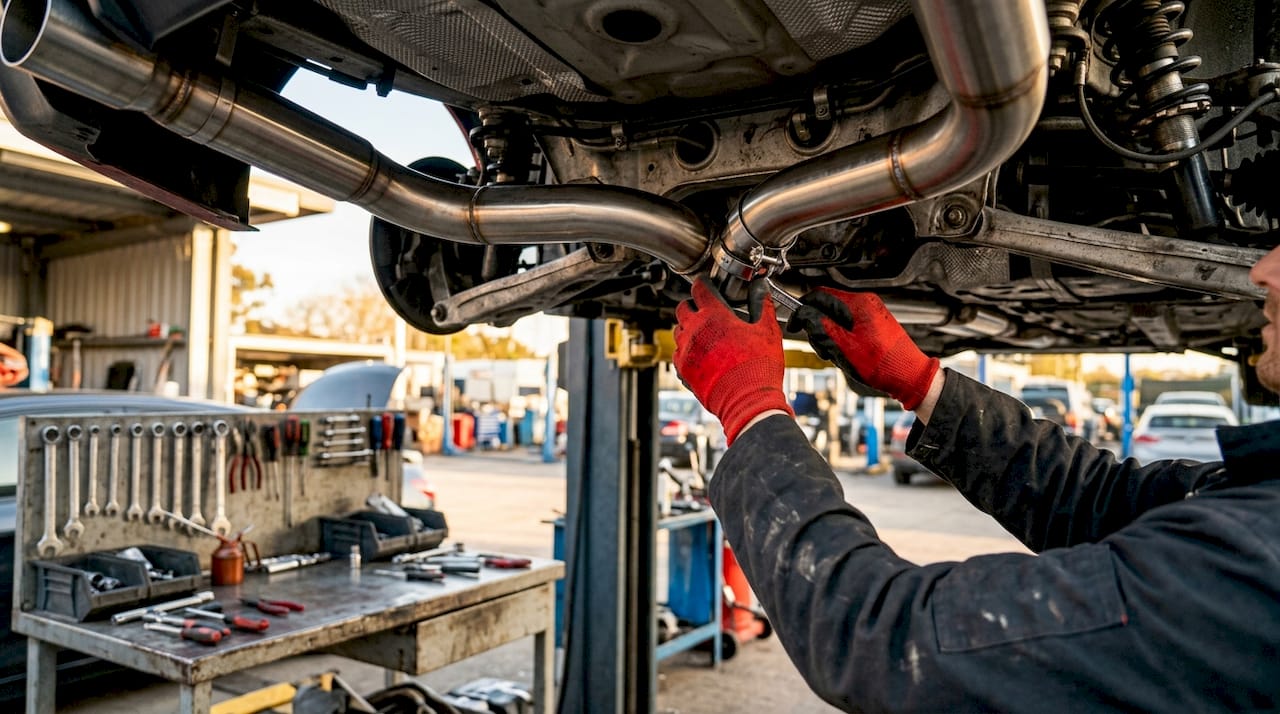
The industry term for the most complete version of this upgrade is a “full race” or “turbo-back” exhaust. A turbo-back system replaces every component from the turbocharger outlet to the tailpipe. On naturally aspirated engines, the equivalent is a “header-back” system. Both eliminate every restriction the factory engineers built in.
Modern race exhausts also use mandrel bends to maintain a constant pipe diameter throughout the system. Crushed bends, common in factory exhausts, reduce the pipe’s internal diameter at corners and create turbulence. Mandrel bending keeps the bore consistent, which keeps gas velocity high.
How does a race exhaust system work to improve engine performance?
The core mechanic is simple: engines produce power by burning fuel and expelling combustion gases. The faster those gases exit, the faster the engine can draw in a fresh air-fuel charge. Every restriction in the exhaust path slows that process.
Race exhaust systems attack this problem at every stage:
- Backpressure reduction. Removing mufflers and catalytic converters eliminates the two biggest flow restrictions in a standard system. Lower backpressure means the engine expels gases more completely on each exhaust stroke.
- Turbo spool improvement. On turbocharged engines, optimized exhaust flow reduces the time it takes for the turbocharger to reach operating speed. Faster spool means power arrives sooner after you press the throttle.
- Exhaust Gas Temperature management. Better flow reduces thermal stress on exhaust components. Lower EGT protects the turbo and keeps the system running within safe temperature ranges under sustained high-load conditions.
- Pipe diameter and header tuning. Primary tube length and pipe diameter must match the engine’s RPM range. Mis-tuning destroys low-end torque even when top-end flow improves.
- Material selection. Race systems use T304 stainless steel or titanium. Titanium saves significant weight and handles extreme heat. Stainless steel costs less and still outperforms factory mild steel in both heat resistance and longevity.
Pro Tip: Never assume a larger pipe diameter always means more power. Pipe sizing must match your engine’s displacement and target RPM band. An oversized pipe on a small-displacement engine kills exhaust velocity and hurts low-end torque.
What are the key benefits and trade-offs of a race exhaust?
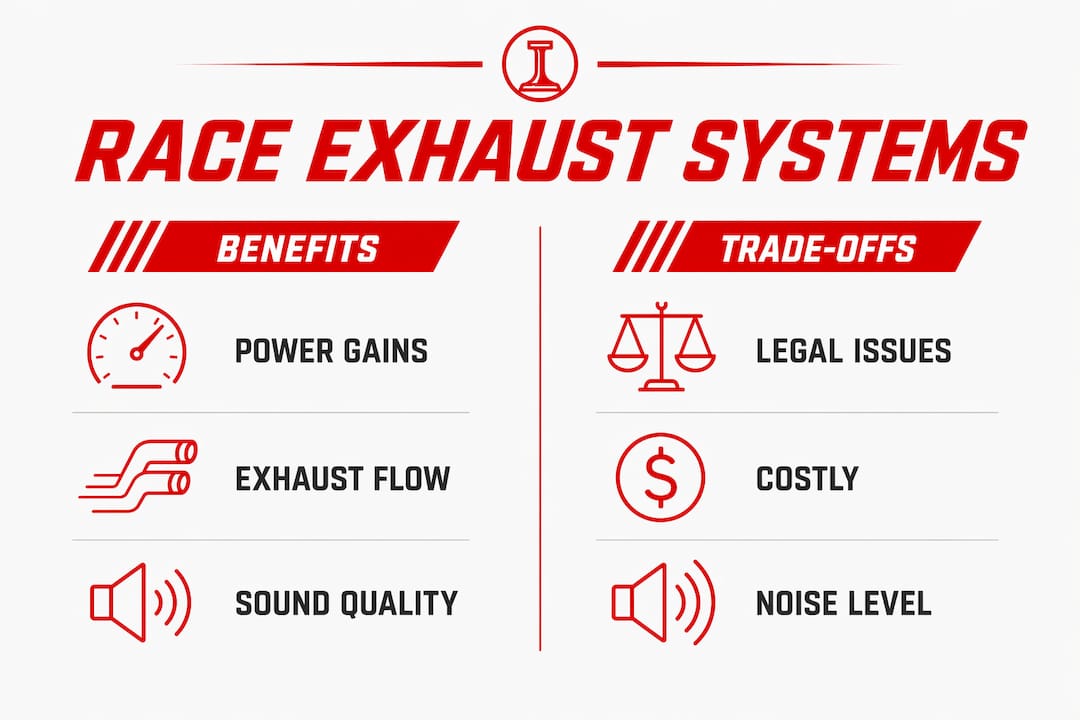
The benefits of a race exhaust system are real, but they come with equally real costs. Enthusiasts who understand both sides make better decisions.
Performance and sound gains
A properly tuned full race exhaust increases horsepower and torque by freeing the engine to breathe. The gains are most significant on turbocharged engines where exhaust flow directly affects boost response. The exhaust sound profile shifts from muted to aggressive, producing a raw, mechanical tone that many track drivers actively seek. High-performance manufacturers aim for a purposeful track tone rather than simply loud and harsh noise.
Legal and regulatory costs
Race exhausts that remove catalytic converters are illegal for road use in most U.S. states and many countries worldwide. Driving on public roads with a cat-deleted system exposes you to fines and failed emissions inspections. Some race tracks also enforce decibel limits, which means an extremely loud race exhaust can get you turned away at the gate.
Financial and practical costs
Full-bolt-on and turbo-back race exhaust systems cost between $800 and over $2,500, not including installation labor or ECU tuning fees. Installation requires cutting, welding, and precise fitment, making professional installation the only realistic option for most enthusiasts. Daily drivability also suffers. Cabin drone at highway speeds, extreme exhaust noise in residential areas, and failed annual inspections are common complaints from drivers who install race systems on street-driven cars.
Pro Tip: If you drive your car to the track and back home, a full race exhaust is the wrong tool. A valved system gives you race-mode sound and flow when you want it, and quiet compliance when you need it.
How do race exhaust systems compare to street-legal options?
Not every performance exhaust is a race exhaust. Three main categories exist, and each serves a different purpose.
| System type | Scope | Legal status | Best use case |
|---|---|---|---|
| Full race / turbo-back | Entire system, no cats or mufflers | Off-road and track only | Dedicated track cars |
| Cat-back | From catalytic converter back | Street legal in most regions | Daily-driven performance cars |
| Axle-back | From rear axle back | Street legal | Sound upgrade, minimal power gain |
Cat-back systems provide the majority of flow and sound benefits for street drivers while keeping the catalytic converter in place. Cat-back alternatives typically cost $300–$800, remain street legal, and pass emissions inspections. They represent the practical middle ground for enthusiasts who want real improvement without legal exposure.
Axle-back systems are the most affordable option and the easiest to install. They change the sound noticeably but deliver minimal power gains because they only replace the muffler and tailpipe section.
A valved exhaust system sits in a separate category entirely. Valvecontrolexhaust builds systems that use electronically controlled valves to switch between a quiet, compliant mode and an open, high-flow mode in real time. Drivers in Audi, BMW, Ferrari, and Lamborghini models can access race-level sound and flow on demand without the legal or comfort penalties of a permanent full race setup. This approach reflects what sound management technology in high-end exhaust engineering now makes possible.
What should enthusiasts know before installing a race exhaust?
Installing a race exhaust without preparation causes more problems than it solves. Follow these steps before committing to the upgrade.
- Check local regulations first. Confirm whether your state or country permits cat-deleted exhaust systems for any road use. In California, for example, CARB regulations prohibit removing catalytic converters on any vehicle driven on public roads, regardless of age.
- Budget for ECU tuning. Improper installation without ECU tuning causes the engine to run lean, triggers check engine lights, and can cause long-term engine damage. Tuning is not optional. Factor it into the total cost before you buy the exhaust.
- Choose materials for your use case. Titanium saves weight and handles sustained high heat better than stainless steel. For a dedicated track car, titanium justifies the premium. For occasional track days, T304 stainless steel performs reliably at a lower cost.
- Plan for professional installation. Full race exhaust installation requires cutting, welding, and precise alignment. A poor fit creates exhaust leaks that reduce performance and produce dangerous fumes inside the cabin.
- Consider your warranty. Installing a race exhaust on a car still under manufacturer warranty voids coverage for any powertrain damage linked to the modification. Consult your dealer before proceeding.
- Think about the full system. Performance exhaust experts treat the exhaust as part of a complete engine exit strategy. A race exhaust paired with a stock intake and untuned ECU delivers marginal gains. Complementary upgrades, including intake, intercooler, and fuel system work, multiply the benefit.
Pro Tip: Before purchasing, use a race mode configuration guide to understand exactly what your target setup requires. Knowing the full picture prevents expensive mistakes.
Key Takeaways
A race exhaust system delivers maximum engine performance on track but demands ECU tuning, legal awareness, and professional installation to work correctly.
| Point | Details |
|---|---|
| Core definition | A race exhaust removes mufflers and catalytic converters to maximize exhaust flow for off-road and track use. |
| ECU tuning is mandatory | Installing without tuning causes lean running conditions and risks serious engine damage. |
| Legal restrictions are real | Cat-deleted systems are illegal for road use in most U.S. states and many countries worldwide. |
| Cat-back is the street alternative | Cat-back systems cost $300–$800, stay street legal, and deliver most of the sound and flow benefit. |
| Valved systems bridge the gap | Electronically controlled valves provide race-level flow on demand without permanent legal or comfort penalties. |
Why loudness is the wrong metric for choosing a race exhaust
The most common mistake I see enthusiasts make is treating volume as a proxy for performance. A straight-pipe race exhaust is loud. It is also frequently slower than a well-tuned cat-back on a street car because the pipe sizing is wrong, the ECU was never adjusted, and the low-end torque has been gutted chasing top-end flow numbers.
Real engineering in this space is about matching the exhaust system to the engine’s actual operating range. Proper header primary tube length, correct pipe diameter, and mandrel bends matter far more than removing every silencing component. The leading valved exhaust systems I have studied use Reflective Sound Cancellation to reduce cabin drone while keeping exhaust flow completely unrestricted. That is a harder engineering problem than simply deleting the muffler, and it produces a better result for most drivers.
For a daily-driven performance car, a full race exhaust is almost always overkill. The legal exposure alone makes it impractical. A valved system or a quality cat-back gives you 90% of the experience with none of the inspection failures or neighbor complaints. Save the full race setup for a car that never sees a public road.
— Info
Performance exhaust options worth knowing about
Choosing the right exhaust upgrade for a high-performance vehicle requires more than picking the loudest option on the market. Valvecontrolexhaust specializes in valved exhaust systems for Audi, BMW, Ferrari, and Lamborghini, giving drivers real-time control over sound and flow without sacrificing street legality.

Their performance exhaust buyer’s guide covers the technical criteria that separate genuine engineering from marketing claims, including material quality, valve actuation systems, and fitment compatibility. For enthusiasts who want to understand exactly what they are buying before spending $800 to $2,500 or more, that level of detail makes a real difference. Valvecontrolexhaust also offers specialist fitting guidance to help owners maximize every gain the system delivers.
FAQ
What does a full race exhaust system mean?
A full race exhaust system replaces every component from the engine’s exhaust manifold or turbocharger outlet to the tailpipe, removing all mufflers and catalytic converters to achieve maximum exhaust flow. It is designed exclusively for off-road and track use.
Does a race exhaust system increase horsepower?
Yes, a properly tuned race exhaust increases horsepower and torque by reducing backpressure and improving exhaust gas velocity. The gains are most significant on turbocharged engines, and ECU tuning is required to realize them safely.
Is a race exhaust system street legal?
Race exhaust systems that remove catalytic converters are illegal for road use in most U.S. states and many countries due to emissions and noise regulations. Running one on public roads risks fines and failed inspections.
What is the difference between a race exhaust and a cat-back exhaust?
A cat-back exhaust replaces components from the catalytic converter back and remains street legal, while a race exhaust removes the catalytic converter entirely for maximum flow. Cat-back systems cost $300–$800 and suit daily-driven performance cars.
Do I need to tune my car after installing a race exhaust?
ECU tuning is mandatory after installing a race exhaust. Without it, the engine runs lean, check engine lights activate, and sustained engine damage becomes a real risk.