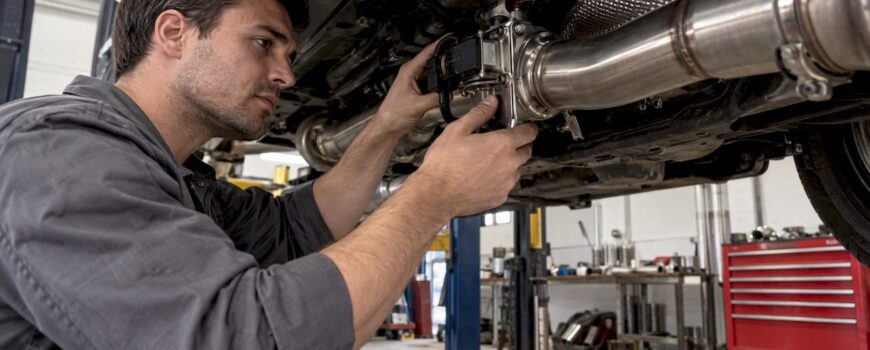
If your build has moderate power and you need compact fitment with strong low and mid-range response, a 2.5 inch system is usually the smarter pick. For higher power levels, especially with sustained high-RPM power or forced induction, 3 inch typically flows better. Packaging limits and emissions rules can override either recommendation, so treat this as a starting point, not a final answer.
TL;DR:
- Naturally aspirated engines below 300 horsepower generally suit 2.5 inch piping; at 220 to 300 horsepower, it can preserve throttle response and midrange torque.
- Turbocharged street builds producing 300 to 450 horsepower generally benefit from 3 inch piping, especially after the downpipe, while sustained high RPM favors greater flow.
- A 3 inch upgrade may require a redesigned midpipe or relocated mounts, and header primaries and collector dimensions can matter more than tailpipe diameter.
- Replacing exhaust sections outside certified configurations can create emissions tampering liability; retain verified catalytic converter replacements and confirm that installers know local rules.
- For builds that need quiet cruising and full flow under load, electronic valves can alter the exhaust path instead of forcing one fixed compromise.
Table of Contents
- 2.5" vs 3" at a glance: pros, cons, and typical use cases
- How pipe diameter affects flow, scavenging, and peak power
- How exhaust diameter changes tone, resonance, and perceived loudness
- Fitment, header relationships, and staying within U.S. rules
- How valve control changes the 2.5" vs 3" trade-off
- Picking the right diameter for your build
- A valved exhaust gives you both diameters in one system
- FAQ
- Sources
2.5" vs 3" at a glance: pros, cons, and typical use cases
Before getting into the engineering, here’s how the two diameters stack up for most street and track builds.
2.5 inch advantages:
- Keeps exhaust gas velocity high at lower RPM, which supports quicker spool and crisper throttle response on four- and six-cylinder engines.
- Fits more easily around factory crossmembers, fuel tanks, and rear subframes without custom bends.
- Weighs less than an equivalent 3 inch system, a small but real factor on track-focused builds.
3 inch advantages:
- Offers more flow capacity for engines making 300 to 500-plus horsepower, particularly turbocharged setups.
- Supports higher-RPM power without the flow restriction that chokes a 2.5 inch pipe near redline.
- Scales better when paired with upgraded turbos, bigger throttle bodies, or built engines expecting more airflow down the road.
A naturally aspirated four-cylinder making 220 horsepower rarely benefits from 3 inch piping and can actually lose low-end snap. A turbocharged six making 380 horsepower will usually suffocate on 2.5 inch pipe at higher boost. Neither diameter is the right call when packaging won’t allow the bends needed, or when a multiple-into-one collector design changes the effective flow path. In those cases, the collector and primary sizing matter more than the tailpipe diameter itself.
How pipe diameter affects flow, scavenging, and peak power
The old idea that engines “need backpressure” doesn’t hold up under testing. Engine Masters testing with Westech engineers showed that what actually matters is exhaust gas velocity and pulse scavenging, not resistance in the pipe. A properly sized exhaust uses the pressure wave from one cylinder’s exhaust pulse to help pull the next cylinder’s spent gases out, a timing effect called scavenging. Oversize the pipe and that wave loses strength, dragging down low and mid-RPM torque even though peak flow capacity goes up.
The MotorTrend and Engine Masters comparison frames this as a powerband trade-off rather than a simple bigger-is-better call. A 2.5 inch system tends to hold velocity longer at low RPM, which is why it feels stronger off idle and through the midrange on smaller engines. A 3 inch system needs more airflow to keep velocity up, but once an engine is making enough volume, usually north of 300 horsepower on gasoline four- and six-cylinders, the larger pipe stops being a liability and starts being the limiting factor if you keep the smaller one.

Primary pipe size and header length shift these numbers too. A long-primary header tuned for midrange torque pairs naturally with 2.5 inch downstream piping, while a short-primary, high-RPM-biased header often wants 3 inch or larger to avoid choking at the top of the rev range. As a conservative guideline drawn from this testing, a single 2.5 inch system comfortably supports moderate horsepower builds, while a single 3 inch system can handle considerably higher power before a second pipe or larger diameter becomes necessary.
Two quick scenarios: a naturally aspirated 2.0-liter four making 220 to 300 horsepower will generally make more usable power through 2.5 inch piping, with better throttle response and a fuller midrange. A turbocharged inline-six making 350-plus horsepower, especially with any supporting mods, will usually respond better to 3 inch piping from the downpipe back, since turbo systems depend on volume to avoid choking the turbine at higher boost levels.
How exhaust diameter changes tone, resonance, and perceived loudness
Diameter doesn’t just affect power, it changes how the car sounds. Larger piping tends to deepen the tone and broaden the frequency range, producing a fuller, more resonant note. Smaller diameter piping tends to emphasize higher harmonics, giving a raspier, sometimes louder-feeling sound even at a similar decibel reading.
- Muffler and resonator design interacts heavily with pipe diameter, so two 3 inch systems can sound completely different depending on internal baffling.
- Valve control systems add another layer, letting the same pipe diameter sound quiet at idle and significantly more aggressive at wide-open throttle.
- Perceived loudness and measured decibels don’t always match: a sharper-pitched smaller pipe can feel louder in the cabin than a deeper, larger one reading the same dB level.
Pro Tip: Judge exhaust note by how it sounds during normal cruising and at wide-open throttle separately. A system can be quiet and civil at 2,000 RPM, then open up entirely once you’re on it.
Fitment, header relationships, and staying within U.S. rules
Packaging is often the deciding factor long before power targets matter. Frame rails, fuel tanks, and factory hanger positions limit how large a pipe can realistically run without custom bends or relocated mounts, and stepping up to 3 inch frequently forces a full mid-pipe redesign rather than a simple swap. Collector and primary sizing also change the effective diameter of the system. On many naturally aspirated builds, enlarging the header primaries and collector earlier in the system produces more low-end gain than enlarging the tailpipe, since the whole path from header to tip functions as one tuned system rather than independent sections.
Turbocharged applications add another variable. Turbine housing size, spool characteristics, and downstream backpressure behave differently than naturally aspirated exhaust, and turbo-specific exhaust tuning often means balancing turbine A/R and downpipe diameter together rather than choosing pipe size in isolation.
One compliance note worth taking seriously: EPA tampering policy treats catalytic converter placement, pipe diameter, and overall exhaust configuration as part of the certified emissions system, and state-level guidance from Ohio EPA confirms that replacing sections in ways that depart from certified configurations can create tampering liability. Sticking with verified catted replacements and checking your installer’s familiarity with local rules avoids most of that risk.
How valve control changes the 2.5" vs 3" trade-off
Valve-controlled exhaust systems change this equation by letting the exhaust path adjust in real time instead of locking in one diameter’s trade-offs permanently. A 3 inch system with electronic valves can route flow through a restricted path at low RPM for better low-end manners, then open fully at higher RPM or under load for maximum flow. That’s the core idea behind how valved systems avoid the backpressure trade-off entirely rather than compromising on one diameter.
We offer customizable valved exhaust systems designed for compatibility with various luxury and performance vehicles, sourcing genuine products from authorized manufacturers. For a turbocharged build targeting both daily comfort and track-day flow, a valved 3 inch system is often the practical answer rather than choosing one diameter and living with its limits.

Picking the right diameter for your build
For a naturally aspirated street engine under 300 horsepower, 2.5 inch piping usually delivers the better balance of response and fit. Turbocharged street builds in the 300 to 450 horsepower range tend to do better on 3 inch, particularly from the downpipe back. Track-focused builds chasing peak power at high RPM almost always want 3 inch or a valved equivalent that can flow freely at full throttle. Whatever target you’re chasing, a few minutes with a tuner or a dyno session before finalizing pipe diameter saves you from guessing. When choosing an installer or system, check that they can match pipe diameter to your actual power band rather than defaulting to the biggest pipe available.
— Info
A valved exhaust gives you both diameters in one system
Instead of locking into one diameter’s trade-offs, a valve-controlled system lets you tune sound and flow characteristics as driving conditions change, closed and quiet around town, open and free-flowing when you want it.

Browse our exhaust parts and downpipe categories to see what fits your platform, and check our guide on catted downpipe benefits if you’re weighing compliance against flow. Every part ships compatible with your specific chassis and engine code.
FAQ
Is a 2.5 inch exhaust loud?
A 2.5 inch exhaust tends to produce a sharper, higher-pitched tone rather than outright loudness, since smaller diameter piping emphasizes higher harmonics. Actual loudness depends more on muffler and resonator design than on pipe diameter alone.
How much horsepower will a 3 inch exhaust support?
A single 3 inch exhaust system can generally support higher horsepower builds before a larger diameter or dual setup becomes necessary, based on Engine Masters dyno testing. Turbocharged engines with higher boost levels may need the extra capacity sooner than naturally aspirated engines.
Would a 3 inch exhaust pipe change the tone of the engine?
Yes, a 3 inch exhaust typically produces a deeper, fuller tone with a broader frequency range compared to a 2.5 inch system. The exact character still depends heavily on muffler design and whether the system includes valve control.
What is the maximum horsepower a single 2.5 inch exhaust can handle?
A single 2.5 inch exhaust system comfortably supports moderate horsepower on most naturally aspirated four- and six-cylinder engines, according to comparative dyno testing. Beyond that range, exhaust gas velocity and flow capacity start limiting power, especially at higher RPM.
Sources
- Engine Masters Ep. 9 Busts the Backpressure Myth: 3-inch vs. 2.5-inch Exhaust!
- EPA Tampering Policy – The EPA Enforcement Policy on Vehicle and Engine Tampering and Aftermarket Defeat Devices
- Ohio EPA Frequently Asked Questions Regarding Repairs Of Exhaust and Emissions Systems
- The Power of 2.5- vs. 3-Inch Exhaust (Engine Masters / MotorTrend)