
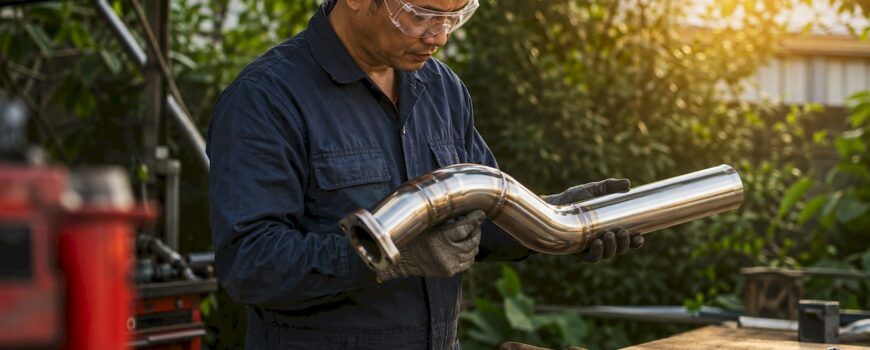
T304 stainless exhaust means your exhaust components are made from AISI/ASTM 304 austenitic stainless steel, an alloy with roughly 18% chromium and 8–10% nickel that forms a self-repairing passive oxide layer on its surface. That chemistry is why T304 systems resist road salt, moisture, and condensation far better than aluminized steel or 400-series alternatives, and why they hold a mirror-bright finish for years instead of months.
- What T304 is: An austenitic 18-8 stainless alloy, standardized under AISI/ASTM 304 and sold under the T304 shorthand in North America.
- Who benefits most: Daily drivers in coastal or salted-road regions, luxury and show car owners, and anyone planning to keep a vehicle long-term.
- One real drawback: Higher upfront cost than T409 or aluminized steel, and at extreme sustained temperatures (race headers, turbo housings), stabilized grades can outperform it.
Table of Contents
- What the “T304” label actually means
- Core material properties that matter for exhaust systems
- How T304 compares to other exhaust materials
- Known disadvantages and limits of T304
- What fabricators and DIYers need to know about working with T304
- Which grade fits your vehicle and environment?
- How Valvecontrolexhaust uses T304 in high-end valved systems
- Key Takeaways
- Why material selection is more than a spec sheet decision
- T304 valved exhaust systems from Valvecontrolexhaust
- Useful sources and further reading
What the “T304” label actually means
T304, 304, and SUS304 all refer to the same base alloy. T304 is the common North American shorthand; SUS304 is the Japanese Industrial Standard (JIS) designation. When you see either on a spec sheet or product listing, you’re looking at the same 18-8 austenitic composition governed by AISI and ASTM standards.
One naming detail worth knowing: most 304 tubing sold for exhaust work carries a dual 304/304L designation. The “L” stands for low carbon. That lower carbon content reduces a phenomenon called sensitization during welding, which in plain terms means the weld zone stays corrosion-resistant instead of becoming a weak point. For exhaust fabrication, 304/304L is the practical standard, not an upgrade.
Core material properties that matter for exhaust systems
The corrosion resistance in T304 comes directly from its chromium content. Chromium reacts with oxygen to form a thin, stable oxide layer on the steel’s surface. Scratch it, and the layer reforms on its own. Nickel stabilizes the austenitic crystal structure, which keeps the steel non-magnetic under normal conditions and gives it the ductility needed for mandrel bending and tight exhaust routing.
18% chromium / 8–10% nickel: That’s the “18-8” shorthand you’ll see on spec sheets. Compared to T409, which carries much lower nickel and chromium, T304’s higher alloy content is what drives its superior corrosion performance and brighter finish.
A few properties that translate directly to exhaust service life:
- Road salt resistance: The passive oxide layer holds up against chloride attack far better than aluminized coatings, which can chip and expose bare steel.
- Condensation tolerance: Cold-start condensation inside the exhaust is mildly acidic. T304 handles it; aluminized steel eventually doesn’t.
- Finish durability: Polished T304 stays bright with basic cleaning. It won’t pit or flake the way coated steels do.
- Thermal discoloration: Gold and bluish hues after heat exposure are normal and cosmetic, not structural failure. The steel underneath is fine.
Expected service life on a T304 system in a harsh climate runs significantly longer than aluminized steel, which can show through-rust within a few years on salted roads.
How T304 compares to other exhaust materials
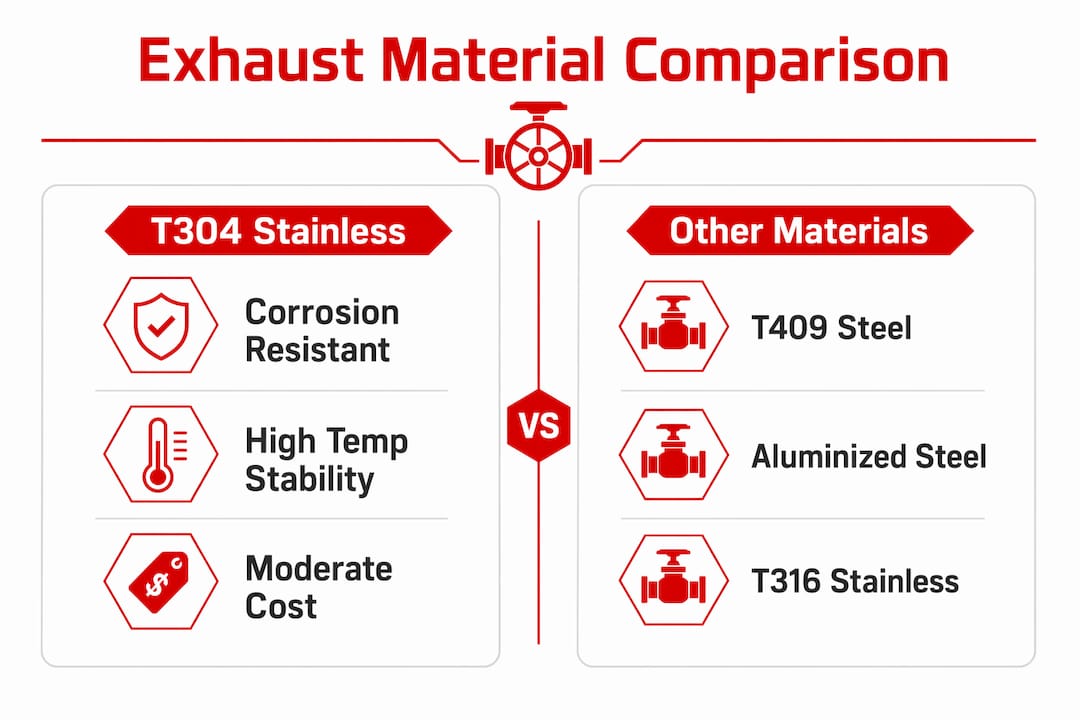
T304 offers superior road-salt corrosion resistance versus T409 and aluminized steel, but the right material depends on your environment, budget, and how you use the car.
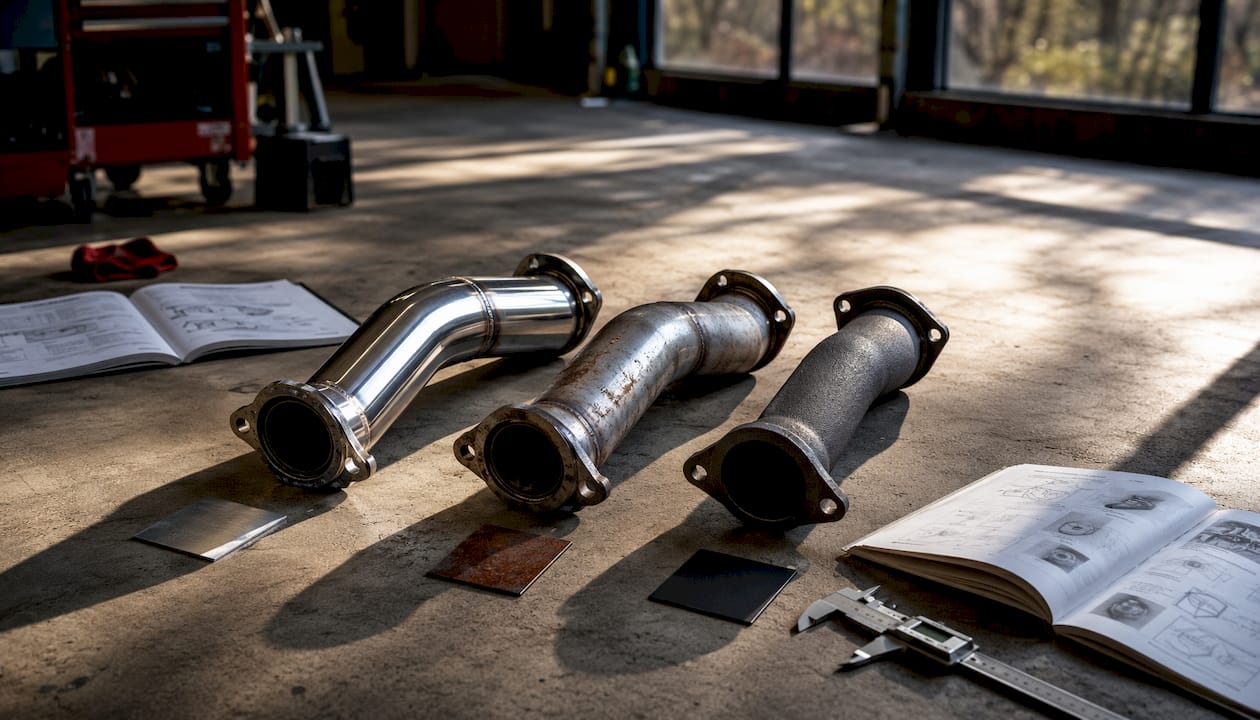
| Material | Corrosion resistance | High-temp stability | Cost vs. T304 | Weldability | Typical exhaust use |
|---|---|---|---|---|---|
| T304 | Excellent | Good | Baseline | Excellent (304L) | Pipes, mufflers, tips, mid-pipes |
| T409 | Fair | Good | Lower | Good | OEM pipes, budget catbacks |
| Aluminized steel | Fair (coating-dependent) | Good | Lowest | Fair | Budget OEM, short-term builds |
| T316 | Excellent–Superior | Good | Higher | Excellent | Marine, extreme salt environments |
| 321/347 | Good | Excellent | Higher | Good | Race headers, turbo systems |
T409 is a ferritic 400-series steel with lower chromium and minimal nickel. It’s magnetic, less expensive, and adequate for moderate climates, but it can show surface rust after salt exposure. Fine for a budget catback in a dry climate; not the call for a coastal daily driver.
Aluminized steel gets its protection from an aluminum-silicon coating. Once that coating chips or wears, the bare steel underneath rusts quickly. It’s the cheapest option and the shortest-lived.
T316 adds molybdenum to the 304 formula, pushing chloride resistance even higher. Worth considering for boats or vehicles in extreme marine environments, but the cost premium over T304 is hard to justify for most street cars.
321 and 347 are stabilized grades. 321 uses titanium and 347 uses columbium (niobium) to prevent intergranular corrosion at sustained high temperatures. They’re the right call for race headers and turbo housings that see temperatures beyond T304’s comfortable range.
Known disadvantages and limits of T304
T304 is not the right answer for every application. Three real constraints:
- Cost: T304 costs more than T409 or aluminized steel. The payback comes over time through longer service life and retained appearance, but the upfront number is higher.
- Extreme heat: At sustained very high temperatures, T304 can develop intergranular corrosion at grain boundaries. For race headers or turbo-adjacent components that stay hot for extended periods, stabilized grades like 321 or 347 are the better specification.
- Cosmetic changes: Heat discoloration to gold or blue is permanent without polishing. It doesn’t hurt the steel, but it surprises owners who expect the finish to stay silver.
Pro Tip: Before buying, ask the seller whether the tubing is supplied as 304 or 304/304L. For any system that will be welded or modified, 304L is the safer spec. The dual designation costs nothing extra and protects the weld zones.
Magnetism is another point of confusion. T304 is normally non-magnetic, but it can pick up slight magnetism after heavy cold work or welding. That doesn’t mean the material is wrong; it means the crystal structure shifted locally under stress.
What fabricators and DIYers need to know about working with T304
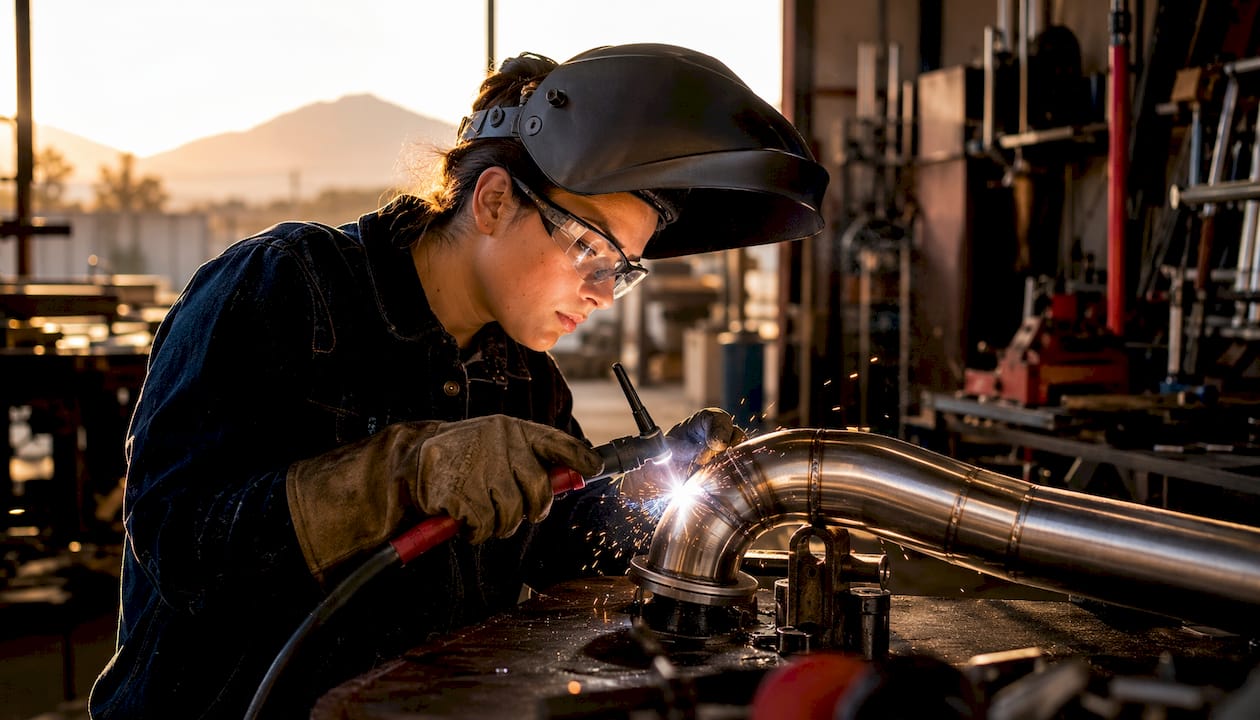
TIG welding is the preferred method for T304 exhaust work. It gives you precise heat control, which matters because overheating the heat-affected zone is what triggers sensitization. If you’re MIG welding, use a low-carbon 308L or 316L filler to keep the weld zone’s carbon content down.
A few practical points for shop work:
- Filler metal: Match to 308L or use 304L base material. Both minimize intergranular corrosion risk at the weld.
- Wall thickness: Most performance exhaust tubing runs 1.5–2.0 mm wall. Thicker walls extend life and reduce resonance but add weight and cost.
- Finish options: Polished tips stay bright longest. Brushed finishes hide minor scratches better. Black-coated tips look sharp but the coating can chip near high-heat zones, so keep them away from headers.
- Post-weld cleanup: Remove heat tint with a stainless-specific pickling paste or fine abrasive. Leaving carbon steel tools or wire brushes on the surface can cause contamination rust.
Pro Tip: Testing with a magnet is unreliable near welds and bends. If you want to verify the material is genuinely T304, test a straight, unworked section of tubing away from any bend or weld zone. A slight magnetic response near a weld is normal; a strong pull on straight tubing is a red flag.
For exhaust valve maintenance on valved systems, the same principles apply: keep the stainless clean, avoid cross-contaminating with carbon steel hardware, and inspect weld zones annually on high-heat applications.
Which grade fits your vehicle and environment?
The honest answer is that T304 is the right call for most enthusiasts, but not every situation demands it.
- Daily driver, moderate climate (no road salt): T409 is adequate and saves money. T304 is a nice-to-have, not a necessity.
- Coastal or salted-road environment: T304 is the clear choice. The corrosion resistance gap over T409 is real and visible within a few seasons. Many premium aftermarket makers specifically position T304 for coastal markets.
- High-heat race headers or turbo systems: Consider 321 or 347. T304 handles normal street temperatures well, but sustained extreme heat is where stabilized grades earn their premium.
- Luxury or show car where finish matters: T304 is the standard. The bright, polishable surface and long-term appearance hold up in ways that aluminized or T409 systems simply don’t.
The payback math on T304 favors long-term owners. If you’re keeping a car five or more years in a harsh climate, the cost difference versus aluminized steel often disappears within the first replacement cycle you avoid. For luxury exhaust customization, T304 also signals build quality in a way that buyers and show judges notice.
How Valvecontrolexhaust uses T304 in high-end valved systems
T304 shows up throughout Valvecontrolexhaust’s lineup for specific reasons, not just marketing. Valve housings, centerpipes, muffler shells, and polished tips all benefit from T304’s combination of corrosion resistance and finish quality. For a valved system on a BMW, Audi, or Porsche that will see years of daily use, the material choice directly affects how the valve mechanism performs and how the system looks five years after installation.
Key application points:
- Valve housings and centerpipes: T304 resists the condensation and thermal cycling that would corrode a lesser material around moving valve components.
- Muffler shells and tips: The polishable surface keeps the visual presentation consistent with the fit and finish of the vehicle.
- Fitment and warranty: Specifying T304 across a system reduces the risk of galvanic corrosion where different metals meet, which matters for fitment integrity on precision-built European platforms.
Products like the FI Exhaust downpipe for Audi A4/A5 and the BMW F3x centerpipe illustrate how T304 integrates at the component level, not just as a marketing claim. For owners of performance-oriented European cars, material consistency across the full exhaust path matters for both longevity and sound quality.
Key Takeaways
T304 stainless steel is the right exhaust material for most enthusiasts in harsh climates, offering superior corrosion resistance and finish longevity that cheaper alternatives can’t match over a full ownership period.
| Point | Details |
|---|---|
| T304 composition | 18% chromium and 8–10% nickel give T304 its corrosion resistance and bright finish. |
| Best use case | Coastal, salted-road, and long-term ownership scenarios where corrosion resistance justifies the cost. |
| High-heat limit | For sustained extreme temperatures (race headers), stabilized grades like 321 or 347 outperform T304. |
| Magnet test caveat | Test straight tubing only; welds and bends can make genuine T304 appear slightly magnetic. |
| Valvecontrolexhaust | Specifies T304 across valve housings, centerpipes, and tips for corrosion resistance and finish quality on luxury and performance builds. |
Why material selection is more than a spec sheet decision
There’s a tendency in the exhaust world to treat T304 as a default premium checkbox rather than a deliberate engineering choice. That framing misses something. The real question isn’t “is T304 good?” It’s “does this environment and ownership horizon justify the cost over T409 or aluminized steel?” For a weekend show car in Phoenix, T409 is probably fine, but if you’re looking for model-specific maintenance guidance to complement your performance car, consider the Audi AWD service parts list: Quattro owner’s guide. For a BMW M3 driven year-round in New England, T304 isn’t a luxury; it’s the only sensible call.
What gets underestimated is the compounding effect of corrosion on valved systems specifically. A corroded valve housing doesn’t just look bad; it affects actuation, sealing, and ultimately sound quality. Choosing T304 for a valved performance exhaust isn’t about aesthetics alone. It’s about keeping the mechanical components working as designed five years from now, not just five months.
The other thing worth saying plainly: heat discoloration is not a defect. Owners who see gold or blue hues on their T304 tips after a spirited drive sometimes worry they’ve bought a bad product. They haven’t. That’s the steel doing exactly what it’s supposed to do under heat, and the structure underneath is unchanged.
T304 valved exhaust systems from Valvecontrolexhaust
If you’ve decided T304 is the right spec for your build, the next step is finding a system that pairs that material with genuine performance engineering. Valvecontrolexhaust builds valved exhaust systems in T304 for Audi, BMW, Porsche, Ferrari, Lamborghini, and Mercedes-AMG platforms, with remote electronic valve control that lets you adjust sound and performance in real time.

The combination of T304 construction and adjustable valve technology means you get the corrosion resistance and finish quality the material promises, plus the sound customization that makes a performance exhaust worth installing in the first place. Browse the full exhaust system lineup to check fitment for your vehicle, or review the performance exhaust buyer’s guide to compare system options and specifications before you order.
Useful sources and further reading
- SUS304 vs T304 stainless steel: Covers the naming overlap between AISI/ASTM 304, T304, and JIS SUS304 — useful for verifying spec equivalency when buying.
- Stainless steels for exhaust systems: Detailed comparison of 304, 304L, 321, and 347 including welding guidance and the 304/304L dual designation.
- Guide to stainless steel for automotive exhausts: Composition data and application notes for T304 and related grades.
- T304 vs T409 stainless steel: Side-by-side composition and corrosion performance comparison.
- Summit Racing: stainless steel characteristics: Practical notes on heat discoloration, magnetism, and material verification for exhaust applications.
- Is a stainless steel exhaust worth it?: Market-oriented overview of T304 vs T409 for coastal and long-term ownership scenarios.
- Valvecontrolexhaust exhaust system anatomy: Component-level breakdown of exhaust systems and material choices for performance builds.