A properly tuned exhaust improves throttle response, makes mid-range torque more usable, shapes your car’s acoustic character, and gives your tuner a cleaner foundation for ECU calibration. Those are the real gains, and they show up on the street long before you ever see a dyno sheet.
Here’s what you actually get from a well-executed exhaust system upgrade:
- Throttle response: Reduced restriction lets the engine breathe more freely, so pedal inputs feel sharper and more immediate
- Mid-range torque: Pulse scavenging and better flow help the engine pull harder in the RPM range you actually use on the street
- Sound character: Muffler core design, resonator placement, and valve architecture shape tone, not just volume
- Weight and packaging: Quality materials like 304 stainless or titanium trim unsprung mass and resist corrosion over time.
One honest caveat: the size of these gains depends heavily on your platform, whether you follow hardware changes with an ECU calibration, and which parts you actually change. A cat-back on a lightly modified daily driver feels different from a full turbo-back on a tuned performance car.
Key Takeaways
Exhaust tuning enhances the driving experience most reliably when hardware changes are matched to the engine’s characteristics and followed by proper ECU calibration.
| Point | Details |
|---|---|
| Match hardware to your engine | Pipe diameter and header length must suit your displacement; oversized piping hurts low-end torque by killing exhaust velocity. |
| Tune after primary restriction changes | Downpipes and headers require ECU calibration to realize gains safely and avoid check-engine lights or lean conditions. |
| Valved systems remove the daily trade-off | Adjustable valve architecture lets you switch between quiet cruise and aggressive sound without committing to either permanently. |
| Verify U.S. emissions compliance first | Cat-back systems are generally street-legal; catless downpipes are not under EPA rules, and California requires a CARB EO number for any exhaust component. |
| Valvecontrolexhaust for luxury and performance platforms | Platform-specific valved systems for Audi, BMW, Ferrari, and others combine remote or ECU-integrated sound control with professional fitment support. |
Table of Contents
- Why exhaust tuning enhances experience: the mechanics behind real power gains
- What you will actually feel: throttle response and drivability
- Sound, acoustics, and NVH: tone vs. volume, drone, and valved systems
- Materials, weight savings, and durability: what to expect
- Fuel economy, emissions, and U.S. legal considerations
- Common myths about exhaust tuning, debunked
- When to tune and what to pair with an upgraded exhaust
- How valved exhaust systems change what you experience behind the wheel
- Quick recommendations: what to choose by your driving goal
- Why balanced exhaust tuning matters more than extreme builds
- Valvecontrolexhaust: configurable sound and performance without the trade-offs
- Sources
Why exhaust tuning enhances experience: the mechanics behind real power gains
The most common misconception about exhaust tuning is that more flow always means more power. It doesn’t. What actually matters is exhaust velocity and scavenging efficiency, and those two factors pull in opposite directions depending on your engine’s displacement and rev behavior.
How pulse scavenging works
Every time an exhaust valve opens, a pressure wave travels down the pipe. If the pipe length and diameter are matched correctly to the engine’s firing interval, that wave reflects back as a low-pressure pulse that arrives at the valve just before it closes. The result: the cylinder gets a little extra help evacuating spent gases, which means a cleaner charge on the next intake stroke. Headers, particularly long-tube designs, are engineered specifically to exploit this timing. Long-tube headers alter scavenging behavior and can yield meaningful mid-range and high-RPM gains, though they often come with fitment and emissions trade-offs on street cars.
The backpressure myth
“Backpressure helps low-end torque” is one of the most repeated half-truths in the enthusiast community. Some backpressure is unavoidable, and on very small-displacement engines a tiny amount of restriction can help maintain exhaust velocity. But on most modern performance engines, especially turbocharged ones, excess backpressure is just wasted energy. The goal is matched diameter and velocity, not restriction for its own sake.
On turbocharged platforms, a correctly designed performance exhaust reduces backpressure and supports ECU calibration that improves usable torque and throttle response — the exhaust’s real value often shows up in what it enables downstream, not in raw flow numbers alone.
Mechanical factors that determine whether your exhaust change actually moves the needle:
- Header length and primary diameter: Long-tube vs. shorty headers change where in the RPM range scavenging peaks
- Collector design: A well-matched collector merges pulses constructively rather than creating turbulence
- Mid-pipe and downpipe diameter: Oversized piping on a small-displacement engine kills velocity and hurts low-end torque
- Catalytic converter placement and design: High-flow cats preserve some restriction while meeting emissions requirements
- Muffler core type: Straight-through vs. chambered designs affect both flow and acoustic character
On modern turbocharged cars, downpipe changes are often a heat, noise, and emissions decision first and a power decision second. Calibration and consistency matter more than chasing maximum flow before your tune is dialed in.
Pro Tip: Before buying headers or a downpipe, check whether your platform’s ECU runs closed-loop corrections that will fight the new hardware. Without a supporting tune, you may see check-engine lights and inconsistent fueling rather than a clean power gain.
What you will actually feel: throttle response and drivability
The most noticeable improvement for most street drivers isn’t peak horsepower. It’s how the car responds between 2,500 and 5,000 RPM, which is exactly where you spend most of your time driving.
A well-matched performance exhaust improves combustion efficiency and throttle response, but the sensation is subtler than people expect. Merging onto a highway, the engine pulls through the mid-range with less hesitation. Passing on a two-lane road, you don’t need to downshift as aggressively to find the power. In spirited canyon driving, the throttle feels connected rather than vague.
What changes, specifically:
- Reduced pumping losses: Less restriction means the engine expends less energy pushing exhaust out, freeing up torque for the wheels
- Faster spool on turbocharged engines: Lower exhaust backpressure reduces the pressure differential the turbo works against, which can improve spool time
- More linear power delivery: Matched pipe sizing and scavenging smooth out torque curves rather than creating a sudden hit
City driving is where the gains are least dramatic. Short trips, low RPM, and stop-and-go traffic don’t stress the exhaust system enough to reveal much difference. The upgrade earns its keep on longer pulls and sustained throttle inputs.
Pro Tip: For a street-focused car, prioritize mid-range response and drone control over chasing peak dyno numbers. A 15 whp gain at 7,000 RPM means almost nothing if the car drones at 70 mph or feels flat below 4,000.
After installation, validate your results with consistent conditions:
- Log a baseline run before the install (same road, same conditions, same fuel)
- Run the same stretch post-install and compare throttle response feel and any available data logs
- Check for exhaust leaks, unusual EGTs, or check-engine lights before declaring the job done
- If you changed a primary restriction, schedule a dyno session rather than relying on seat-of-the-pants impressions alone
Sound, acoustics, and NVH: tone vs. volume, drone, and valved systems
Volume is the least interesting thing an exhaust can do. Tone, character, and controllability are what separate a well-engineered system from one that just sounds angry.
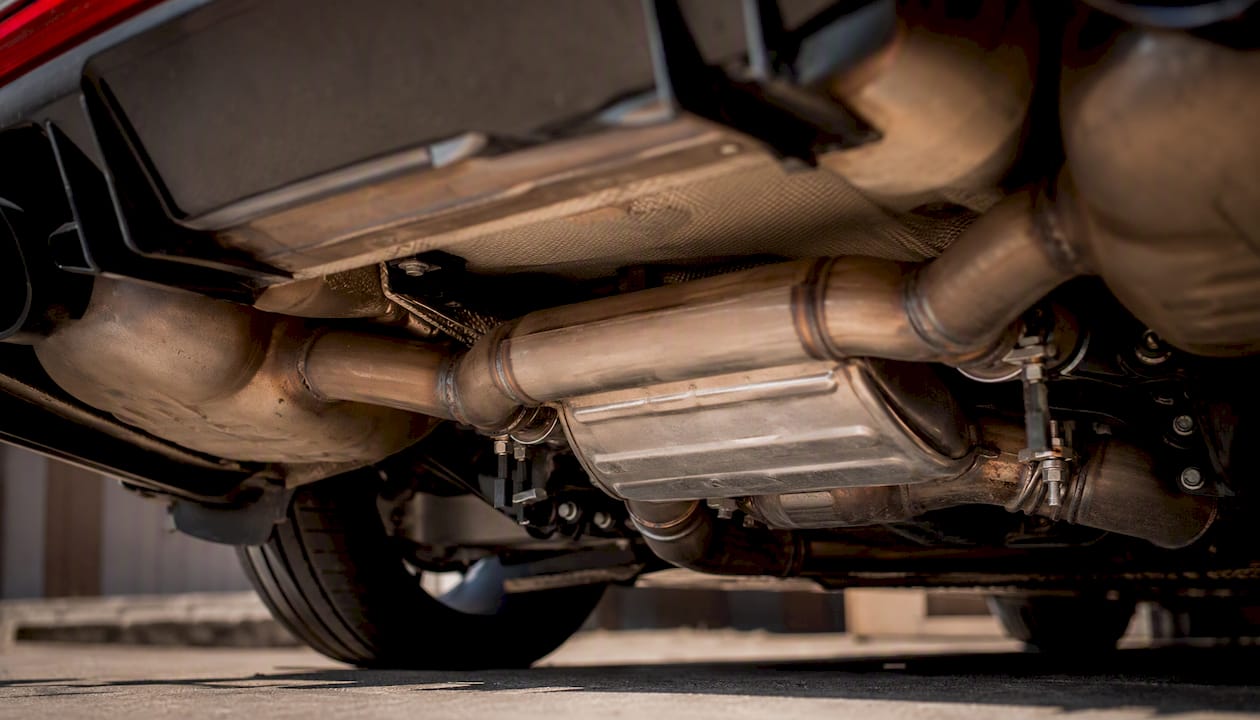
The parts that shape tone most are the muffler core design, resonator placement, and pipe diameter. The parts that most affect loudness are the muffler’s internal volume and the presence or absence of resonators. Drone, the low-frequency cabin resonance that makes highway driving miserable, is primarily a function of pipe length, resonator tuning, and muffler core type. Exhaust sound matters for performance vehicles in ways that go beyond aesthetics; NVH character affects how fatiguing a car is to drive daily.
| Attribute | Primary influencing parts | Notes |
|---|---|---|
| Tone (character) | Muffler core type, resonator placement | Straight-through cores produce a rawer note; chambered cores add depth |
| Loudness (SPL) | Muffler volume, resonator presence/absence | Removing resonators raises volume significantly |
| Drone (cabin resonance) | Pipe length, resonator tuning, muffler core | Most common complaint on highway-speed daily drivers |
How valved systems change the equation
A valved exhaust uses a butterfly valve in the pipe to alter the effective flow path and acoustic behavior in real time. When the valve is closed, exhaust routes through a quieter path, reducing drone and overall volume. Open the valve, and you get the full, unrestricted note. Partial positions let you tune the character between those extremes.
This matters for daily drivers because it removes the core compromise: you don’t have to choose between a system that sounds great on a Sunday drive and one that’s tolerable on a Monday commute. Exhaust noise control setup for luxury sports cars specifically benefits from this architecture, since these vehicles often have strict community noise ordinances and long highway commutes.
Pro Tip: To avoid highway drone, prioritize a system that includes a properly tuned resonator and a valved muffler you can close at cruise RPM. A resonator delete might sound great in a parking lot and be genuinely unpleasant at 75 mph for two hours.
Materials, weight savings, and durability: what to expect
Material choice affects four things: weight, corrosion resistance, cost, and how the system handles heat over time. None of these trade-offs are trivial on a performance or luxury vehicle.
- Mild steel: Cheapest upfront, heaviest, and least corrosion-resistant. Fine for budget builds or temporary setups, but expect rust within a few years in wet climates
- 409 stainless: Mid-tier corrosion resistance, moderate cost, and widely used in OEM and entry-level aftermarket systems. Better than mild steel but not the long-term choice for a car you’re keeping
- 304 stainless: The standard for quality aftermarket systems. Excellent corrosion resistance, good heat tolerance, and repairable by most shops. The right choice for most performance and daily-driven builds
- Titanium: Lightest option available, with exceptional heat resistance and a distinctive blue-tinted finish. Cost is significantly higher, and repair requires specialized welding. Worth it on track-focused builds where every pound matters
On some sport compact platforms, enthusiasts commonly cite perceptible weight savings from switching to a titanium system versus the factory unit. That figure circulates widely in the community as an industry reference point, though it varies by vehicle and isn’t universally documented. On a 3,000 lb car, that reduction in unsprung and rotating mass is perceptible in handling and acceleration feel, even if it doesn’t show up dramatically on a dyno.
Quality installation is as important as material choice. Poor fitment, low-quality flanges, or incorrect gaskets can cause leaks that reduce performance, create noise, and introduce exhaust gases into the cabin. The material on the pipe matters less than whether the system is sealed and properly supported.
Fuel economy, emissions, and U.S. legal considerations
Exhaust changes alone rarely improve fuel economy in any meaningful way. Any efficiency gain from reduced pumping losses is typically small and conditional on a supporting tune and a change in driving style. Don’t buy an exhaust expecting to recoup the cost at the pump.
The legal picture in the U.S. is more consequential:
- Cat-back systems are legal in most states for street use because they don’t alter the catalytic converter. California is the exception: even cat-back systems need a CARB Executive Order (EO) number to be street-legal there
- Catless downpipes remove the catalytic converter entirely. They are not street-legal in the U.S. under federal EPA rules and will fail emissions inspections in any state that requires them
- High-flow catalytic converters occupy the middle ground: they reduce restriction compared to stock cats while maintaining catalytic function. Many carry CARB EO numbers; verify before purchasing
- O2 sensor placement matters for both emissions compliance and ECU function. Moving or deleting sensors triggers codes and can cause fueling problems
Pro Tip: Always ask your vendor for the CARB EO number before purchasing any exhaust component if you’re in California or a CARB-compliant state. For federal compliance, check the EPA’s Clean Air Act regulations and your state’s inspection requirements before installing anything that touches the catalytic system.
Before buying, confirm:
- Whether your state requires emissions testing and what it checks
- Whether the part carries a CARB EO number (required in California and states that follow CARB rules)
- Whether the downpipe or cat change requires an ECU tune to avoid check-engine lights
Common myths about exhaust tuning, debunked
Myth: Backpressure is always good for low-end torque.
Fact: Matched velocity and scavenging efficiency matter far more. Excess restriction hurts power across the board on most modern engines.
Myth: Louder means faster.
In many real-world scenarios, a slightly less aggressive flow choice yields better repeatability, lower drone, and more consistent street or track usability. Volume is an acoustic property, not a performance metric.
Myth: Catless is always the best performance choice.
Fact: High-flow catalytic converters on a properly tuned car often produce nearly identical power to catless setups while remaining street-legal. The catless choice is primarily a track-only decision.
Myth: You can test exhaust flow by putting a potato in the tailpipe.
This is dangerous and tells you nothing useful. A running engine produces exhaust pressure and heat that can cause injury. Use a smoke machine or pressure test for leak diagnosis.
Myth: Any aftermarket exhaust will improve your car.
Fact: Oversized piping on a small-displacement engine can hurt low-end torque by killing exhaust velocity. Matching diameter to engine characteristics is the job, not just going bigger.
Pro Tip: If you suspect an exhaust leak, check for soot deposits near joints and flanges, and listen for a ticking or hissing sound under load. Don’t guess at air-fuel ratios; log them with a wideband O2 sensor or have a tuner check exhaust gas temperatures before and after the change.
When to tune and what to pair with an upgraded exhaust
The single most important rule: if you change a primary restriction like a downpipe or headers, pair it with an ECU calibration. Without a tune, the ECU’s closed-loop corrections will fight the new hardware, and you risk running lean, triggering check-engine lights, or leaving most of the gain on the table.
By driver goal
Daily driver:
- Start with a cat-back system that includes a resonator and a valved muffler
- Verify CARB/state compliance before purchasing
- No ECU tune required for most cat-back installs; monitor for codes
- Prioritize drone control and tone over peak flow
Weekend track or performance enthusiast:
- Evaluate headers or a high-flow downpipe based on your platform’s known gains
- Schedule a dyno tune immediately after any primary restriction change
- Log air-fuel ratios and exhaust gas temperatures post-install
- Consider heat shielding around headers, especially near wiring and rubber components
Luxury or performance owner seeking controllable sound:
- Choose a valved system with remote or ECU-integrated control
- Confirm fitment compatibility with your specific model year and trim
- Professional installation is strongly recommended; luxury exhaust requires specialist fitting to avoid clearance and NVH issues
- Post-install validation: drive at highway speed with the valve closed to confirm drone is eliminated
Installation checklist
- Use new gaskets at every flange; never reuse compressed OEM gaskets
- Check heat clearance from rubber boots, wiring harnesses, and brake lines
- Torque O2 sensor bungs to spec and confirm sensor placement matches ECU expectations
- Pressure-test or smoke-test for leaks before a first drive
- Inspect hangers and mounts; a loose hanger causes rattles that are difficult to diagnose later
How valved exhaust systems change what you experience behind the wheel
Valved systems solve the problem that every other exhaust type forces you to accept: the compromise between daily comfort and on-demand aggression. With a fixed system, you pick one acoustic character and live with it. A valved system lets you change that character in real time.
The mechanics are straightforward. A butterfly valve sits in the exhaust path, typically in the mid-pipe or muffler section. In the closed position, exhaust routes through a bypass path with more acoustic damping, reducing volume and drone. Open the valve, and flow takes the direct path, producing the full character of the system. Partial positions, controlled by a remote fob, a smartphone app, or ECU integration, let you map specific behavior to driving modes.
Valved systems provide the best compromise for owners who want both daily drivability and on-demand aggression because they alter effective flow and acoustic path simultaneously.
Practical integration notes:
- Remote controllers are the simplest option: a key fob or wireless switch triggers the valve actuator directly
- ECU integration maps valve position to existing drive modes (Comfort, Sport, Sport+) so the exhaust behavior changes automatically with the car’s character
- Maintenance: Valve actuators are electrical components; inspect wiring and connectors annually, especially on track-driven cars exposed to heat cycling
- Compatibility: Confirm valve placement clears heat shields, suspension components, and exhaust hangers on your specific chassis before ordering
On platforms like BMW M-series, Audi RS models, and Ferrari V8 variants, exhaust customization for luxury cars is particularly valuable because these vehicles already have sophisticated drive-mode systems that a valved exhaust can integrate with cleanly.
Quick recommendations: what to choose by your driving goal
Exhaust tuning is worth it when you have a clear goal, a plan for compliance, and a tuner lined up if the hardware requires calibration. It’s not worth it if you’re chasing peak horsepower numbers on a stock engine without a supporting tune.
- Daily driver: A cat-back with a valved muffler and resonator gives you sound control, drone-free highway driving, and zero emissions risk. No tune required on most platforms.
- Weekend track enthusiast: Headers or a high-flow downpipe paired with a dyno tune unlocks real mid-range gains. Budget for the tune before you buy the parts.
- Luxury or performance owner: A valved system with ECU or remote integration gives you the full range from refined to aggressive without committing to either extreme permanently.
Next step: consult a tuner before purchasing primary restriction components, verify emissions compliance for your state, and schedule a professional install with post-install validation on any platform where the ECU needs recalibration.
Why balanced exhaust tuning matters more than extreme builds
The loudest, most aggressive exhaust setup is almost never the most satisfying one to own. The cars that get the most out of their exhaust work are the ones where the hardware, the tune, and the acoustic design were treated as a single system rather than three separate decisions.
Valved, controllable systems represent that balance better than any fixed setup. They don’t ask you to sacrifice your morning commute for a good canyon run. They don’t force a choice between passing a noise ordinance and enjoying the car on a track day. That flexibility is what makes them the practical recommendation for most performance and luxury owners, not just an enthusiast indulgence.
When you’re ready to move beyond a cat-back, bring a tuner into the conversation early. Logs and dyno data before and after the install are the difference between knowing your exhaust is working and just hoping it is.
Valvecontrolexhaust: configurable sound and performance without the trade-offs
Most exhaust upgrades force a choice: aggressive sound or daily comfort. Valvecontrolexhaust is built around eliminating that choice for owners of Audi, BMW, Ferrari, Lamborghini, Porsche, and Mercedes-AMG vehicles.

Every system uses electronically adjustable valves that let you shift between a refined, drone-free cruise and a full-throated performance note at the press of a button, or automatically through your car’s existing drive modes. The lineup covers valved cat-back systems, downpipes, mufflers, rear diffusers, and controllers, all engineered for fitment on specific luxury and performance platforms rather than adapted from a universal design.
- Adjustable valve control via remote fob or ECU integration
- Platform-specific fitment for European and luxury performance vehicles
- Post-install validation support to confirm sound and performance targets are met
- Compatible with professional dyno tuning workflows
See which system fits your car and explore customizable exhaust options, or check the performance exhaust buyer’s guide to compare valve-control features before you order.
Sources
- Downpipes and exhaust: power, heat, and legality (Drivurs Academy)
- What Drivers Should Know Before Upgrading Performance Exhaust Systems – Elite Performance Automotive
- Exhaust Mods Pros And Cons – Your Motor Care
- Exhaust modification: pros & cons – SVI International