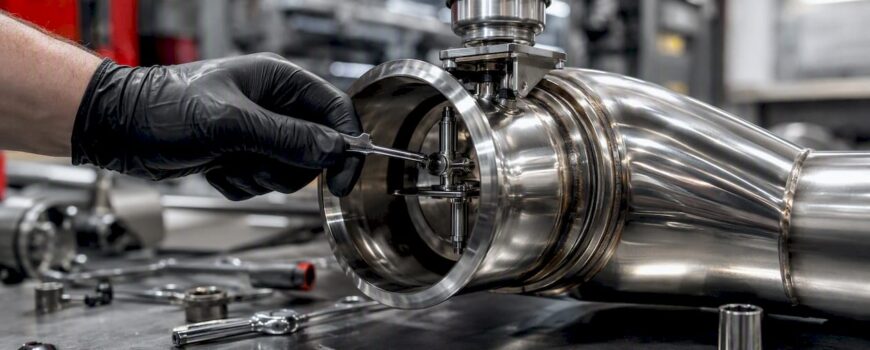
Yes, your exhaust system directly affects how long your engine lasts. The mechanism comes down to three variables: backpressure, scavenging efficiency, and exhaust gas temperatures (EGTs). Get those three right and a modified exhaust can be neutral or even beneficial to engine life. Get them wrong and you’re accelerating wear on pistons, valves, turbochargers, and bearings faster than almost any other single modification.
Here’s what that means practically for you as an owner:
- Backpressure: Every engine has a manufacturer-specified maximum allowable backpressure. Exceed it and pumping work increases, fuel consumption rises, and EGTs climb. According to DieselNet’s technical guidance, excessive backpressure can also affect turbocharger performance and invalidate your warranty.
- Scavenging and flow balance: Pipe diameter, header length, and collector design determine how well spent gases exit the cylinder. Too much restriction traps exhaust gas; too little velocity kills low-rpm scavenging and torque.
- Exhaust gas temperatures: High EGTs are the silent killer. They stress turbo bearings, cook piston crowns, and accelerate valve-seat wear. Any modification that raises EGTs without a corresponding ECU correction is a longevity risk.
Immediate actions for owners: Check your manufacturer’s backpressure limit before buying any aftermarket system. Never fit a decat downpipe or large-diameter pipe on a turbocharged car without an ECU tune. Monitor EGTs and watch for check-engine lights in the first 500 miles after any exhaust change.
Pro Tip: When in doubt, choose a valved exhaust matched to your specific platform. Valved systems let you run near-stock flow for daily driving and open high-flow mode when you want it, reducing the constant compromise that causes long-term wear.
Key Takeaways
The exhaust system is an active engine-breathing component, and how you modify it determines whether you gain performance, lose longevity, or both.
| Point | Details |
|---|---|
| Backpressure has a measurable fuel penalty | BSFC rose noticeably in controlled testing; stay within your manufacturer’s specified limit. |
| The tune matters more than the pipe | Fueling and timing errors after exhaust changes are the primary cause of accelerated engine wear, not the hardware itself. |
| Turbo engines need the most care | Restrictions raise EGTs and reduce turbine pressure ratio, accelerating bearing wear and triggering ECU protective limits. |
| Valved systems reduce permanent compromise | Dynamic flow control lets you run near-stock conditions daily and open high-flow mode when needed, protecting longevity without sacrificing sound. |
| Valvecontrolexhaust | Platform-matched valved systems for BMW, Audi, Porsche, Ferrari, and Lamborghini with correct sensor placement and retained catalyst options. |
Table of Contents
- How exhaust systems change the way your engine breathes
- Common aftermarket exhaust mods and what they actually do to engine life
- Why ECU tuning matters more than the pipe itself
- How turbocharged and naturally aspirated engines respond differently
- Warning signs that your exhaust is starting to hurt the engine
- What the experimental data actually shows
- How to modify your exhaust without shortening engine life
- The tradeoffs no one talks about honestly
- Valvecontrolexhaust gives you control without the compromise
- Sources
How exhaust systems change the way your engine breathes
The exhaust system is not just a noise pipe. It is an active participant in combustion, and understanding how it works explains why the effects of exhaust on engine longevity are so direct.
Backpressure and pumping work
Every time a piston rises on the exhaust stroke, it has to push spent gases out against whatever resistance the exhaust system creates. That resistance is backpressure. A small amount of backpressure is unavoidable and, in some naturally aspirated engines, can even help low-rpm torque by slowing exhaust pulses at the right moment. But once backpressure climbs beyond the manufacturer’s specified limit, the piston is doing extra work on every single exhaust stroke. That extra pumping work shows up as increased brake specific fuel consumption (BSFC) and elevated cylinder temperatures. The JEMS single-cylinder diesel study found that backpressure also retards combustion phasing and reduces peak cylinder pressure, a combination that forces a tradeoff between fuel economy and combustion efficiency when you try to compensate with timing changes.
Pulse scavenging and pipe geometry
When an exhaust valve opens, a pressure pulse travels down the pipe. If the pipe length and diameter are tuned correctly, a low-pressure reflection wave arrives back at the valve just before it closes, helping pull residual exhaust gas out of the cylinder. This is pulse scavenging, and it is why header length and collector design matter so much for volumetric efficiency. A correctly sized exhaust maintains the gas velocity needed for scavenging; an oversized pipe reduces that velocity at low rpm, hurting torque and leaving more residual gas in the cylinder to dilute the next charge.
Turbocharger interactions
Turbocharged engines are especially sensitive to exhaust system design. The turbo’s turbine wheel is driven by exhaust energy, specifically the pressure differential across it. Restrictions downstream of the turbine reduce that differential, delay spool, and lower boost. Restrictions upstream (between the engine and turbine inlet) raise turbine inlet pressure and temperature, accelerating thermal and mechanical stress on the turbo. Lab and modeling data show that rising backpressure lowers turbine pressure ratio, increases EGTs, and can trigger ECU protective strategies including boost reduction and limp mode.
Statistic callout: Controlled tests showed BSFC rising noticeably at high added backpressure, with measurable reductions in volumetric efficiency and peak cylinder pressure at every increment tested.
Pro Tip: Think of the exhaust system as the engine’s exhale. Restrict it too much and the engine labors on every breath. Open it too far and it loses the velocity that makes low-rpm scavenging work. The goal is a matched system, not just a louder one.
Common aftermarket exhaust mods and what they actually do to engine life
Not all exhaust modifications carry the same risk. Here is how each common change maps to longevity impact.
Cat-back and axle-back systems
These are the lowest-risk modifications for engine longevity. Because they sit downstream of the catalytic converter, they leave the emissions system and primary exhaust flow largely intact. Typical horsepower gains are modest, often in the 5–15 hp range for cat-back systems according to aftermarket tuning data, and no ECU tune is required in most cases. The main longevity considerations are weight reduction (less stress on hangers and mounting points) and ensuring the new system doesn’t create a resonance that stresses flex joints or manifold gaskets.
Headers: shorty vs. long-tube
Shorty headers improve flow with minimal disruption to scavenging pulses, making them a reasonable upgrade for daily-driven naturally aspirated cars. Long-tube headers are more aggressive: they tune the pulse length for high-rpm power, which can reduce low-end torque and alter valve-seat temperatures. On high-compression engines, long-tube headers can raise EGTs enough to warrant monitoring. The role of exhaust in turbo performance is different again, since turbo engines use the manifold primarily as a turbine feed rather than a scavenging device.
Downpipes: catted vs. decat
This is where longevity risk rises sharply. A high-flow catted downpipe on a turbocharged car increases turbine flow, reduces backpressure upstream of the turbo, and can meaningfully improve spool and power. Done correctly with an ECU tune, it is a durable modification. Removing the catalyst creates a large change in backpressure and exhaust flow that throws off oxygen sensor readings, triggers catalyst-efficiency codes, and forces the ECU into closed-loop corrections that can run the engine lean or rich depending on the platform. Without a tune, that fueling error is the primary longevity risk, not the pipe itself.
Larger diameter mid-pipes
Bigger is not always better. Tuning guides confirm that oversized pipes reduce gas velocity and scavenging at low rpm, which hurts torque and can leave more residual exhaust gas in the cylinder. The correct diameter depends on displacement, peak flow rate, and rpm range. A 3-inch mid-pipe that works well on a high-revving 3.0-liter turbo can be counterproductive on a 2.0-liter daily driver.
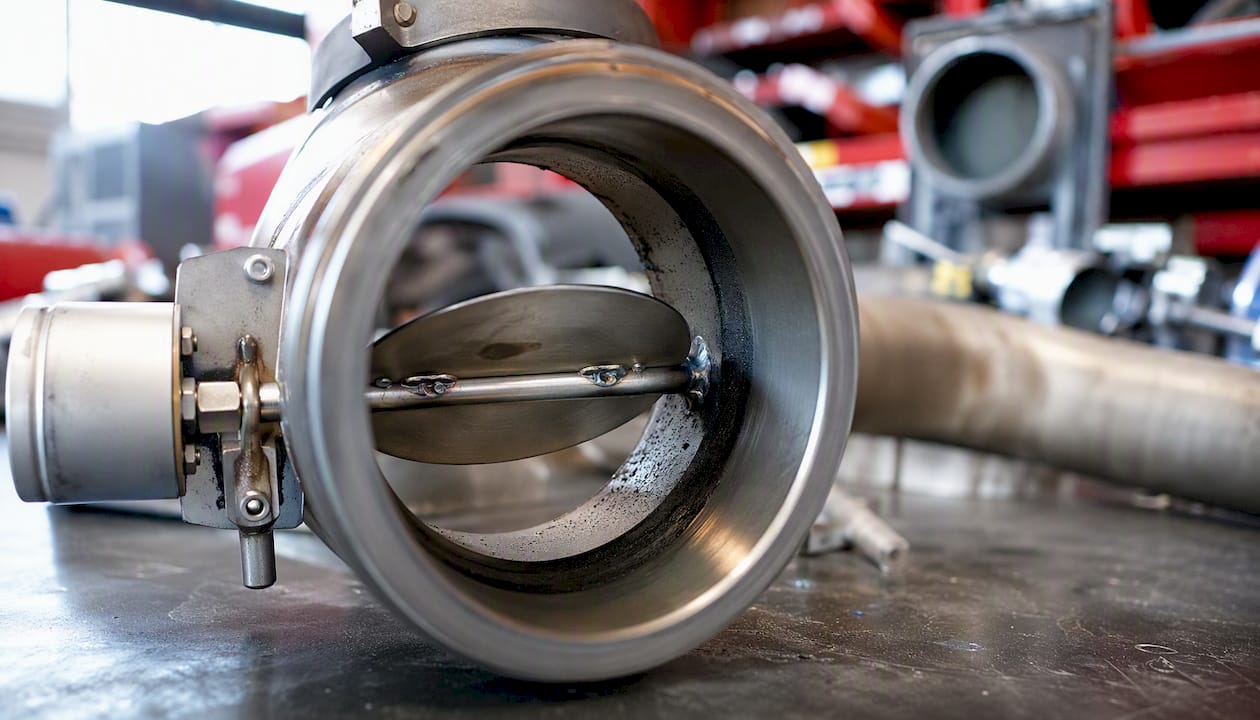
Valved exhaust systems
Valved systems solve the core tradeoff. In closed mode, they maintain near-stock backpressure and gas velocity, preserving low-rpm scavenging and keeping EGTs in a normal range. In open mode, they reduce restriction for high-flow, high-rpm driving. That dynamic control means you are not permanently committed to a single flow compromise. For owners who want both sound and durability, a properly matched valved system is the most sensible path.
Pro Tip: The pipe alone is rarely the whole story. Every significant exhaust change alters the conditions the ECU was calibrated for. Treat the exhaust and the tune as a single system, not two separate decisions.
Why ECU tuning matters more than the pipe itself
The exhaust hardware gets the attention, but the ECU calibration is where engine longevity is actually won or lost after a modification.
Modern engines run closed-loop fueling based on oxygen sensor feedback. When you change the exhaust, you change the pressure and flow conditions those sensors read. A decat or large downpipe can cause the front O2 sensor to read differently, pushing fuel trims lean or rich. A lean condition under load means elevated EGTs, potential detonation, and accelerated piston and valve wear. A rich condition wastes fuel, washes cylinder walls with unburned fuel, and can foul injectors.
- Detonation risk: Incorrect ignition timing after an exhaust change, especially on high-compression or turbocharged engines, can cause knock that damages piston crowns and ring lands within a few thousand miles.
- EGT spikes: Without a tune, turbo cars running a decat downpipe often see EGTs climb into ranges that shorten turbo bearing life and can cause oil coking in the center section.
- ECU protective intervention: Tuning data shows that the ECU will often pull boost or fuel to protect hardware when it detects out-of-range conditions, which means you may not realize the damage is accumulating until a component fails.
Safe tuning practices after an exhaust modification:
- Use a dyno or data logger to verify air-fuel ratio (AFR) across the full rpm range before driving hard.
- Stage changes: fit the hardware, drive conservatively for a week, log fuel trims, then tune.
- Keep ignition timing conservative, especially at high load. You can always add timing later; you cannot un-detonate a piston.
- Monitor knock counts and EGTs on every spirited drive for the first month.
- Have a rollback plan: keep the original ECU map so you can revert if something goes wrong.
Pro Tip: Re-check AFR and EGTs at full operating temperature, not just on a cold dyno pull. Thermal expansion changes clearances and sensor readings enough that a map that looks safe cold can run lean at 200°F coolant temp.
How turbocharged and naturally aspirated engines respond differently
The sensitivity to exhaust changes is not the same across engine types, and the failure modes differ enough to warrant separate attention.
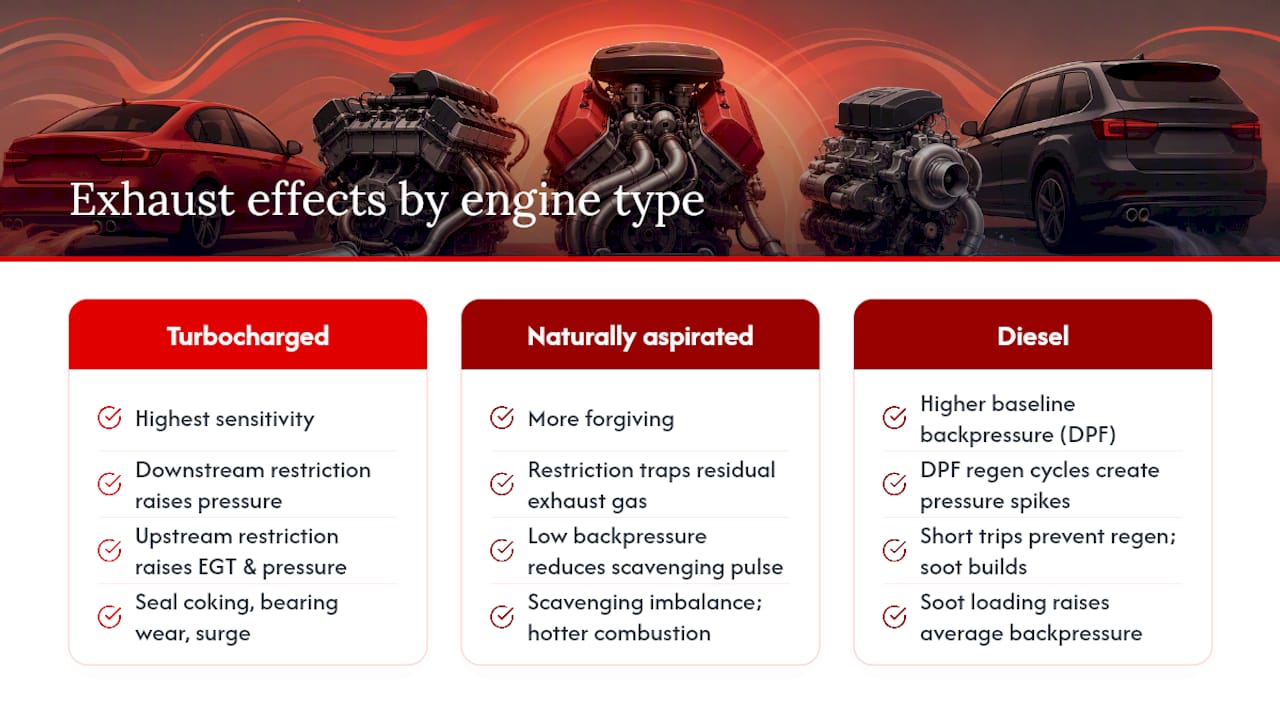
Turbocharged engines are the most sensitive. The turbo sits between the engine and the rest of the exhaust, making it a pressure amplifier for any restriction downstream. Backpressure downstream of the turbine raises turbine outlet pressure, reduces the pressure ratio across the wheel, and forces the engine to work harder to push exhaust through. Upstream restrictions (clogged catalyst, collapsed flex pipe) raise turbine inlet temperature and pressure, which is even more damaging. Common failure modes include turbo seal coking from sustained high EGTs, bearing wear from oil that has been heat-soaked repeatedly, and compressor surge from boost instability caused by erratic backpressure. Monitor boost behavior, EGT, and transient throttle response. A turbo that spools later than usual or surges under light throttle is telling you something is wrong with the exhaust path. For a deeper look at how exhaust design interacts with forced induction, the forced induction performance guide covers platform-specific considerations.
Naturally aspirated engines are more forgiving but not immune. The primary risk is scavenging imbalance: too much restriction traps residual exhaust gas, diluting the incoming charge and raising combustion temperatures. Too little backpressure at low rpm reduces the scavenging pulse effect, hurting torque and increasing valve-seat temperatures as the valve closes against a hotter, less-cleared cylinder. Watch for loss of low-end torque and any increase in oil consumption, which can signal elevated piston-ring temperatures.
Diesel engines operate at higher baseline backpressure than gasoline engines, partly because of the diesel particulate filter (DPF). DPF regeneration cycles, where the filter burns off accumulated soot at high temperature, create temporary backpressure spikes. Frequent short trips that prevent full regeneration cause soot loading to build faster, raising average backpressure and accelerating the degradation pattern documented in the PLOS ONE long-duration study. Diesel owners should track regen frequency as a direct indicator of exhaust system health.
Warning signs that your exhaust is starting to hurt the engine
Exhaust components do not last forever, and the failure modes are predictable enough that you can catch them before they cause engine damage.
Typical component lifespans in real-world U.S. driving conditions:
- Exhaust manifolds: 100,000–150,000 miles on most platforms, shorter with frequent heat cycling (track use, towing)
- Catalytic converters: 100,000–150,000 miles under normal use; significantly shorter with oil consumption, coolant leaks, or rich-running conditions that contaminate the substrate
- Mufflers and mid-pipes: 80,000–100,000 miles in dry climates; 50,000–70,000 miles in road-salt states
- DPFs: 100,000–150,000 miles with proper regeneration; shorter with short-trip driving patterns
Red flags that justify immediate inspection:
- Rising EGTs at cruise or light throttle (not just under hard acceleration)
- Repeated DPF regeneration cycles, more than once per 300–400 miles of mixed driving
- Loss of low-end torque that was not there before
- Power loss under sustained load (highway passing, towing)
- Check-engine codes P0420 or P0430 (catalyst efficiency below threshold)
- Frequent limp-mode events on turbocharged cars
- Exhaust smell inside the cabin, which signals a leak that also upsets O2 sensor readings and can cause dangerous CO ingress
Statistic callout: The PLOS ONE long-duration study found that wet exhaust systems raised backpressure significantly over hundreds of hours of operation, producing notable power loss. Even dry systems showed measurable thermal fatigue over longer durations, confirming that backpressure growth is a time-dependent process, not a one-time installation event.
A preventive maintenance schedule that includes exhaust inspection at every oil change interval catches most of these issues before they cascade into engine damage. When you take the car in, ask the shop to measure backpressure at the test port (if fitted), check EGTs under load, and inspect for leaks at every joint and gasket.
What the experimental data actually shows
The research on backpressure and engine performance is more specific than most tuning forums suggest. Here is what controlled studies found.
The JEMS single-cylinder diesel experiment measured BSFC at three backpressure increments:
These numbers come from a diesel single-cylinder test, so the absolute values will differ for gasoline engines. The directional relationship holds: more backpressure means more fuel burned for the same output, and the penalty is nonlinear. The jump from 6 kPa to 24 kPa more than triples the BSFC penalty.
The PLOS ONE long-duration study adds the time dimension. Dry systems held up longer but eventually showed thermal fatigue. The practical implication: aftertreatment condition matters as much as pipe diameter for long-term engine health.
DieselNet’s technical documentation confirms that every engine manufacturer publishes a maximum allowable backpressure, and exceeding it is both a warranty and a reliability risk. Most passenger-car manufacturers set limits in the range of 5–20 kPa depending on platform and load condition, though the specific value for your car lives in the service manual, not on a forum.
Statistic callout: At high added backpressure levels, BSFC increased noticeably in controlled testing, indicating measurable fuel consumption penalties for persistent restrictions.
How to modify your exhaust without shortening engine life
Follow this sequence and you eliminate most of the risk that turns exhaust modifications into engine-damage events.
Pre-purchase checklist
- Look up your engine’s manufacturer-specified maximum backpressure in the service manual or from the OEM technical documentation.
- Verify that the system you are considering has been flow-tested and that the manufacturer provides backpressure data at your engine’s peak flow rate.
- Confirm sensor bung placement: O2 sensors and EGT probes must be in the correct location after installation.
- Check emissions compliance for your state. Some states follow California Air Resources Board (CARB) standards, which restrict aftermarket exhaust modifications more tightly than federal EPA rules. The sports car exhaust legal checklist covers U.S. compliance requirements in detail.
- For turbocharged platforms, prefer systems with retained catalyst options to avoid sensor and fueling disruption.
Installation best practices
- Use new gaskets at every joint. Reusing old gaskets on a new system is the most common source of post-install exhaust leaks.
- Torque all fasteners to spec. Over-tightened manifold studs crack; under-tightened ones leak.
- Check heat shielding around fuel lines, brake lines, and wiring harnesses after installation.
- Inspect all hangers and mounts. A system that vibrates against the chassis will fatigue at welds within 20,000 miles.
- Start the car and check for leaks before driving. A leak at the manifold flange will upset the front O2 sensor immediately.
Tuning and monitoring sequence
- Log a baseline drive cycle with the stock system before removal. You want a reference for fuel trims, boost behavior, and EGTs.
- After installation, drive conservatively for 500 miles. Let the ECU adapt to the new flow conditions before pushing the engine.
- Have a professional tune performed on a load-bearing dyno, not a free-roll dyno. Towing and highway conditions stress the system differently than a dyno pull.
- Re-verify AFR and EGTs at full operating temperature.
- Check fuel economy over the next two tanks. A drop of more than 5% suggests the ECU is compensating for something it does not like.
Emergency signs requiring immediate rollback or service:
- Persistent EGTs above the platform’s safe threshold at cruise
- Limp mode on more than one occasion within the first 1,000 miles
- Erratic boost that was not present before the modification
- Fuel trims consistently above +10% or below -10% at idle
Pro Tip: Match exhaust diameter to your engine’s actual flow requirements, not to the largest pipe that fits. A 2.5-inch system on a 2.0-liter four-cylinder will almost always outperform a 3-inch system at the rpm range you actually use. Bigger feels better in the parking lot; correctly sized performs better on the road.
The engine response exhaust checklist walks through platform-specific fitment verification for high-performance cars and is worth reviewing before finalizing any purchase.
The tradeoffs no one talks about honestly
Most exhaust content online treats the decision as purely technical: flow numbers, dyno charts, decibel readings. The honest version is messier.
Sound is emotional. The reason most enthusiasts modify their exhaust is not the 8 hp gain; it is the way the car sounds at 4,000 rpm. That is a legitimate reason. But it creates a conflict: the modifications that produce the most dramatic sound change (decat, straight-pipe, large-bore) are also the ones that carry the most longevity risk without proper tuning. Owners who chase sound without addressing fueling are essentially trading engine life for an audio experience.
The daily driver versus track car distinction matters more than most guides acknowledge. A daily driver covering 15,000 miles per year at mixed loads needs a system that performs well at low rpm, stays quiet enough for residential streets, and does not require a tune every time the weather changes. A track car that sees 20 hard sessions per year and gets a fresh tune before each season can tolerate a more aggressive setup because the monitoring and maintenance cadence is already there.
For daily drivers, a valved system with a conservative tune is the right answer almost every time. For track cars, the calculus shifts: more aggressive hardware is acceptable when paired with regular data-logging, professional tuning, and a maintenance schedule that treats the exhaust as a wear item rather than a set-and-forget part.
The performance exhaust weight reduction benefits article covers the non-breathing advantages of aftermarket systems, which are worth factoring into the full cost-benefit picture for track-focused builds.
Valvecontrolexhaust gives you control without the compromise
The core problem with most aftermarket exhaust decisions is that owners are forced to pick a permanent flow setting: either a quiet, restrictive system for daily use or an open, loud system that stresses the engine at low rpm and requires a tune to be safe. Valvecontrolexhaust solves that with electronically controlled valve systems built specifically for European performance platforms including BMW, Audi, Porsche, Ferrari, and Lamborghini.

In closed mode, the valve maintains near-stock backpressure and gas velocity, keeping EGTs in range and scavenging intact for daily driving. Open the valve for spirited driving and you get the high-flow, high-sound profile without permanently compromising the low-rpm behavior your engine was calibrated for. Fitment includes correct sensor bung placement, retained catalyst options, and compatibility verification for your specific platform, which eliminates the most common sources of post-install fueling errors.
- Browse premium valved system comparisons to find the right fit for your car.
- Review the exhaust valve customization guide for platform-specific options.
- Check the luxury car exhaust valve maintenance guide to understand long-term upkeep requirements.
Request fitment guidance directly through the Valvecontrolexhaust site and get a system matched to your engine’s actual flow requirements, not a generic catalog recommendation.
Sources
The data and recommendations in this article draw on the following primary sources. Each one is worth reading directly if you want to go deeper on a specific aspect of exhaust system impact on engines.
- Effects of Exhaust Backpressure Increment on the Performance and Exhaust Emissions of a Single Cylinder Diesel Engine – JEMS
- Long-term degradation and failure mechanisms of dry, wet and combined exhaust systems (PLOS ONE)
- Exhaust backpressure effects and technical considerations – DieselNet
- How exhaust restrictions affect turbo and engine performance – Goldfarb Inc.
- Engineerskill