
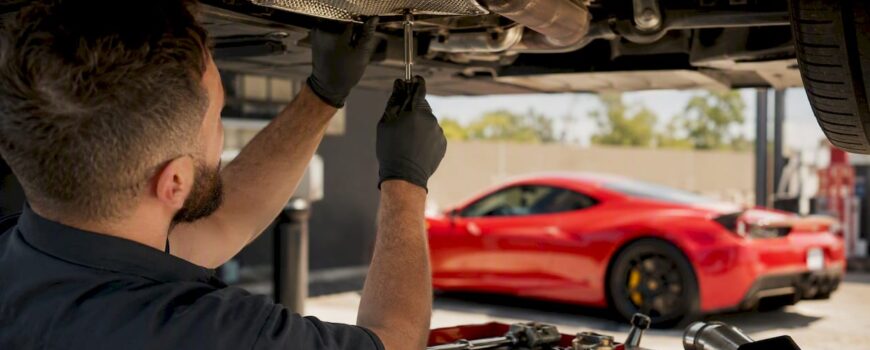
Most exhaust rattles trace back to one of four culprits: a loose heat shield, a worn or broken exhaust hanger, internal damage inside the muffler or catalytic converter, or an exhaust valve that’s stuck partway open. The fastest way to confirm which one you’re dealing with is a cool-system tap test. Let the exhaust cool completely, then press or lightly tap suspect components with your palm or a fist to see if you can reproduce the rattle on demand.
A few things narrow it down fast:
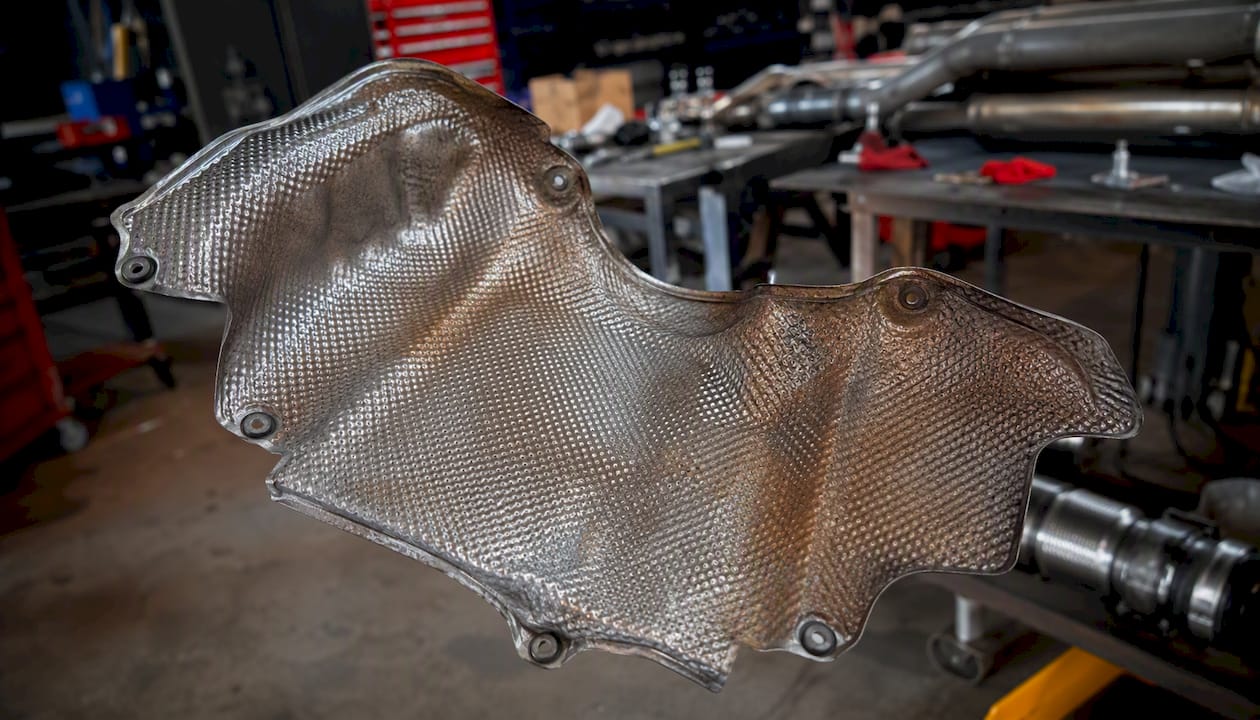
- Metallic buzz that fades as the engine warms up usually points to a heat shield expanding into place.
- Rattle that worsens over bumps almost always means a broken hanger or bracket letting the pipe swing into the chassis.
- Rattle that shows up only at certain RPMs (often 1,500 to 2,500) is classic heat-shield resonance.
- Constant rattle under acceleration, regardless of RPM, suggests something loose inside the muffler or catalytic converter.
Pro Tip: Never tap-test a catalytic converter with anything harder than an open palm. The ceramic honeycomb inside is brittle, and a solid hit can shatter it, turning a cheap fix into an $800 repair.
Key Takeaways
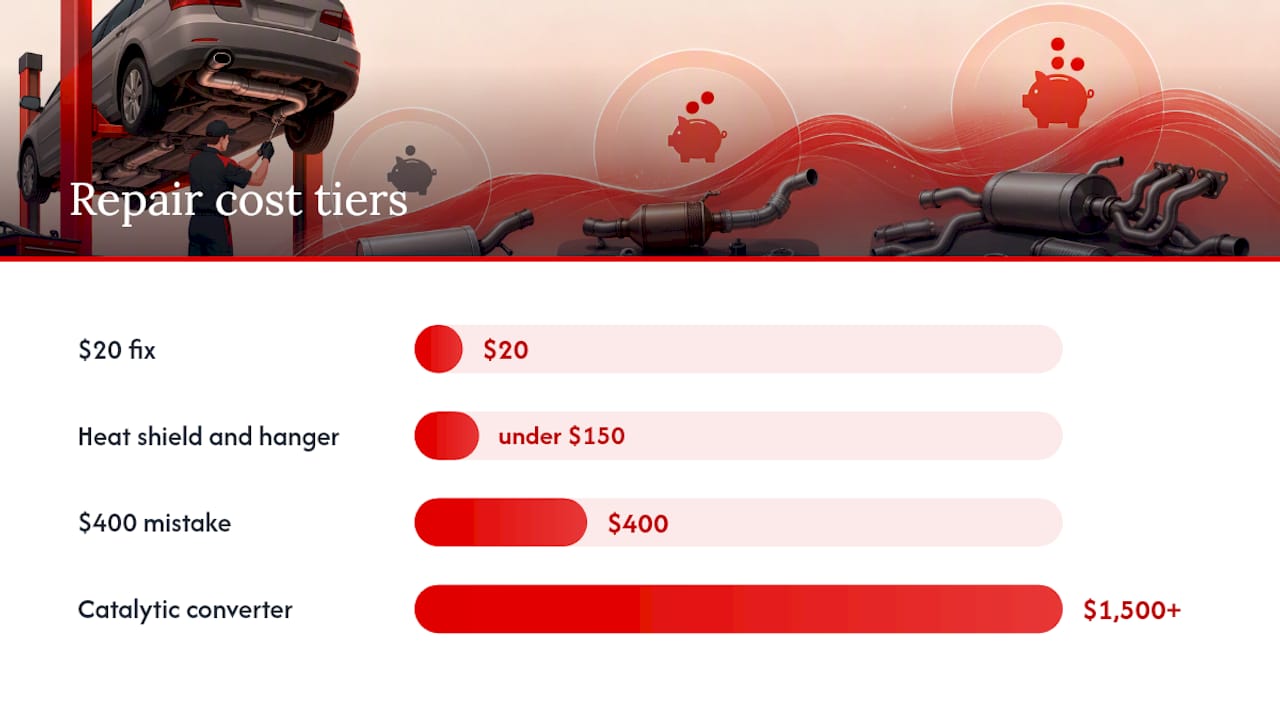
Correctly localizing an exhaust rattle before buying parts is the single factor that separates a $20 fix from a $400 mistake.
| Point | Details |
|---|---|
| Start with the tap test | Cool the system fully, then tap suspect components by hand to reproduce the rattle safely. |
| Match timing to cause | Cold-start rattles suggest thermal expansion or valve actuators; bump-triggered rattles suggest broken hangers. |
| Watch the RPM band | A rattle isolated to 1,500 to 2,500 RPM usually points to heat-shield resonance, not internal damage. |
| Know your cost tiers | Heat shield and hanger fixes run under $150 total; catalytic converter repairs can exceed $1,500. |
| Escalate on red flags | Startup clatter tied to oil level, check-engine codes, or smoke means stop DIY and see a mechanic. |
Where to Learn More About Exhaust Sound and Behavior
For readers who want to go deeper on why exhausts sound the way they do, a few resources are worth bookmarking:
- Common exhaust sound issues in supercars breaks down resonance patterns beyond basic rattles.
- How exhaust sound changes with RPM explains the resonance behavior behind RPM-correlated noises.
- How valve control exhausts enhance your car’s sound is worth a look if your rattle keeps tracing back to a stuck or aging exhaust valve. Valvecontrolexhaust builds these systems specifically to eliminate that kind of unpredictable actuator noise while giving you direct control over sound and performance.
Table of Contents
- Exhaust Rattle Diagnosis: What the Timing Tells You
- How Do You Diagnose an Exhaust Rattle Yourself?
- What Does It Cost to Fix an Exhaust Rattle?
- When Is a Rattle Actually an Engine Problem?
- What Should You Keep in Your Diagnostic Toolkit?
- When Should You Call a Mechanic Instead?
- Frequently Asked Questions
- Sources
Exhaust Rattle Diagnosis: What the Timing Tells You
The conditions under which the rattle happens are your biggest clue, often more useful than the sound itself. Before you touch a wrench, spend one drive cycle just listening and noting patterns.
Cold start only, gone after a minute or two. This is usually thermal expansion. Metal heat shields and pipe sections expand at different rates as they warm, and mounting tabs that have a little play will buzz until everything reaches operating temperature. On vehicles with valve-actuated exhaust systems, it’s also common during the valve’s startup cycle. Some owners report this pattern disappearing after a dealer reflash or valve reinitialization, with no parts replaced at all.
Rattle over bumps or rough pavement. This points to something physically loose enough to make contact with the frame or floor pan. Broken rubber hangers are the usual suspect since they lose elasticity and snap after years of heat cycling, letting the pipe sag and knock against nearby brackets.
Rattle that peaks in a specific RPM band. Heat shield resonance often centers around 1,500 to 2,500 RPM, where vibration frequency matches the shield’s natural resonance. If the noise sharpens and dulls as you move through that range and disappears above or below it, you’re very likely looking at a shield problem, not an internal one.
Rattle under load or acceleration that doesn’t fade at any RPM. That’s a stronger signal of internal trouble. Loose baffles inside a muffler, or a catalytic converter’s substrate breaking apart internally, produce a rattle tied to engine load and exhaust pulse rather than a narrow speed window.
Pro Tip: Grab a friend and have them rev the engine in short bursts while you listen from underneath the car (safely, engine off and cool for any physical contact). Sound travels oddly under a vehicle, and pinpointing location by ear alone often sends you to the wrong spot.
How Do You Diagnose an Exhaust Rattle Yourself?
This is the core exhaust rattle diagnosis workflow mechanics actually use, adapted for a driveway with basic tools. Work through it in order. Skipping steps is how people end up replacing a muffler that was never the problem.
Safety first. Park on level ground, set the parking brake, and use wheel chocks. Let the exhaust cool for at least 30 minutes before touching anything. If you need to get underneath the car, use proper jack stands rated for the vehicle’s weight. Never rely on a jack alone. Wear gloves and eye protection since rust and debris fall constantly from old exhaust hardware.
- Reproduce and record. Drive the same route or replicate the same RPM and load conditions where the rattle showed up. Note whether it happens at idle, under acceleration, over bumps, or only cold. A 15-second phone video with audio is genuinely useful here, both for your own reference and if you end up calling a shop.
- Run the tap test. With the engine off and system cool, tap heat shields, the muffler body, and pipe sections with your palm or a rubber mallet. Loose components will rattle or buzz distinctly under light pressure.
- Use a stethoscope or cardboard tube. A mechanic’s stethoscope (or a length of cardboard tubing held to your ear) lets you localize sound while a helper revs the engine, without you having to be directly underneath.
- Visually inspect cold. Look for bright, shiny wear marks where metal is rubbing metal, rust-through on shield mounting tabs, cracked rubber hangers, and loose clamps at exhaust joints.
- Run a controlled warm test. With the car safely supported, have a helper blip the throttle in short bursts while you listen and gently probe suspect areas with a long screwdriver (never with the engine running and your hands near moving parts or hot surfaces).
- Verify with a temporary fix. If you suspect a specific shield or hanger, secure it temporarily with a stainless hose clamp and retest. If the rattle disappears, you’ve found your source.
A sound-based diagnostic approach that starts with acoustic signature before moving to physical inspection tends to save real time versus guessing and replacing parts blind. Reattaching a loose heat shield with hose clamps resolves the majority of straightforward cases without a shop visit.
Tools to have on hand: flashlight, gloves, jack and stands, stainless hose clamps, penetrating oil, a mechanic’s stethoscope or cardboard tube, a small pry bar, and a basic socket set.
Stop immediately if you smell fuel, see smoke, or notice the car running rough during testing. That’s not an exhaust rattle problem anymore.
What Does It Cost to Fix an Exhaust Rattle?
Once you’ve localized the noise, the fix usually falls into one of five categories, and the price gap between them is enormous.
- Loose heat shield: Reattaching with stainless hose clamps or new mounting hardware costs $5 to $30 in parts if you do it yourself. A shop that tack-welds a shield back into place typically charges $20 to $60.
- Broken exhaust hanger or insulator: Parts run $5 to $30. Labor ranges from $30 to $120 depending on how accessible the hanger is and whether rust has fused surrounding hardware.
- Muffler or internal baffle failure: This almost always means full muffler replacement. Expect $80 to $400 in parts plus $75 to $250 in labor.
- Catalytic converter internal failure: The expensive one. Parts run $200 to $1,500 or more, with labor around $150 to $400. If you’re seeing a check-engine light alongside the rattle, this is worth ruling out early.
- Exhaust valve or actuator issues: Often intermittent and sometimes fixable by cycling the valve or reinitializing the actuator. Persistent cases typically need shop diagnosis, since valve assemblies aren’t always a simple bolt-off job.
Pro Tip: Spend the extra few dollars on stainless steel hose clamps instead of standard zip ties near hot exhaust sections. Regular plastic ties melt within minutes of engine heat, and you’ll be back under the car doing the same fix twice.
When Is a Rattle Actually an Engine Problem?
Not every clunk from under the hood is exhaust-related, and mistaking an engine issue for an exhaust rattle can be expensive if you ignore it.
Heavy, rhythmic clatter at startup that lasts one to three seconds and fades is often normal lifter or chain noise on higher-mileage engines. But a clatter that changes pitch with oil level, or one that persists well past startup, points toward timing chain or oil-pressure problems that need immediate attention, not exhaust troubleshooting.
Watch for these signs that you’re past DIY exhaust territory:
- Check-engine light with codes P0420 or P0430, which flag catalytic converter efficiency problems.
- Sudden loss of power alongside the rattle.
- Visible smoke or a sulfur smell from the exhaust, both signs of internal cat damage.
- Metallic knocking that gets worse with engine load rather than exhaust load.
If any of these show up, stop testing and get the car to a shop. Tell them exactly when the noise happens, what RPM range it’s in, whether it changes with throttle input, and any codes your scanner pulled.
What Should You Keep in Your Diagnostic Toolkit?
You don’t need a full shop setup to run a proper exhaust rattle diagnosis. A basic kit covers almost every scenario you’ll run into.
- Core tools: flashlight, small pry bar, ratchet with sockets from 8mm to 15mm, penetrating oil, gloves, and eye protection.
- Diagnostic aids: a mechanic’s stethoscope or a length of cardboard tubing, your phone for audio and video, and an OBD-II scanner to pull any related fault codes.
- Common spare parts: stainless hose clamps, replacement exhaust hanger insulators, extra bolts and nuts, and stainless repair straps.
MyCarFault’s driver-reported repair data shows heat-shield brackets and worn hangers as the most frequently confirmed fix among owners who tracked down their own rattle, which is exactly why those parts belong in your kit before you even start testing. Skip anything plastic near hot pipe sections. It will melt and you’ll be redoing the job within a season.
When Should You Call a Mechanic Instead?
Call a shop if the rattle persists after you’ve secured every shield and hanger you can find, if you suspect catalytic converter internals, if you’re getting catalyst-efficiency codes, or if the noise sounds tied to oil pressure rather than the exhaust.
Before you call, gather this:
- A short video of the sound, captured from both the engine bay and underneath the car.
- The exact conditions: cold start, specific RPM, over bumps, or under load.
- Any OBD-II code numbers from a scan.
- Describe exactly when the rattle happens and under what conditions.
- List what you’ve already tried, including any temporary fixes.
- Note whether the sound changes with throttle input or exhaust valve mode, if your car has one.
A local exhaust repair specialist can usually turn a well-documented case into a same-day fix instead of a multi-visit guessing game.
A Technician’s Note on What DIY Can Actually Fix
Heat-shield and hanger fixes succeed at home far more often than catalytic converter or internal baffle failures, which almost always need shop tools and parts. The real lesson: localize the rattle before you buy anything. Guessing wastes money twice, once on the wrong part and again on the right one.
Frequently Asked Questions
What is the most common cause of an exhaust rattle?
Loose heat shields are the single most common cause, especially on vehicles past 100,000 miles where mounting tabs have rusted or the shield itself has cracked.
Can I drive with an exhaust rattle?
A rattle from a loose heat shield or hanger is usually safe to drive on short term, but a rattle tied to a failing catalytic converter or an engine noise should be checked before you keep driving.
Why does my exhaust rattle only on cold start?
Cold-start-only rattles are typically thermal expansion in heat shields or pipe joints, or valve actuator movement in vehicles with electronically controlled exhaust systems, both of which often quiet down once the system reaches operating temperature.
How much does it cost to fix an exhaust rattle?
Simple heat shield or hanger fixes often run $5 to $120 total including labor. Muffler replacement lands between $150 and $650, and catalytic converter repairs can exceed $1,500 depending on the vehicle.
Is an exhaust rattle always an exhaust problem?
No. Heavy rhythmic clatter at startup or knocking that changes with oil level often signals a timing chain or oil-pressure issue, not the exhaust system, and needs prompt professional attention.
Sources
- Dealing With Exhaust Rattles – EricTheCarGuy
- Rattles, Whistles, and Hissing: A Sound-Based Checklist for Exhaust System Diagnosis
- Exhaust rattle noise from underneath — MyCarFault