California does not ban aftermarket exhausts. They’re legal if they keep noise at or below 95 dbA for most passenger cars, use a functioning muffler, and skip banned hardware like cutouts, bypass pipes, and whistle tips. Cross any of those lines and you’re looking at a citation, a court date, and possibly a hold on your vehicle registration.
TL;DR:
- Aftermarket exhausts are legal in California if they keep noise at or below 95 dbA, use a functioning muffler, and avoid banned components like cutouts and whistle tips.
- Enforcement has shifted to heavier fines and court appearances since 2019, with the court requiring a certificate of compliance before dismissing a citation.
- Noise readings are standardized with SAE methodology at referee stations, not subjective roadside judgments, making proper testing crucial for contesting citations.
- Modifications such as bypass valves, cutouts, and catalytic converter removal are automatically flagged and often lead to citations, regardless of noise level.
- Owners can avoid violations by pre-checking noise levels, maintaining receipts, and using CARB-exempt parts, especially if considering valved systems for street-legal flexibility.
Table of Contents
- What California Exhaust Law Actually Requires
- Enforcement Got Tougher: AB 1824, AB 2496, and What Happens in Court
- Smog Check vs. Noise Testing: Two Separate Systems
- The Exact Modifications That Get You Cited
- What Happens After a Citation: The Referee Process
- Staying Ahead of a Citation: A Practical Owner Checklist
- How Noise Testing Actually Works
- Are There Any Exceptions to the Noise Rules
- What Fines and Penalties Actually Look Like
- Can You Fight a Citation? Your Rights After Being Cited
- Factory Exhausts vs. Modified Systems: Where the Law Draws the Line
- Why Valved Systems Make Sense Under California’s Noise Rules
- Where to Go for an Adjustable, Street-Legal Exhaust
- Sources
What California Exhaust Law Actually Requires
Two statutes carry the weight here, and most confusion about “california exhaust law” comes from people not knowing which one applies to their situation.
Vehicle Code §27150 requires every registered gas or diesel vehicle to run an exhaust system with a muffler in constant operation. It flatly forbids cutouts, bypasses, and any device that lets exhaust escape without passing through that muffler. This is the statute that makes straight piping a car illegal in California, full stop.
Vehicle Code §27151 goes further. It prohibits modifying an exhaust system in a way that amplifies or increases noise above what the original equipment produced, and it sets the numeric line in the sand: 95 dbA for non-motorcycle passenger vehicles under 6,000 pounds GVWR, measured using current SAE International testing protocol.
That SAE reference matters more than most owners realize. It means:
- Testing follows a standardized methodology, not a random handheld reading through a rolled-down window.
- Microphone placement, engine RPM, and distance from the vehicle are all specified by the standard, not left to an officer’s judgment.
- A shop or referee station using SAE-aligned equipment produces a result that holds up if you ever need to contest a reading.
The California Vehicle Code doesn’t outlaw aftermarket parts by brand or design. It regulates outcome: noise level and the presence of prohibited devices. A well-tuned aftermarket system that stays under 95 dbA and routes everything through a functioning muffler is just as legal as a factory setup.
Enforcement Got Tougher: AB 1824, AB 2496, and What Happens in Court
Exhaust tickets used to be treated like a broken taillight. Not anymore. Since 2019, officers have moved away from simple “fix it” tickets for loud exhaust and toward citations that carry real fines and require a court appearance to resolve.
The bigger shift came with AB-2496, which changed what happens after you’re cited. Here’s the sequence that now plays out:
- You receive a citation for a suspected exhaust violation, typically written under §27150 or §27151.
- The court handling your case is required to obtain a certificate of compliance before the citation can be dismissed or resolved.
- If you don’t produce that certificate within the statutory window, the court can notify the DMV, which places a hold on your vehicle registration.
- That hold stays active until you submit proof the vehicle meets noise and equipment requirements.
Missing that certificate isn’t a paperwork technicality. A registration hold means you can’t renew, and depending on timing, you may not be able to legally drive the car at all. Owners who assume a quiet “fix it and forget it” outcome are often surprised the case doesn’t close itself.
Smog Check vs. Noise Testing: Two Separate Systems
These get confused constantly, and the confusion causes real problems. Smog Check and exhaust noise enforcement run on different tracks, checking different things, with different consequences.
The Bureau of Automotive Repair runs California’s Smog Check program, which focuses on emissions output and the presence of required emissions-control equipment. BAR referee stations handle a separate function: they can test noise output and issue certificates of compliance that courts require after an exhaust citation.
- A car can pass Smog Check and still be too loud, because Smog Check doesn’t measure decibels.
- A car can be perfectly quiet and still fail Smog Check, because the Smog Check Manual requires emissions-control components to be present and functioning, regardless of noise.
- Removing or modifying a catalytic converter triggers a Smog Check failure even if your muffler brings noise in well under 95 dbA.
- You’ll typically only need a referee station visit for noise specifically when a court or DMV requires that certificate after a citation.
The Exact Modifications That Get You Cited
Some parts are legal to sell, install, and run on public roads. Others are automatic red flags regardless of how quiet your car sounds. Knowing the difference saves you a court date.
Exhaust cutouts, bypass valves that dump exhaust before the muffler, and whistle tips are all explicitly named under §27150’s prohibition list. It doesn’t matter if the car is under 95 dbA with the cutout closed. Having the device installed at all is the violation.
- Cutouts and bypass valves: banned outright, even if rarely opened.
- Whistle tips: banned as a category, regardless of decibel output.
- Catalytic converter removal or tampering: a separate emissions violation, enforced through Smog Check rather than noise statutes, and it often carries its own penalty structure.
- Motorcycles: tested under different decibel thresholds and procedures than passenger cars, since §27151’s 95 dbA figure applies to non-motorcycle vehicles under 6,000 pounds GVWR.
What Happens After a Citation: The Referee Process
Getting cited isn’t the end of the road, but the clock starts ticking the moment it happens.
- Read the citation carefully. It will specify whether you’re being cited under §27150 (equipment/device) or §27151 (noise level), which determines what you need to fix.
- Schedule testing at a BAR referee station. Inspectors check both noise output using SAE-aligned testing and the physical presence of required emissions components.
- Submit your certificate of compliance to the court. Under AB-2496, courts require this certificate to dismiss a citation, but the exact timing for submission depends on the court’s procedures.
- Missing that window risks the DMV registration hold discussed earlier, which can outlast the original citation’s fine in terms of hassle.
Pro Tip: Reinstalling a stock muffler doesn’t automatically satisfy the court. Referee stations issue the actual certificate the court needs, so skipping that step and just “swapping the pipe back” can leave your legal obligation technically unmet.
Staying Ahead of a Citation: A Practical Owner Checklist
The cheapest fix for a noise violation is never getting one. A little diligence before you ever hit a checkpoint saves the court date entirely.
Get your system checked with a professional sound test before you assume it’s fine. Handheld apps and guesswork readings from inside the cabin don’t reflect SAE testing conditions, and a system that sounds reasonable to your ear at idle can spike well past 95 dbA under load. Guides like Aftermarket Exhaust Sound Testing: A Complete Guide walk through how to get a reading that actually predicts what a referee station will find.
- Keep every receipt from your exhaust purchase and installation, along with any CARB Executive Order documentation the part carries.
- Ask your installer for written notes on what was changed and why, plus before/after sound readings if they took any.
- Never remove, gut, or bypass catalytic converters. That’s a Smog Check issue layered on top of any noise concern.
- Use CARB-exempt or EO-approved parts wherever the part category requires it, particularly for anything touching emissions equipment.
- Consult a licensed shop before major changes, and schedule a referee test proactively if you’ve already been cited or plan to sell the vehicle.
Pro Tip: A shop-documented baseline showing your system meets 95 dbA in its quietest setting makes referee visits faster. Resources like the Sports Car Exhaust Legal Checklist cover exactly what paperwork to bring.
How Noise Testing Actually Works
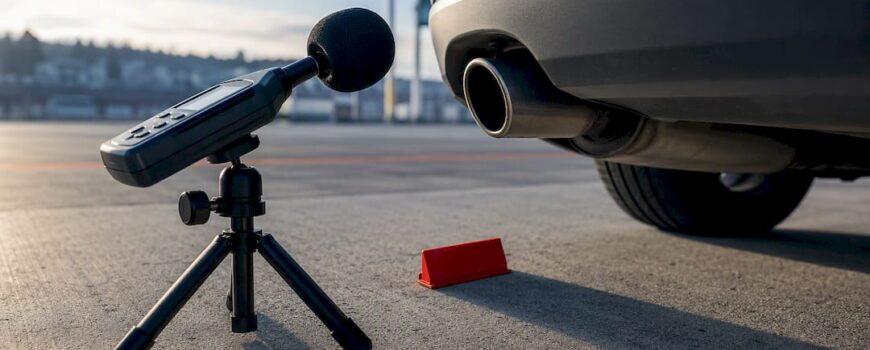
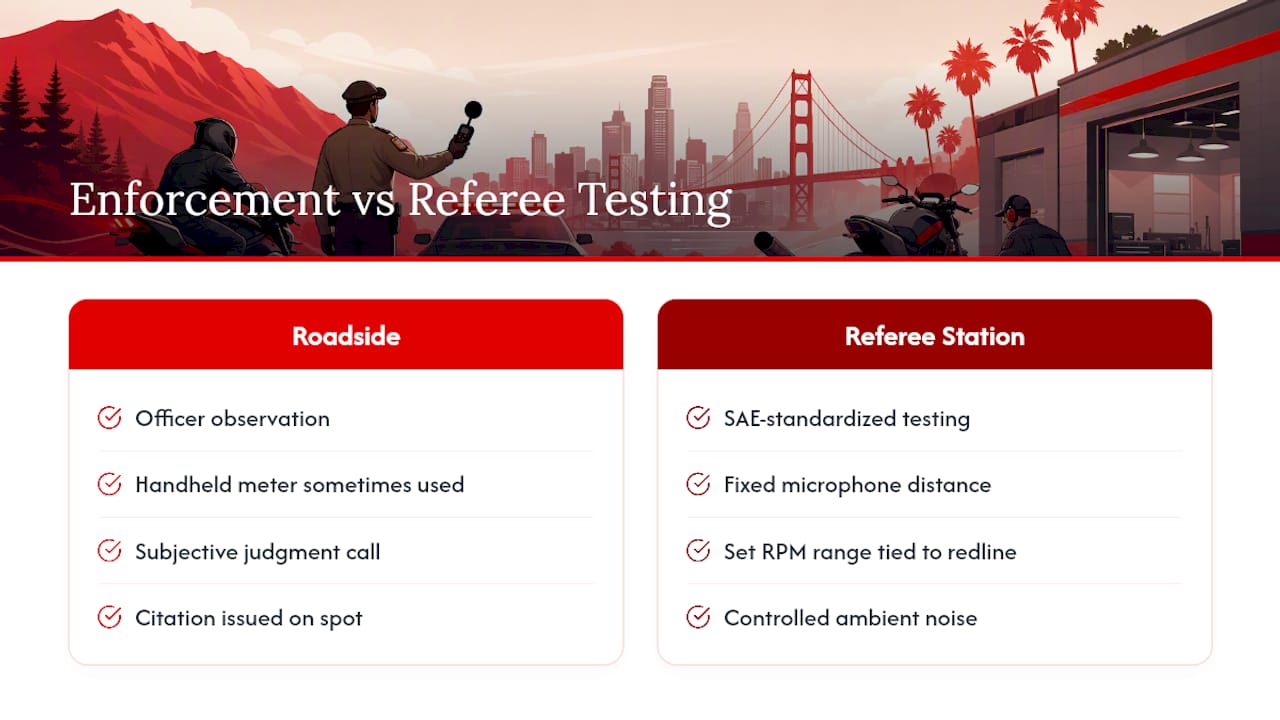
The 95 dbA figure isn’t measured by an officer eyeballing your exhaust tip or listening from the sidewalk. SAE-standardized testing specifies a fixed microphone distance from the exhaust outlet, a set engine RPM range tied to the vehicle’s redline, and a controlled ambient noise environment so background sound doesn’t skew the reading.
Referee stations run this testing as part of the process for issuing a certificate of compliance, and they’re the primary official location for the kind of test result a court will accept. Some independent shops offer pre-check sound testing using comparable methodology, which is useful for catching a problem before it becomes a citation, but the referee station reading is what actually satisfies a court requirement under AB-2496.
Roadside enforcement works differently. An officer typically identifies a vehicle as suspiciously loud through direct observation, sometimes supported by a handheld meter, and issues a citation based on that judgment call. The formal SAE-standard test happens later, either to contest the citation or to produce the compliance certificate the court needs. That gap between a subjective roadside stop and a standardized referee test is exactly why owners who get cited unfairly still have a path to resolve it with hard data instead of an argument.
Testing locations are limited to facilities equipped for it, generally BAR referee stations and select licensed shops with SAE-compliant equipment. Not every muffler shop can issue a court-accepted certificate, so confirm a station’s referee status before scheduling.
Are There Any Exceptions to the Noise Rules
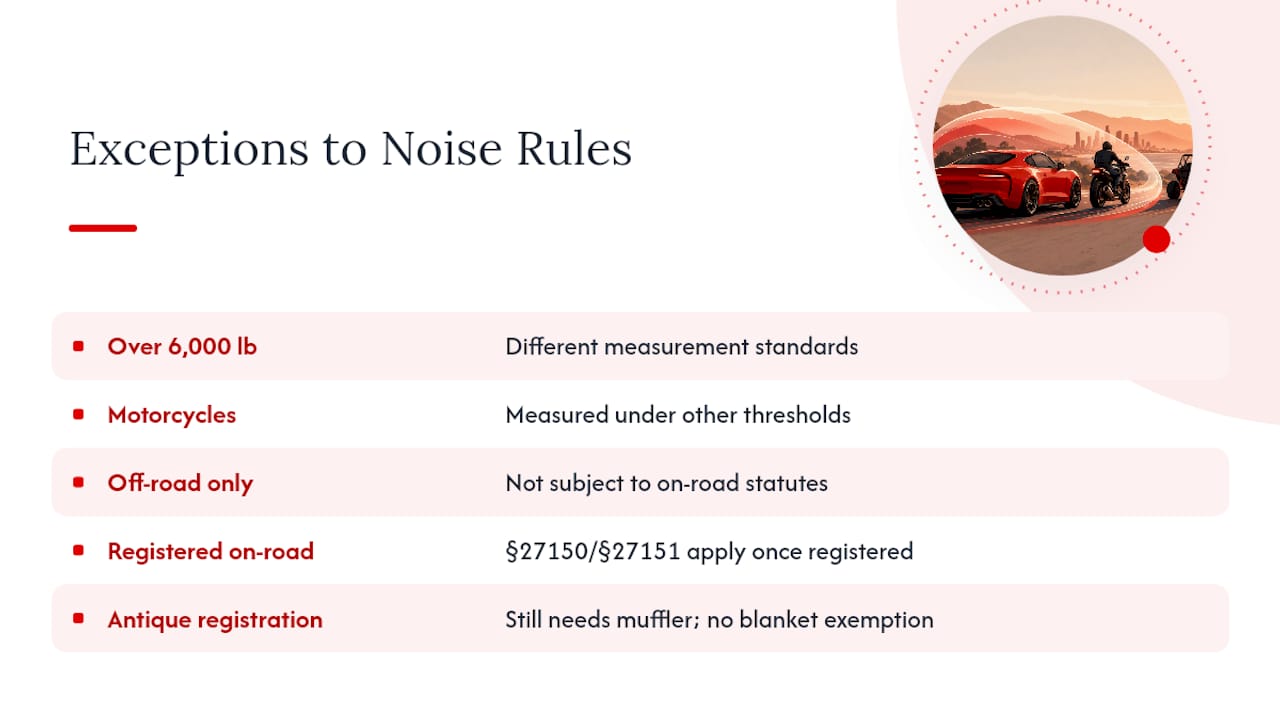
The exemptions here are narrower than most owners assume. The 95 dbA threshold in §27151 applies specifically to non-motorcycle passenger vehicles under 6,000 pounds GVWR, which means heavier trucks, certain commercial vehicles, and motorcycles fall under different measurement standards and thresholds entirely rather than being exempt from noise regulation altogether.
Vehicles used exclusively off public roads, such as dedicated track cars or off-highway vehicles that never register for street use, aren’t subject to the same on-road exhaust statutes because those laws govern vehicles operated on public highways. The moment a car is registered and driven on a public street, though, it falls under §27150 and §27151 regardless of how it’s primarily used.
Antique and historic vehicle registrations don’t grant a blanket exemption from the noise or muffler requirements either. An older car still needs a functioning muffler and still can’t exceed the applicable decibel threshold, though enforcement in practice sometimes varies with the age and rarity of a vehicle.
There’s no exemption tied to horsepower, brand, or the price of the exhaust system. A six-figure supercar with a straight-piped system is just as noncompliant as a modified economy car running the same setup. The statute regulates the outcome, not the vehicle class or the money spent on the parts.
What Fines and Penalties Actually Look Like
Beyond the court appearance and potential DMV registration hold covered earlier, exhaust violations carry standard traffic infraction fines that vary by county and court, since California doesn’t set a single statewide fixed-dollar penalty in the vehicle code text itself. Courts typically add penalty assessments on top of the base fine, which is standard practice across most California traffic infractions and can meaningfully increase the total owed beyond the number printed on the citation.
Repeat violations on the same vehicle can draw closer scrutiny from both the court and the DMV, and a pattern of citations makes it harder to argue an isolated equipment failure rather than an intentional modification. Separately, emissions tampering, like removing a catalytic converter, can trigger penalties tied to Smog Check enforcement rather than the noise statute, meaning a single vehicle with both problems could face consequences on two independent tracks at once.
The financial risk that catches owners off guard isn’t usually the base fine. It’s the compounding cost of a missed certificate deadline leading to a registration hold, which then blocks legal driving, insurance renewal in some cases, and resale until it’s resolved. A $200 exhaust ticket can quietly become a much bigger inconvenience if the compliance paperwork slips through the cracks.
Can You Fight a Citation? Your Rights After Being Cited
You have the right to contest an exhaust citation in court, the same as any other traffic infraction. If you believe the roadside noise assessment was inaccurate, an SAE-standard test result from a referee station or a qualified shop is your strongest evidence, since it replaces an officer’s subjective judgment with a documented, standardized measurement.
Practically, this means getting your vehicle tested promptly after a citation rather than waiting until close to your court date. A test showing your system reads under 95 dbA gives you something concrete to present, whether that means the citation gets dismissed or reduced. If the vehicle genuinely exceeds the limit, addressing the issue before your court date, through a valve adjustment, a different muffler, or reversing an illegal modification, and then obtaining a new certificate, is usually the faster path than contesting a valid citation.
Owners also have the right to request clarification on which statute they were cited under, since §27150 (equipment) and §27151 (noise level) call for different fixes. Fighting a §27150 cutout citation with a decibel reading doesn’t address the actual violation; the cutout itself has to go, regardless of how quiet the car measures.
Factory Exhausts vs. Modified Systems: Where the Law Draws the Line
Manufacturers design factory exhaust systems to meet federal and California standards from the factory, which is why a stock car essentially never draws a noise citation. The moment you modify that system, the legal burden shifts to you to prove the result still complies.
This doesn’t mean every modification is risky. A quality aftermarket system engineered around the 95 dbA threshold, with a functioning muffler and no prohibited devices, carries the same legal standing as the factory part it replaced. The SEMA industry explainer on California’s exhaust noise law makes this point directly: selling and installing aftermarket exhaust systems remains legal, and the enforcement focus is on the decibel outcome, not the aftermarket label itself.
Where owners get into trouble is assuming “performance exhaust” and “loud exhaust” are the same thing. They aren’t. A system tuned for better flow and a deeper tone can still land comfortably under 95 dbA, while a cheap, poorly baffled system can push a bone-stock-looking car well over the line. The legal risk tracks the actual decibel reading and hardware, not the aftermarket badge on the box.
Why Valved Systems Make Sense Under California’s Noise Rules
Static aftermarket exhausts force a tradeoff: quiet enough for daily driving or loud enough to satisfy on track. Adjustable valve technology sidesteps that by letting the driver dial sound down for street use and open it up where it’s actually legal to do so, like a closed course or private property.
Good installation practice matters here. Documenting valve settings, keeping every emissions component intact, and holding onto CARB documentation when a part requires it all make a referee visit far less stressful if one ever comes up. Buying from a source that understands what BAR referee stations actually check tends to prevent the surprises that catch other owners off guard.
— Info
Where to Go for an Adjustable, Street-Legal Exhaust
Some companies build customizable valved exhaust systems for performance and luxury platforms, with remote electronic valve control that lets you manage sound output instead of locking into one volume permanently.

That flexibility is the real advantage here: instead of gambling on whether a static system stays under 95 dbA in every driving scenario, a valved setup lets you keep the car quiet for daily commuting and courthouse-free driving, then open it up somewhere it’s actually appropriate. If you’re weighing a purchase, the Sports Car Exhaust Legal Checklist walks through model-specific compliance considerations, and the Exhaust System Anatomy guide breaks down how each component affects both sound and legal standing before you commit to a build. Reach out to Valvecontrolexhaust’s technical team to talk through valve configuration options for your specific make and model before you order.