What US exhaust noise regulations actually require
Exhaust noise regulation in the United States sets enforceable limits on how loud your vehicle’s exhaust can be, and the rules are more layered than most drivers realize. At the federal level, there is no single national decibel cap for passenger vehicles on public roads. Instead, the framework splits across federal guidelines, state statutes, and local ordinances, all of which can apply to the same vehicle at the same time.
The core principle is consistent, though: your vehicle must have a working muffler, and you cannot modify the exhaust to make it louder than the manufacturer originally designed it to be. That last part catches a lot of enthusiasts off guard. It is not just about hitting a decibel number. It is about not exceeding OEM levels, period.
Here is what the law generally requires across US jurisdictions:
- Vehicles must be fitted with a functional muffler or silencer at all times
- Exhaust gases must pass through the silencer before escaping into the atmosphere
- The exhaust system must be maintained in good working order
- Modifications that increase noise beyond original manufacturer levels are prohibited
- Regulations exist to reduce noise pollution and protect public health, since prolonged traffic noise exposure is linked to elevated blood pressure and cardiovascular stress
- Federal, state, and local laws all intersect, meaning you can violate a city ordinance even while technically meeting state law
How state and local exhaust sound regulations differ across the US
The variation between states is where exhaust sound regulations get genuinely complicated. California is one of the most aggressive states with specified decibel limits for exhaust noise, and the Bureau of Automotive Repair runs a referee program specifically to certify exhaust noise compliance. California AB 1824, which took effect in 2019, removed the option to fix a loud exhaust citation with a repair order and instead made the fine mandatory, with no dismissal upon repair.
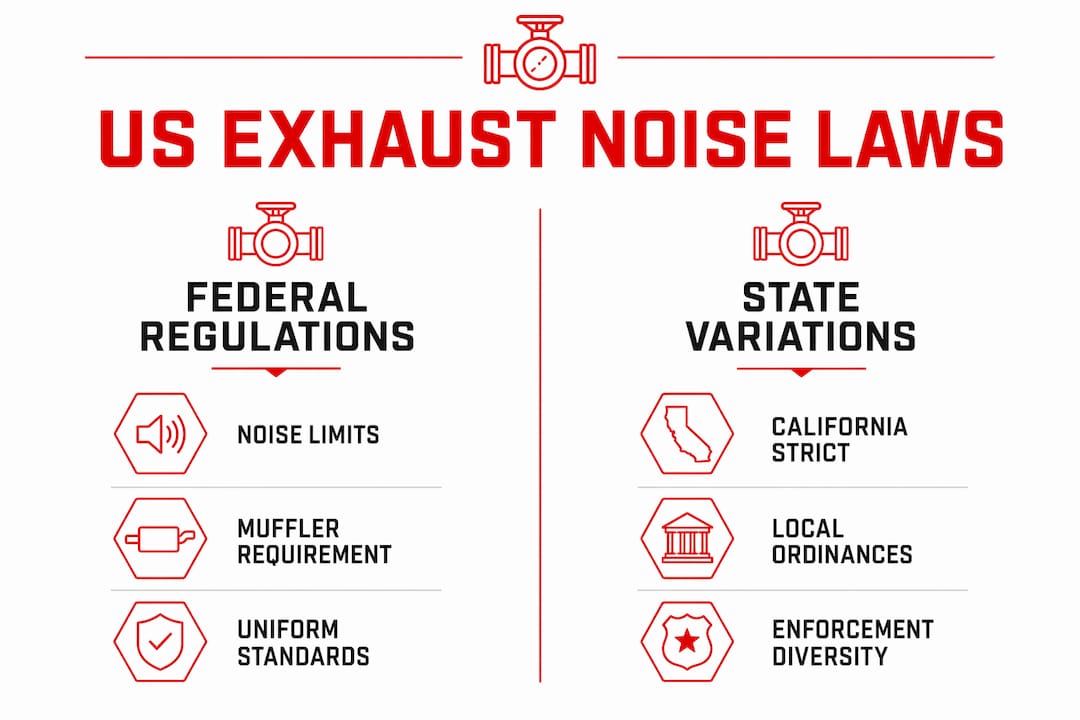
Washington State takes a different approach. State law prohibits any motor vehicle from producing excessive or unusual noise, while the Washington Administrative Code sets specific decibel limits measured at 50 feet from the center of the lane of travel. Cities like Spokane layer additional muffler ordinances on top of state law, meaning a vehicle that passes the state test can still draw a citation under local rules.
Key differences you will find across jurisdictions:
- Some states specify exact decibel thresholds; others rely on “excessive noise” as the legal standard
- Testing distances vary, which affects how the same exhaust reads on a meter
- California requires CARB-compliant parts for any aftermarket exhaust modification
- Certain jurisdictions exempt antique or historic vehicles from standard noise rules
- Racing events on closed courses typically fall outside public road noise laws
- Aftermarket systems that are louder than OEM are illegal in most states regardless of the decibel number
What muffler and exhaust system requirements the law mandates
Every state with exhaust noise statutes shares one baseline requirement: the muffler must work. A missing or defective muffler is a violation in virtually every US jurisdiction, and “defective” includes mufflers that have been gutted, drilled, or packed with materials that degrade over time and lose their damping effect.
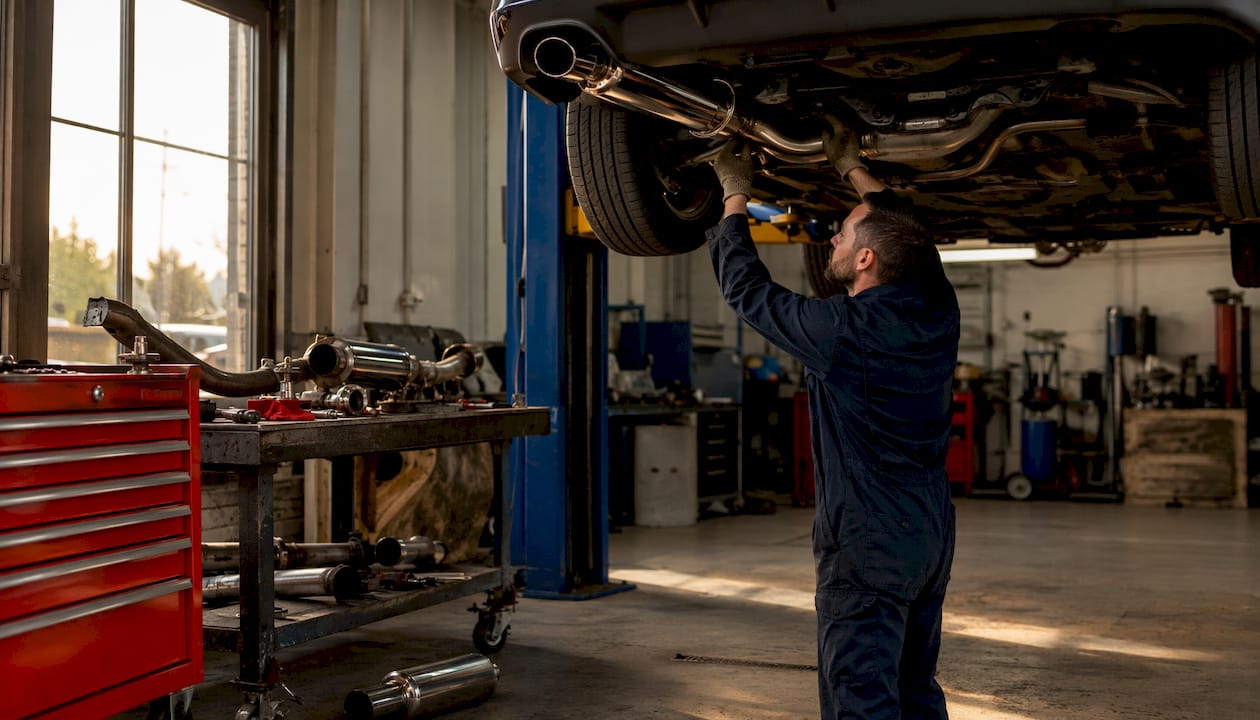
Beyond the muffler itself, the law addresses the entire system. Resonators, flex pipes, and connecting sections all contribute to overall sound output, and a leak anywhere in the system can push noise levels above legal limits. The distinction between OEM and aftermarket parts matters here. A factory exhaust is presumed legal. An aftermarket system carries the burden of proof, and in states like California, that means CARB Executive Order documentation.
What the law typically mandates:
- A fully intact muffler with no intentional perforations or baffles removed
- No cutouts, bypasses, or valves that route exhaust around the muffler
- All joints and connections sealed to prevent exhaust leaks
- Aftermarket systems must not exceed OEM noise output
- Resonators play a key role in meeting these requirements by canceling specific frequency ranges before sound exits the tailpipe
- Chambered and absorptive muffler designs are both legal, provided they keep output within limits
How law enforcement measures and penalizes exhaust noise violations
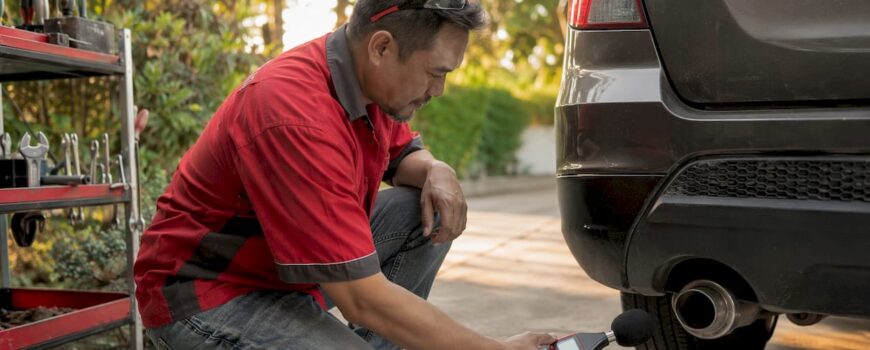
Officers can cite a vehicle for exhaust noise using either objective or subjective methods, and both hold up in court. The objective approach uses a calibrated decibel meter at a specified distance, typically 50 feet in states that follow SAE J1169 or similar test protocols. The subjective approach, used in states with “excessive noise” language, allows an officer to issue a citation based on trained judgment alone, without a meter reading.
Penalties vary widely. A first offense in most states runs from $50 to a few hundred dollars. California AB 1824 made fines non-dismissible, so a repair alone will not get the ticket dropped. Some jurisdictions also require a vehicle inspection or smog referee visit before the registration can be renewed.
Contesting a citation is possible but requires preparation:
- Request the calibration records for any decibel meter used in the stop
- Document the vehicle’s exhaust system with photos and any manufacturer spec sheets
- In states using subjective standards, challenge the officer’s training documentation
- A referee test from a state-certified facility can serve as evidence of compliance
- Local ordinances sometimes conflict with state law, which can be grounds for dismissal
Managing exhaust noise legally with valve-controlled systems and maintenance
The most practical path to staying compliant without sacrificing performance is a combination of good maintenance and the right hardware. Many noise citations stem from poorly maintained systems, loose hangers, cracked flex pipes, or degraded muffler packing. Fixing a leak or retightening a hanger often brings a vehicle back into compliance without touching the muffler itself.
For drivers who want more control, valve-controlled exhaust systems offer a real advantage. Valvecontrolexhaust builds systems for vehicles like Audi, BMW, Ferrari, and Lamborghini that use adjustable valves to modulate sound output in real time. In quiet mode, the valves route exhaust through the full muffler path, keeping sound levels within legal limits. Open the valves on a track or in a designated area, and the character of the exhaust changes entirely. That kind of dynamic sound control is exactly what the law allows, because the system can demonstrably meet OEM noise levels when required.
Component choices matter too. Reactive mufflers use internal chambers and baffles to reduce low-frequency noise, while absorptive silencers use packing material to dampen high frequencies. Combining both types gives the broadest coverage across the sound spectrum. Pipe diameter is another factor people often get wrong. Oversized pipes can actually worsen the exhaust noise profile, producing a hollow, boomy tone that reads poorly on a meter and sounds worse to the ear.
Pro Tip: Tailpipe length can be tuned to cancel specific resonant frequencies. Sizing the tailpipe to one-quarter of the wavelength of a problem tone uses acoustic wave interference to reduce that frequency at the outlet, a technique used in professional exhaust design that works on street cars too.
Key compliance practices:
- Inspect exhaust hangers, gaskets, and flex sections at every oil change
- Replace straight-through or race-style mufflers with street-grade units for daily use
- Choose OEM-comparable aftermarket systems with documented noise output data
- Use a valve-controlled system to switch between compliant and performance modes
- Have any aftermarket installation verified by a professional before driving on public roads
If you drive a performance vehicle and want a detailed breakdown of which systems meet legal thresholds while still delivering the sound you are after, Valvecontrolexhaust’s performance exhaust buyer’s guide covers the leading options with specifics on noise output and compliance.

Key Takeaways
US exhaust noise laws require functional mufflers, prohibit noise-increasing modifications, and vary significantly by state, with California and Washington among the strictest enforcers.
| Point | Details |
|---|---|
| No single federal limit | States and localities set their own decibel thresholds or use subjective “excessive noise” standards. |
| Muffler removal is illegal | Every US jurisdiction requires a working muffler; gutted or bypassed units violate the law regardless of decibel output. |
| California AB 1824 changed enforcement | Fines are now mandatory and non-dismissible upon repair, making prevention the only real strategy. |
| Maintenance prevents most citations | Fixing leaks and tightening hangers resolves many violations without replacing the muffler or system. |
| Valve-controlled systems offer legal flexibility | Adjustable valves let drivers meet OEM noise limits on public roads while unlocking full sound on track. |