
Exhaust sound is a direct indicator of how efficiently your engine breathes, making it one of the most telling mechanical signatures on any performance vehicle. The relationship between exhaust sound and performance is not cosmetic. It reflects real engineering decisions about backpressure, scavenging, pipe diameter, and material choice, all of which shape both the noise you hear and the power your engine produces. Components like headers, cat-back systems, and valved mufflers each influence that sound profile in measurable ways. Understanding why exhaust sound matters for performance means understanding how those engineering choices translate into throttle response, horsepower, and the sensory feedback that makes a great car feel alive.
Why exhaust sound matters for performance: the engineering behind the noise
Exhaust sound is not a byproduct you tune out. It is a direct result of how gases exit the combustion chamber, travel through the exhaust manifold, and pass through mufflers and resonators before leaving the tailpipe. Every restriction or opening in that path changes both the acoustic character and the engine’s ability to expel spent gases efficiently.
Pipe diameter is the starting point. Larger diameter pipes reduce backpressure and allow gases to exit faster, which typically raises the exhaust note’s pitch and volume. However, the relationship between pipe size and power is not linear. Some backpressure is critical on naturally aspirated engines to maintain low-end torque through exhaust gas scavenging. Removing all backpressure by going too large can actually hurt torque in the low RPM range where most street driving happens.
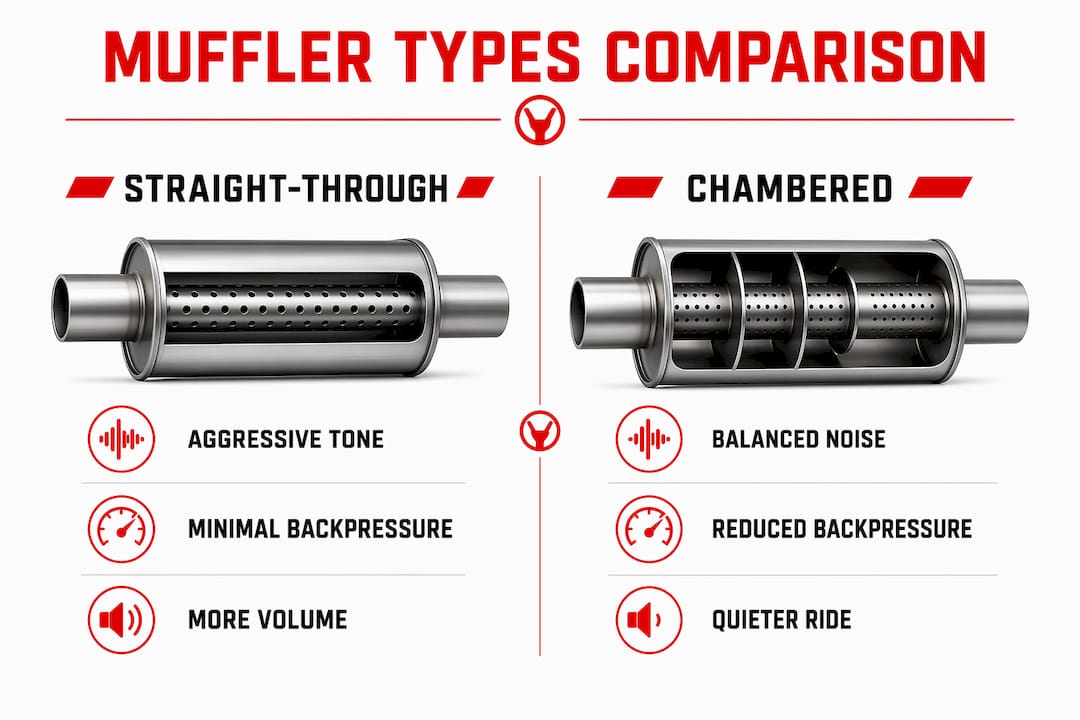
Mufflers and resonators shape the sound without necessarily hurting power. A straight-through muffler core uses perforated tubing and packing material to reduce volume while preserving flow. A chambered design, like those found on American muscle cars, uses internal baffles to create a deeper, more aggressive tone at the cost of slightly more restriction. Resonators target specific frequency ranges, canceling the harmonic frequencies that cause drone at highway speeds.
| Design type | Sound character | Performance trade-off |
|---|---|---|
| Straight-through muffler | Aggressive, high-flow tone | Minimal restriction, best for power |
| Chambered muffler | Deep, burbling muscle car note | Slight restriction, strong low-end feel |
| Resonator added | Cleaner, drone-free tone | Negligible power loss |
| Muffler delete | Maximum volume | Risk of drone, no tuning control |
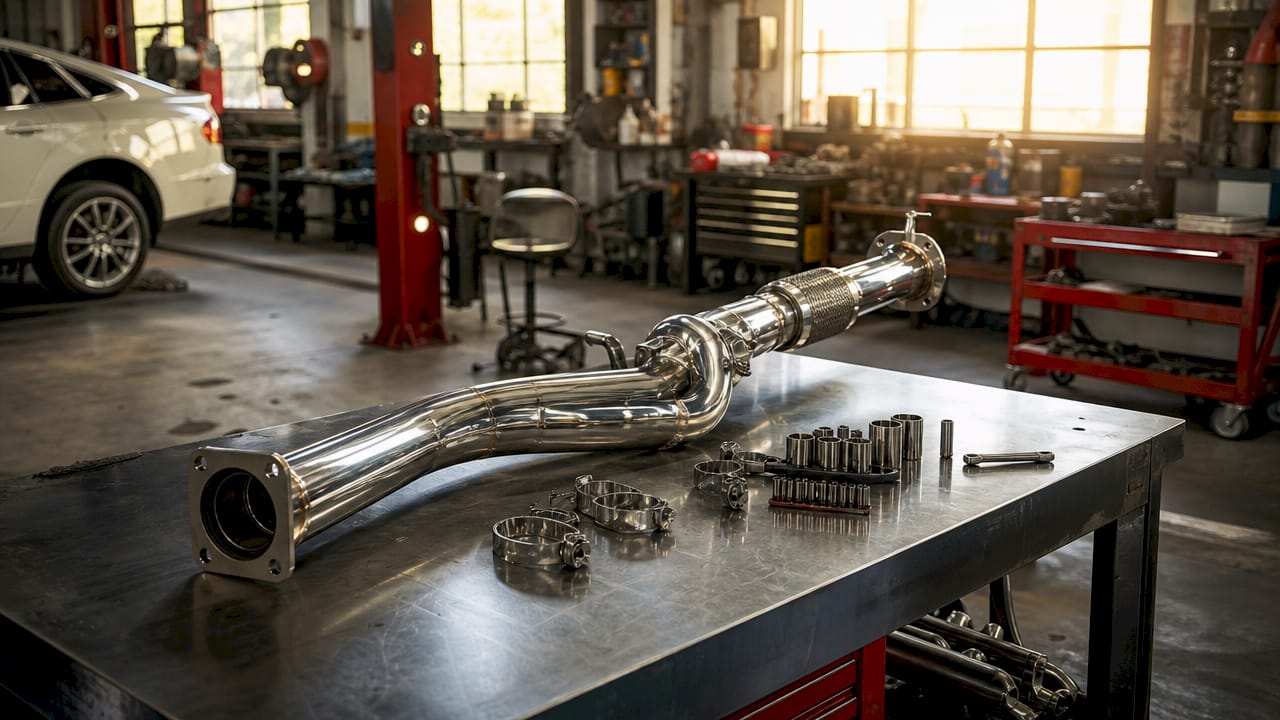
Material choice adds another layer. Titanium exhausts save up to 40% in weight compared to stainless steel, with performance systems reducing overall vehicle weight by 20 to 40 lbs. That weight reduction improves the power-to-weight ratio and reduces unsprung mass, which sharpens handling. Titanium also produces a higher-pitched, more metallic exhaust note compared to the warmer tone of stainless steel, so why exhaust material matters for performance extends beyond durability into the acoustic character of the system.
Does louder always mean more power?
The most persistent myth in the exhaust world is that louder equals faster. It does not. Sound amplitude and horsepower gain are separate outputs of exhaust design, and confusing them leads to expensive regrets.
Upgrading to a straight-through muffler increases exhaust sound by 5 to 15 dB, but that volume increase does not guarantee a proportional power gain. A muffler delete, for example, removes restriction and adds significant volume, but it also eliminates the frequency management that keeps the exhaust note pleasant and the cabin livable. The result is often drone, which is a low-frequency resonance that builds in the cabin at sustained RPM ranges, typically between 2,000 and 3,000 RPM.
A 2023 survey found that 43% of vehicle owners regretted their loud exhaust choices, citing noise complaints and excessive cabin drone as the primary reasons. That is nearly half of all buyers who prioritized volume over engineering. The regret rate alone makes the case for choosing a properly tuned system over a simple muffler delete.
Here is the hierarchy of exhaust upgrades ranked by the balance of sound quality and performance gain:
- Cat-back exhaust system with quality resonators: delivers improved flow, tuned sound, and minimal drone for daily driving.
- Headers plus cat-back combination: maximizes scavenging efficiency and produces the most noticeable throttle response improvement.
- Valved exhaust system: provides adjustable sound profiles from quiet to aggressive without sacrificing flow or comfort.
- Straight-pipe or muffler delete: maximum volume, maximum risk of drone, and no sound tuning control.
- OEM exhaust with resonator delete only: modest volume increase with low cost, but limited performance benefit.
Pro Tip: If highway drone is your concern, add a quality resonator before committing to a full muffler delete. Resonators cancel specific problem frequencies without meaningfully restricting flow, and they cost a fraction of a full system replacement.
The real performance gains from exhaust upgrades are also more nuanced than peak horsepower numbers suggest. The most noticeable improvement is throttle response, where turbochargers spool faster and naturally aspirated engines rev more freely. That improvement in responsiveness is often more meaningful on the road than a 5 horsepower gain on a dyno sheet.
How exhaust sound improves driver engagement
“Exhaust sound provides critical sensory feedback that connects the driver emotionally to the engine, communicating load and RPM beyond mere power figures.” — The Intercooler
That quote captures something dyno numbers cannot. When you accelerate hard through a corner, the exhaust note tells you where the engine is in its power band before you consciously process the tachometer. A sharp crack at redline signals maximum output. A flat, muted tone at mid-range suggests you are short-shifting. Sound is real-time data delivered through your ears, and experienced drivers use it constantly.
This is why exhaust sound as a mechanical signature matters for track driving and spirited road use. On a circuit, where visual attention is fully committed to the road ahead, audio feedback from the exhaust becomes a primary input for throttle management. Drivers who have switched from a stock exhaust to a well-tuned performance system consistently report that they feel more connected to the engine’s behavior, not just louder.
The emotional dimension is equally real. The specific tone of a Ferrari flat-plane V8, a BMW straight-six, or a Lamborghini V12 is part of what makes those cars desirable. Valved exhaust systems, like those offered through exhaust sound customization platforms, let drivers select between a quiet mode for urban driving and a full-open aggressive mode for track days. That flexibility preserves the emotional payoff without the daily-driving penalties of a permanently loud system.
Practical guide to choosing the right exhaust upgrade
Selecting an exhaust upgrade requires matching the system to your engine type, driving environment, and sound goals. Getting this wrong is how you end up in that 43% regret category.
For naturally aspirated engines (think BMW M3 with the S58, or a Porsche 911 GT3), the priority is preserving low-end scavenging while opening up mid-range and top-end flow. A cat-back system with properly sized piping and a quality resonator delivers the best balance. Going too large on pipe diameter kills low-end torque on these engines.
For turbocharged engines, the calculus shifts. Aftermarket exhausts can deliver up to 20 hp on forced-induction cars by reducing backpressure and improving turbo spool. The sound benefit is also different: turbos naturally suppress exhaust noise, so a freer-flowing system restores the character that the turbo muffles. On a BMW M5 or Audi RS6, a valved cat-back system gives you the aggressive tone on demand without the drone that a straight-pipe creates at motorway speeds.
For sound customization without compromise, valved systems are the answer. High-end valved exhausts balance aggressive tones with drone elimination and quiet modes, offering flexibility that no fixed system can match. Brands like IPE, Armytrix, Akrapovic, Valvetronic, and Ryft each approach valve control differently, and comparing them before buying is worth the time.
Pro Tip: Always pair an exhaust upgrade with an ECU tune on turbocharged vehicles. The tune recalibrates fueling and boost targets to match the new exhaust flow, which is where the real performance gains are unlocked. Without the tune, you leave measurable power on the table.
Additional factors to weigh before purchasing:
- Legal noise limits: Many regions enforce sound level regulations, and a system that passes in one state may fail in another. Check local decibel limits before buying.
- Weight savings: Titanium systems cost significantly more than stainless, but the 40% weight reduction is meaningful on track-focused builds where every pound counts.
- Tuning requirements: Well-tuned headers and cat-back systems deliver 5 to 10% peak horsepower gains on naturally aspirated engines and 5 to 12 wheel horsepower improvements on turbocharged platforms, but only when paired with appropriate engine management calibration.
Key takeaways
Exhaust sound matters for performance because it reflects the same engineering decisions that determine engine efficiency, throttle response, and power output across the RPM range.
| Point | Details |
|---|---|
| Sound reflects engine breathing | Exhaust tone is a direct result of backpressure, pipe sizing, and flow efficiency. |
| Louder does not mean faster | 43% of owners regret loud exhausts due to drone; engineered sound beats raw volume. |
| Throttle response is the real gain | Improved spool and rev response are more noticeable than peak horsepower numbers. |
| Material changes both sound and weight | Titanium saves up to 40% weight over stainless and produces a distinct higher-pitched tone. |
| Valved systems offer the best flexibility | Adjustable sound profiles let drivers switch between quiet daily use and aggressive performance modes. |
The exhaust note is not a luxury, it is information
After years of working with performance exhaust systems on vehicles ranging from BMW M cars to Lamborghini Huracáns, the insight that surprises most enthusiasts is this: the drivers who get the most out of an exhaust upgrade are not the ones chasing the loudest system. They are the ones who treat sound as a tool.
I have seen owners spend serious money on straight-pipe setups, only to remove them within six months because the highway drone made long drives genuinely unpleasant. The dyno numbers looked great. The daily reality did not. Contrast that with drivers running quality valved systems on their Audi RS models or Ferrari 488s, who report that the ability to switch between modes transformed how they use the car. Quiet mode for the morning commute, full open for the canyon run on Saturday. That is the version of exhaust sound tuning that actually improves the driving experience.
The other thing worth saying plainly: do not expect an exhaust upgrade alone to transform a stock engine into a race car. The performance gains are real, but they are incremental. What is not incremental is the feedback quality. A well-tuned exhaust makes a good driver better by giving them cleaner, more immediate information about what the engine is doing. That is worth more than five horsepower on a street car.
If you are considering an upgrade, start by deciding what you want the car to do. Daily driver with weekend track days? A valved system is the right call. Dedicated track build where weight matters? Titanium cat-back with headers. Street car where sound is the primary goal? Invest in a system with a resonator, not a muffler delete, and you will still be happy with it in two years.
— Info
Find the right valved exhaust system for your vehicle

Choosing between IPE, Armytrix, Akrapovic, Valvetronic, and Ryft is not straightforward without a side-by-side breakdown of sound profiles, material quality, and compatibility with your specific vehicle. Valvecontrolexhaust has built the most detailed resource available for performance vehicle owners making this decision. The performance exhaust buyer’s guide covers each brand’s approach to valve control, sound tuning, and power optimization across Audi, BMW, Ferrari, and Lamborghini platforms. For owners who want to see how these systems compare head to head before committing, the brand comparison page breaks down the differences in detail.
FAQ
Does exhaust sound directly affect horsepower?
Exhaust sound reflects the same design choices that influence horsepower, but sound alone does not create power. Well-engineered cat-back and header systems deliver 5 to 10% horsepower gains on naturally aspirated engines by improving flow, not by increasing volume.
Why does my exhaust drone at highway speeds?
Drone occurs when exhaust frequencies resonate in the cabin, typically between 2,000 and 3,000 RPM. Quality resonators cancel the specific problem frequencies without restricting flow, making them the most effective fix for drone on performance systems.
Is titanium worth the cost over stainless steel?
Titanium exhausts save up to 40% in weight compared to stainless steel systems, which improves the power-to-weight ratio and reduces unsprung mass. The cost premium is justified on track-focused builds; for street use, stainless steel delivers comparable performance at lower cost.
What is a valved exhaust system and how does it work?
A valved exhaust system uses electronically controlled butterfly valves inside the exhaust path to open or close flow routes, changing both volume and tone in real time. Valved systems provide quiet modes for daily driving and full-open aggressive modes for performance driving, all from the same hardware.
Do I need an ECU tune after installing a performance exhaust?
On turbocharged vehicles, an ECU tune is strongly recommended after an exhaust upgrade to recalibrate fueling and boost targets for the new flow characteristics. On naturally aspirated engines, a tune is less critical but still unlocks the full performance benefit of the new system.