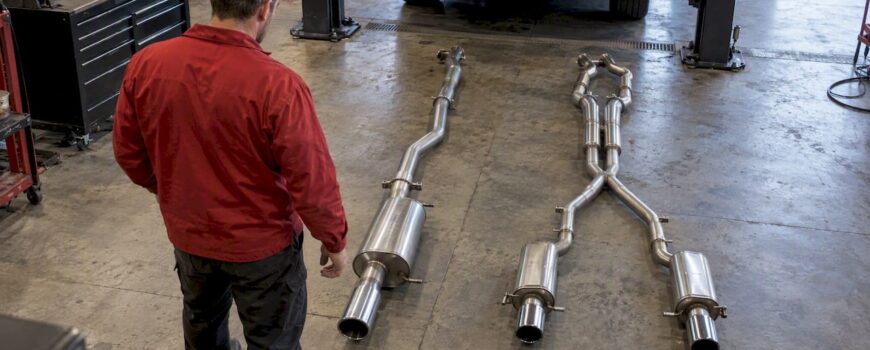
For most street engines, a correctly sized single exhaust beats a poorly designed dual, and true dual systems only pull ahead on large V6, V8, or high-horsepower builds with two exhaust banks. The real factors are pipe diameter, merge quality, and muffler restriction, not the number of tips out back. An inline-four daily driver usually wants a well-matched single or valved single, a turbocharged car should size around the turbo’s single outlet, and a high-output V8 is where genuine duals start to earn their keep.
TL;DR:
- Properly sized single exhaust systems can outperform poorly designed duals by maintaining optimal gas velocity and scavenging, especially on smaller engines.
- True dual systems only provide significant power or tonal benefits on large V6, V8, or high-horsepower builds with separate exhaust banks.
- Sound quality and drone are influenced more by crossover type and muffler design than by the number of tips, with options like X-pipes and valved exhausts offering tailored acoustic control.
- Oversized pipes reduce exhaust velocity and scavenging, negatively impacting performance, so matching diameter to engine flow is crucial for gains.
- Installing a dual exhaust on a vehicle originally designed for a single may breach EPA tampering rules if emission components are altered without proper documentation.
Table of Contents
- Performance: when a dual layout improves power and when a single is superior
- How dual vs single exhaust changes the sound and the drone
- Exhaust sizing and layout rules: diameter, length, and merges
- EPA tampering rules, inspection risks, and staying legal
- Costs, weight, complexity, and maintenance differences
- Decision framework: matching your engine and goals to the right layout
- How a valved system solves the trade-off without compromise
- Execution beats configuration: a perspective on getting this right
- Get the right exhaust setup without the usual trade-offs
- FAQ
- Sources
Performance: when a dual layout improves power and when a single is superior
Exhaust performance comes down to three interacting variables: gas velocity, cross-sectional area, and scavenging, which is the way a departing exhaust pulse helps pull the next one out of the cylinder. Velocity needs to stay high enough to keep that scavenging effect working, and that depends far more on pipe diameter relative to engine output than on whether there are one or two pipes.
This is why dyno comparisons keep producing a counterintuitive result: a well-designed single-exit system with the right merge collector and a low-restriction muffler can outperform a dual system using undersized pipes, because exhaust pipe diameter that is mismatched to displacement kills velocity and scavenging no matter how many outlets exist downstream. Splitting flow into two narrow pipes does not automatically beat one properly sized pipe. It often loses to it.
Exhaust layout changes alone tend to yield modest performance gains, with larger improvements more common on big-displacement or already high-horsepower engines than on modest four-cylinders. The honest takeaway is that configuration is a secondary lever. Execution is the primary one.
To judge whether your engine will actually see gains from going dual, check these conditions before spending money:
- Your engine has two exhaust banks or a V-shaped layout where true duals follow factory logic rather than being bolted on for looks.
- Your current system has an undersized or heavily restrictive stock muffler that is choking flow before any outlet count matters.
- You are targeting a horsepower level where the stock single pipe diameter is already a measurable bottleneck.
- You have access to a dyno or a tuner who can verify a gain instead of guessing from sound alone.
If none of those apply, a properly sized single, built around the merge and muffler rather than the tip count, is the safer bet for power.
How dual vs single exhaust changes the sound and the drone
Sound character comes from pulse timing as much as pipe count. A V6 or V8 with true dual exhaust lets each bank’s pulses travel independently, which tends to produce a fuller, more layered tone than a single pipe collecting both banks into one path. An inline engine funneled into dual pipes after a single collector does not get that same separation. It is mostly a cosmetic and volume change rather than a tonal one.
Crossover pipes change the story further. An X-pipe blends the two exhaust streams in a crossing pattern and tends to produce a smoother, higher-pitched tone with less drone at highway cruising speed. An H-pipe connects the two sides more simply and tends to preserve more of the deep, separated burble that enthusiasts associate with classic V8 sound. Neither crossover changes horsepower by much on its own, and our internal piece on X-pipe vs H-pipe performance for Mustang owners lays out just how small that delta typically is, usually only a couple of horsepower in either direction.
Muffler style and resonators do the rest of the work:
- A straight-through (glass pack style) muffler is louder and more aggressive with less flow restriction than a chambered design.
- A chambered muffler quiets the tone more aggressively but can add backpressure if undersized.
- Resonators smooth out raspy or droning frequencies without major volume loss.
- A valved exhaust lets you shift between a quiet mode for daily driving and an open mode on demand, sidestepping the need to commit to one tone permanently.
For more detail on how these choices affect perceived performance, our guide on why exhaust sound matters for performance vehicles breaks down how tone and loudness interact with driver perception.
Pro Tip: If you are unsure which crossover or muffler style fits your goals, test a rental or loaner car with the setup you are considering before committing, since sound preference is genuinely personal and hard to judge from video clips.
Exhaust sizing and layout rules: diameter, length, and merges
Backpressure gets blamed for a lot of exhaust underperformance, but the real culprit is usually velocity loss from an oversized pipe, not pressure from an undersized one. A pipe that is too large for the engine’s flow rate drops exhaust gas velocity, which weakens scavenging and can actually cost power even though it reduces measurable backpressure. The goal is matching diameter to the engine’s real flow needs, not simply going as large as possible.
Follow this general process when choosing pipe diameter and layout:
- Start with displacement and target horsepower, since pipe size recommendations are built around moving a specific exhaust volume efficiently, as outlined in sizing charts for engine displacement and horsepower targets.
- Check whether two smaller pipes provide less total cross-sectional area than one correctly sized pipe, because undersized dual piping often loses to a single pipe with adequate area and far less internal friction.
- Evaluate header and collector geometry, since a smooth merge collector with gradual transitions outperforms a sharp, abrupt junction regardless of how many pipes feed into it.
- Consider equal-length headers for engines where cylinder firing order creates uneven pulse spacing, which helps scavenging stay consistent across cylinders.
- Consult a dyno session or an experienced tuner once you are near your performance ceiling, because rules of thumb get you close, but verifying with real data prevents expensive guessing on a high-horsepower build.
Shops that understand this sequence tend to build systems that outperform bigger-looking setups assembled without regard for merge quality or pipe area, which is exactly the finding behind well-executed single-exit systems beating poorly matched duals on the dyno.
EPA tampering rules, inspection risks, and staying legal
Changing a vehicle’s certified exhaust configuration is not automatically illegal, but it can cross into tampering territory depending on what gets altered. The EPA’s guidance on exhaust system repair notes that converting a single system to dual, or otherwise altering certified components like catalytic converter placement, can be treated as tampering, and repair shops that make those changes without a reasonable basis face liability.

The EPA’s enforcement policy on vehicle tampering specifically calls for replacement parts that either restore the certified configuration or come with documentation showing they will not adversely affect emissions. That documentation, sometimes called a reasonable basis, is what separates a compliant upgrade from an enforcement risk, as detailed in the EPA’s enforcement policy on vehicle and engine tampering.
Practical consequences of skipping that step include failed state emissions inspections, voided manufacturer warranties on related drivetrain components, and potential fines directed at the installing shop rather than the vehicle owner. To minimize risk:
- Use certified replacement parts or components that appear on an approved application list for your specific vehicle.
- Keep documentation from your shop showing why the modification does not adversely affect emissions performance.
- Avoid removing or relocating catalytic converters, since the Clean Air Act specifically targets that kind of swap.
- Check your state’s inspection rules before finalizing a build, since requirements vary by location.
Our EPA exhaust tampering checklist for luxury owners and sports car exhaust legal checklist both walk through what to ask your shop for before work begins.
Costs, weight, complexity, and maintenance differences
A basic muffler-back single exhaust is the cheapest and simplest option to install, since it typically replaces one section with minimal hanger and clearance work. A full dual setup running header-to-exit roughly doubles the piping, hangers, and welds involved, which raises both parts and labor costs and adds weight that most owners never notice on the road but that matters on a scale or a track build. A valved system sits above both in upfront cost because of the added electronics and actuators, but it replaces the need to choose one tone permanently.
More joints and hangers mean more potential failure points over the vehicle’s life:
- Dual systems have roughly twice the welds, clamps, and hanger points of a comparable single system, each one a potential future leak or rattle.
- Valved systems add actuator motors and wiring that require occasional inspection, though they eliminate the need for a second physical exhaust path to get two different sound profiles.
- Purely cosmetic dual tips welded onto a single-pipe system add weight and visual flair without touching the actual flow path, so they deliver no real performance benefit.
- Single systems are generally easier to inspect, repair, and keep leak-free over time simply because there is less hardware to fail.
Our breakdown of exhaust system anatomy covers where these components sit on a typical layout if you want to see what you are actually paying for in labor.
Decision framework: matching your engine and goals to the right layout
Before picking a configuration, answer four questions: what engine you have, what peak horsepower you are targeting, whether sound or power is the primary goal, and what emissions constraints apply in your state. Those answers point toward a specific recommendation rather than a generic preference for more pipes.
- If you drive a daily-driven inline-four, choose a correctly sized single exhaust or a valved single rather than chasing a dual layout that your engine’s single exhaust bank cannot meaningfully use.
- If you drive a turbocharged inline-four, size the system around the turbo’s single outlet and prioritize a smooth merge and low-restriction muffler over splitting into dual pipes downstream.
- If you drive a V6, true dual exhaust starts to make engineering sense because each bank gets its own path, though a well-built single collector system can still compete if space or budget is limited.
- If you drive a V8, dual exhaust is usually the stronger choice both for power and for the tonal separation enthusiasts want, provided the pipe diameter matches your horsepower target.
- If you are building a high-horsepower forced-induction V8 or V6, verify pipe sizing and merge geometry on a dyno rather than relying on rules of thumb alone, since the margin for error shrinks as output climbs.
The short rubric: if your engine has one exhaust bank and modest output, build the best single you can afford. If it has two banks and real power behind it, dual is worth the added cost and complexity.
How a valved system solves the trade-off without compromise
A valved exhaust lets you keep a quiet, compliant mode for daily driving and open it up to a louder, freer-flowing mode when you actually want it, which sidesteps the permanent choice that a fixed single or dual system forces on you. We build valved and customizable exhaust systems for performance and luxury vehicles including Audi, BMW, Porsche, Ferrari, Lamborghini, and Mercedes-AMG, with electronic valve control that adjusts sound and flow character on demand rather than locking you into one setup.
This approach fits best for owners who want an aggressive tone for weekends or track days but need to stay reasonable around neighbors, inspections, or daily commuting. Rather than welding in a second exhaust bank purely for looks, a valved system changes character through the same properly sized piping, which keeps the performance fundamentals intact.
A few things worth checking before buying:
- Confirm your specific model and model year against the application list, since fitment on luxury platforms varies by chassis generation.
- Check whether your target setup pairs with a catted downpipe if emissions compliance matters in your state.
- Ask whether the valve controller integrates with factory drive modes or requires a separate remote.
- Verify whether the muffler and piping diameter match your engine’s actual output, not just its reputation for sound.
We sell components sourced directly from manufacturers, which matters when fitment and emissions documentation are part of what you are paying for.
Execution beats configuration: a perspective on getting this right
The biggest mistake installers make is choosing dual exhaust for the look and then cutting corners on pipe diameter, merge angle, or muffler quality, which hands back whatever gain the extra outlet might have offered. A single well-sized pipe with a clean merge and a quality muffler will usually outperform a dual system assembled from mismatched, undersized parts, and it will almost always be quieter at idle and more consistent over time.
My advice to anyone comparing dual exhaust vs single is to stop thinking in terms of outlet count and start thinking in terms of velocity, area, and flow path quality. Test before you commit if you can, ask a shop for dyno data or at least a documented rationale for their pipe sizing choices, and treat tip count as the last decision you make, not the first.
— Info
Get the right exhaust setup without the usual trade-offs
If you have made it this far, you already know that picking between dual and single exhaust is really about matching pipe sizing, merge quality, and sound control to your actual engine and goals, not about counting tailpipes. A valved system removes the need to pick one tone forever: you get a quiet, compliant mode for daily driving and an aggressive mode whenever you want it, built around genuine components sourced directly from authorized manufacturers for Audi, BMW, Porsche, Ferrari, Lamborghini, and Mercedes-AMG platforms.

A few places to start:
- Browse our exhaust parts category for mufflers, pipes, and tips matched to your platform.
- Check downpipe options if you need a catted solution that keeps you inspection-ready.
- Look at accessories for valve controllers and fitment hardware if you are building out a valved system piece by piece.
If you want a second opinion on acoustic engineering before you buy, our partners at e6carbon’s analysis of valved exhaust design cover how executive-luxury builds balance track-ready acoustics with daily usability. When you are ready, request a fitment check or a quote through our product catalog and we will help you match the right configuration to your car.
FAQ
What is the disadvantage of dual exhaust?
The main disadvantage is added weight, cost, and complexity from roughly double the piping, hangers, and welds compared with a single system, which creates more potential leak points over time. Dual setups can also underperform a well-sized single if the pipe diameter is too small for the engine’s actual flow needs.
Does a 2-into-1 exhaust make a difference?
Yes, a 2-into-1 merge collector that transitions smoothly from two header pipes into one path can preserve scavenging better than an abrupt junction, which helps both power and tone. The quality of that merge geometry matters more than whether the system stays dual-exit or converts to a single outlet downstream.
Does dual exhaust sound better?
It depends on the engine: a true dual system on a V6 or V8 with separate exhaust banks tends to produce a fuller, more layered tone because each bank’s pulses stay independent. On an inline engine routed into dual pipes after a single collector, the sound difference is mostly cosmetic rather than tonal.
How much horsepower will dual exhaust add?
Gains from exhaust layout changes alone are typically modest, in the low single digits as a percentage, with the largest improvements showing up on large-displacement or already high-output engines. A poorly sized dual system can produce no gain at all, or even lose power, compared with a single exhaust built around correct pipe diameter and a quality merge.
Sources
- Is it tampering to install a dual exhaust system on a vehicle originally equipped with a single exhaust? — EPA (exhsysrepair.pdf)
- Exhaust sizing chart: choosing the right exhaust pipe diameter for your car’s engine — CarParts blog
Recommended
- Comparing High-Performance Exhausts: IPE, FI, Armytrix, Akrapovic, Valvetronic, and Ryft
- Technical Appraisal: Choosing Between IPE, FI, Armytrix, Akrapovic, Valvetronic and Ryft Exhausts
- Evaluating Performance Exhausts: IPE, FI, Armytrix, Akrapovic, Valvetronic, Ryft
- Comparing High-Performance Systems: IPE, FI, Armytrix, Akrapovic, Valvetronic, and Ryft Exhausts